
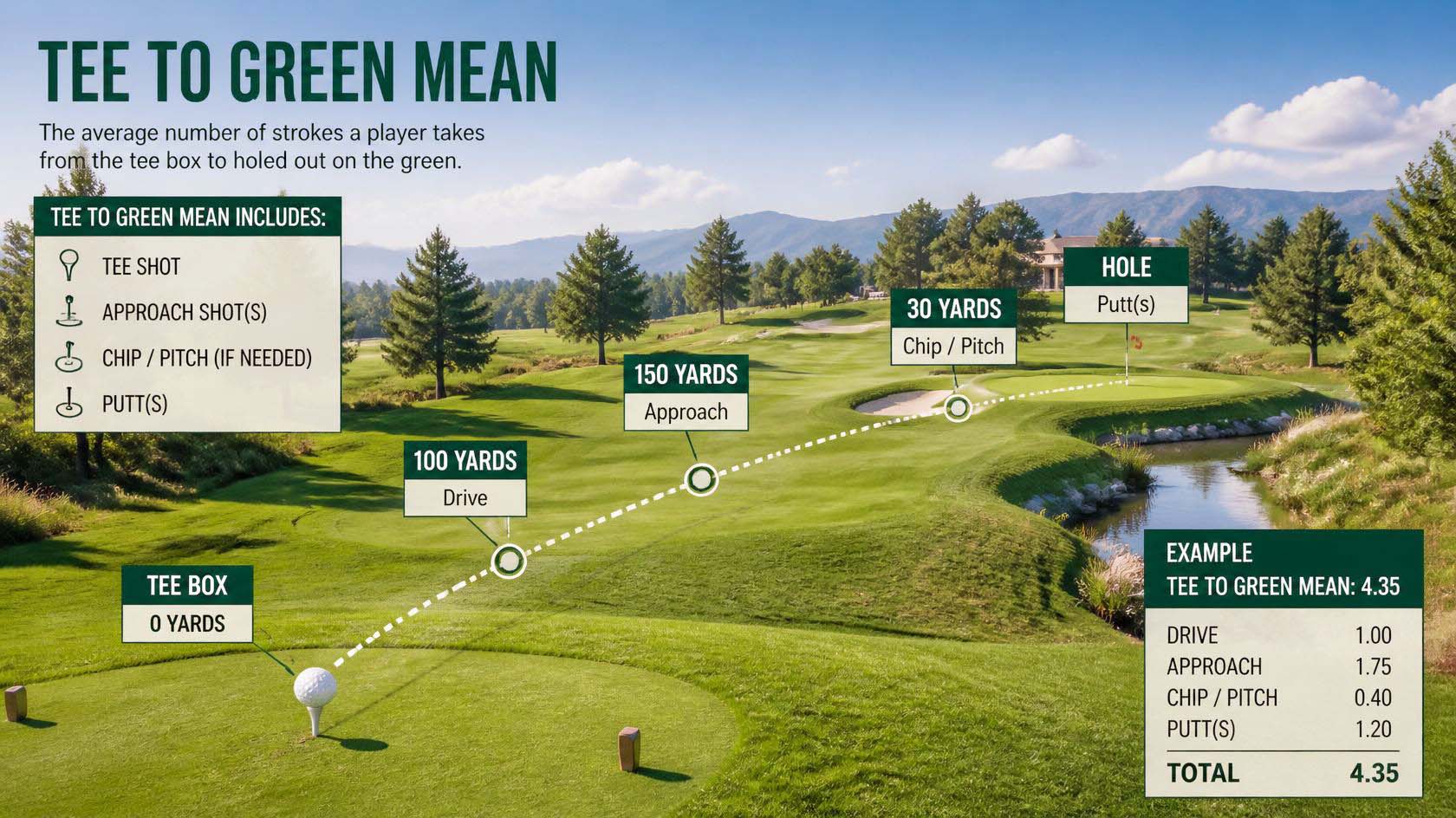
If you have looked at modern golf statistics, you have probably seen the term “Strokes Gained: Tee to Green.” It sounds complicated, but it is a simple way to measure how well you hit the ball from the tee all the way until you reach the green. It leaves out putting. This makes it a very useful number for finding out if your full swing and short game are actually helping you or hurting you.
What Strokes Gained Tee to Green Measures?
Strokes Gained Tee-to-Green (SG: Tee-to-Green) is a number that shows your performance on every shot except putts. It combines three parts of your game:
- Strokes Gained: Off-the-Tee – Your drive or tee shot on par 4s and par 5s.
- Strokes Gained: Approach – Your shots from the fairway or rough that aim for the green.
- Strokes Gained: Around-the-Green – Your chips, pitches, bunker shots, and any other shot from near the green that is not a putt.
The final number tells you how many strokes you gained or lost relative to a baseline group of golfers (usually PGA Tour players, but it can also be compared to your own handicap level). A positive number means you performed better than the baseline. A negative number means you lost strokes.
How Strokes Gained Tee to Green Is Calculated?
The math is simple when you break it down. Every shot starts from a certain distance and lies. Golf databases know how many strokes an average player takes to finish the hole from that spot.
The basic formula for any shot is:
(Strokes to hole out from starting position) – (Strokes to hole out from ending position) – 1
For tee-to-green, you add up the results from your tee shots, approach shots, and short game shots. Here is an example:
- You hit a drive that leaves you 150 yards away in the fairway. This gains you 0.3 strokes off the tee.
- Your approach shot ends up 20 feet from the hole on the green. This loses you 0.1 strokes on approach.
- You chip in from 20 feet for a birdie. This gains you 0.2 strokes around the green.
Your SG: Tee-to-Green for that hole is 0.3 – 0.1 + 0.2 = 0.4 strokes gained. Over a full round, you add the values from every hole. Over a season, you look at the average per round.
Why Tee to Green Matters More Than Total Strokes Gained?
Putting is very volatile. One day, you might make everything. The next day, you might three-putt five times. Your putting performance can change due to green conditions, luck, and nerves. Tee-to-green performance is much more stable. It depends on your swing mechanics, course management, and short game technique. These skills improve slowly and stay with you.
If you only look at total strokes gained, putting can hide problems in your ball-striking. For example, a golfer who loses 2 strokes per round, tee-to-green, but gains 1 stroke putting, still loses 1 net stroke. Their total strokes gained look average, but they are actually losing strokes from poor full swings and short game. To improve in the long term, you need to fix the ball-striking weakness first.
How to Interpret Positive and Negative Values?
A positive SG: Tee-to-Green means you hit the ball better than the baseline from the tee through the green. A negative value means you lost strokes in those areas. However, the baseline matters a lot.
- Against a PGA Tour baseline: Even very good amateur players (scratch or low single-digit handicaps) will have a negative number, often around -2 to -4 per round. That is normal.
- Against a handicap baseline: Shot Scope and similar systems let you compare to the average golfer at your handicap. If your SG: Tee-to-Green is positive against a 10-handicap baseline, you are hitting the ball better than most 10-handicaps.
The most useful comparison is against your own handicap. If you are a 15-handicap and your SG: Tee-to-Green is -3 against the Tour baseline, that number is less useful. But if the same number is +2 against a 20-handicap baseline, you know you are a better ball-striker than most 20-handicaps. True progress comes from seeing that number move toward positive over time.
Using Tee to Green for Practice Prioritization
This metric tells you exactly where to spend your practice time. If your overall SG: Tee-to-Green is negative, break it down into the three components:
- If you lose 2 strokes on approach but gain 0.5 off the tee and lose 0.5 around the green, your biggest problem is approach shots. Spend 60% of your practice on iron and wedge work.
- If your tee-to-green is consistently positive but you still shoot high scores, the problem is likely putting or course management. You might be taking penalty strokes or making poor decisions.
- If you lose strokes around the green but hit the ball well from the tee and on approach, focus on chipping and bunker work.
Devices like Shot Scope, Arccos, and Golfshot automatically compute SG: Tee-to-Green for you. You can track this number over weeks and months to see if your practice is actually working.
Frequently Asked Questions
a) Do you want strokes gained tee-to-green to be positive or negative?
Positive. A positive number means you gained strokes compared to the baseline. You performed better than average. A negative number means you lost strokes. Aim for positive against a baseline that fits your goal.
b) How is tee-to-green different from total strokes gained?
Total strokes gained includes putting. Tee-to-green excludes it. If you subtract Strokes Gained: Putting from total strokes gained, you get tee-to-green. The two together explain exactly where your strokes are won or lost.
c) Does tee-to-green include penalty strokes?
Yes, indirectly. If you hit a tee shot out of bounds, that shot is recorded with an endpoint in a penalty area. The expected strokes to finish from that spot is much higher, so the strokes gained value for that shot is very negative. The penalty is built into the calculation.
d) What is a good SG: Tee-to-Green for an amateur?
It depends on the baseline. Against a PGA Tour baseline, even scratch amateurs are typically -2 to -4 per round. Against a scratch baseline, a 10-handicap might be -3 to -5. The most useful number is against your current handicap. If you are positive against that baseline, you are outperforming other players at your level.
e) Can I calculate strokes gained tee-to-green without technology?
Not accurately. You need exact distances, lie types, and a database of baseline averages. Manual tracking with a laser rangefinder and a notebook is possible, but very slow. A GPS golf watch or shot-tracking app is the best way to get this data automatically.
Conclusion
Now that you understand what does strokes gained tee to green mean in golf, you have a powerful tool to take your game to the next level. This metric cuts through the noise of putting luck and gives you an honest picture of your ball-striking and short game performance.
Whether you are a weekend golfer or a serious competitor, tracking this number helps you practice smarter, not harder. Focus on moving it in a positive direction over time, and your scores will follow. Start using a shot-tracking app today and let the data guide your improvement on every hole.