
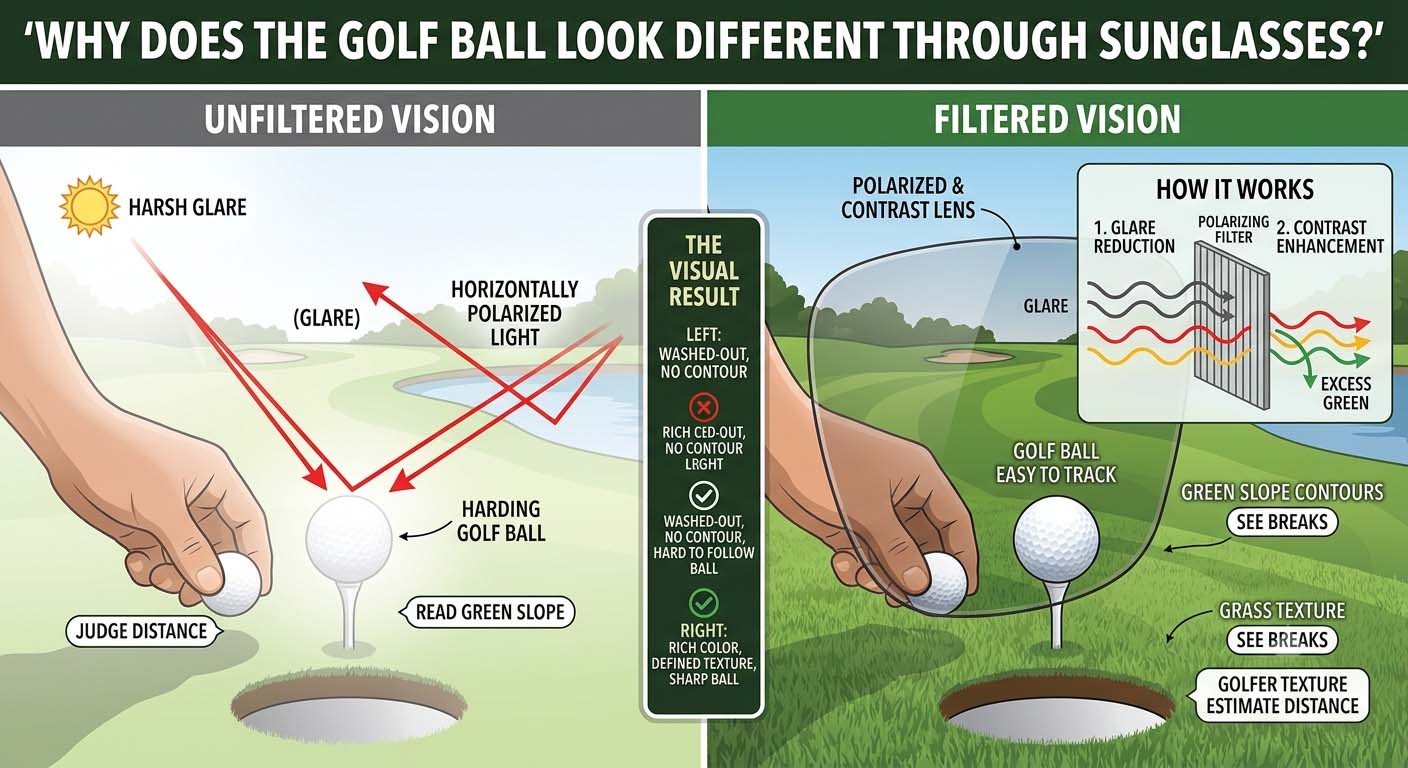
If you have ever slipped on a pair of sunglasses on the first tee and thought the ball looked odd, you are not imagining things. The white ball suddenly looks cream-colored. It seems to float above the grass. It might even look like it shifts position when you start your swing. This is real, and it has nothing to do with your eyes going bad.
Sunglasses alter the light that reaches your eyes in three distinct ways. Each one changes what you see. The golf ball is a perfect target for these optical tricks because it is a small, highly reflective white object sitting against a bright green background. Here is exactly what is happening.
How Lens Tint Rewrites the Colors You See
A white golf ball reflects every color in the visible spectrum equally. That is why it looks white in normal sunlight. But when you put on tinted lenses, you are effectively removing certain colors before they hit your eyes. The ball itself has not changed color. Your brain compares it to the grass around it, and that grass has changed.
Gray lenses are the most neutral. They reduce overall brightness without shifting colors much. The ball looks pretty much white.
Amber and brown lenses block blue light. Grass contains a lot of yellow-green light. When you cut the blue, the grass looks warmer and richer. Your brain then perceives the white ball as slightly yellow or cream-colored by comparison.
Copper and rose lenses boost red-green contrast. The grass gets a reddish tint, and the ball looks brighter, sometimes with a slight pinkish cast.
Yellow lenses block almost all blue light. They are popular on overcast days because they cut haze and sharpen contrast. The ball will look stark white. The grass will look vividly green.
The key point is that the ball does not change color. Your frame of reference changes because the grass looks different. Your brain adjusts what it thinks white should look like.
Polarized Lenses and the Hidden Light
Polarized lenses do something entirely different from tint. They act like a mail slot for light. They only let through light waves that are oriented vertically. Horizontally oriented light gets blocked.
Grass reflects a lot of horizontally polarized light. When you wear polarized sunglasses, that reflected glare gets wiped out. The grass suddenly looks darker and richer. The white golf ball reflects all orientations of light equally. The ball stays bright while the background dims.
The result is that the ball appears to pop or float above the grass. This can look helpful. But for some golfers, it is actually disorienting. The ball looks unnatural, almost like it is not sitting on the ground properly.
This effect weakens on overcast days. Cloudy light is already diffused and less polarized. That is why you might notice the ball looking different on sunny days but normal when clouds roll in, even with the same pair of glasses.
The Lens Distortion Nobody Talks About
This is where things get real for anyone who wears prescription sunglasses. You might have a pair of sunglasses that you love for driving. You put them on to golf, and suddenly the ball looks like it is jumping or shifting during your swing. You blame the sunglasses. You are right.
Progressive lenses have a gradient. The top of the lens is for distance. The middle is for intermediate. The bottom is for reading. When you tilt your head down to address the ball, your eye moves through that gradient. The ball can appear to move because you are looking through different lens powers.
This is not a small issue. Read through any golf forum and you will find golfer after golfer who struggled for months before realizing their progressive lenses were causing them to top the ball or hit behind it. One guy bought a dedicated pair of distance-only glasses and said he rarely topped the ball anymore.
Bifocals with a visible line create an even harder problem. When your gaze crosses that line, the image jumps. The ball can disappear or look like it shifts a few inches. If you have bifocals and you feel like the ball looks different between clubs, this is likely the cause. Each club length changes your posture, which changes where your eye sits relative to that line.
Monovision contact lenses cause a similar problem. One eye is set for distance. The other is set for reading. Your brain learns to ignore the blurry eye most of the time. But when you are looking down at the ball, each eye might be sending a slightly different image to your brain. Depth perception gets thrown off.
Why Each Club Changes the View
A driver address is much different from a wedge address. When you have a driver, the ball is teed up and your head is higher. With a wedge, you are bent over more. Your eye angle relative to the lens changes with every club.
Polarized lenses are directionally sensitive. If you tilt your head even a few degrees, the amount of light that gets through changes. That can make the ball look brighter or dimmer from club to club.
The curve of the lens also matters. Wraparound sunglasses have more distortion at the edges. If you look at the ball through the center of the lens on one shot and near the edge on another, you will get two different visual experiences.
What to Do About It
If you do not wear prescription glasses, the fix is simple. Choose the right tint for how you see. Gray lenses are the most true to life. They help you read greens accurately because you are seeing the true color of the grass. Amber and copper lenses give you more contrast for tracking the ball in the air. Try them with a golf ball before you buy.
If you wear prescription glasses, consider getting a dedicated pair of golf sunglasses. The best option is single-vision distance lenses with your preferred tint. No gradient, no progressive zone. Just pure distance correction. You will see the ball the same way every time.
If you need reading power for scorecards, you can get bifocals made with the reading segment placed very low in the lens. Some optometrists can put the bifocal line at the 25% mark instead of the standard 50%. That keeps your distance vision clear for the swing and still lets you read.
Contacts are another option. You can wear non-prescription polarized sunglasses over contact lenses. That solves the gradient distortion problem entirely.
Some golfers find they play better without polarization. The ball pop effect is too distracting. If you have tried polarized sunglasses and the ball feels unnatural, try a pair with the same tint but no polarization. It might make all the difference.
Frequently Asked Questions
Do yellow lenses actually help you see the golf ball better?
Yellow lenses block blue light, which reduces haze and sharpens contrast. The ball looks stark white against brighter green grass. Many golfers find them effective on overcast days. They can be too bright in full sun.
Why does the golf ball look blurry through my polarized sunglasses?
If you do not need prescription lenses, blurriness usually means the polarized filter is too strong for your eyes. If you do wear prescription lenses, the blur is likely an incorrect prescription or astigmatism correction. Get your sunglasses checked by an optometrist.
What color sunglasses do pro golfers wear?
Most tour players wear gray or brown tints. Gray gives the most neutral color for reading greens. Brown enhances contrast for tracking ball flight. Yellow and rose tints are rare in professional tournament play.
Can I wear transition lenses for golf?
They work on the course but have two drawbacks. They do not darken much inside a car because the windshield blocks UV. They are also slow to lighten when you walk from shade into sun. If they are progressive lenses, you have both issues at once.
Why does the ball look bigger through one lens than the other?
This is likely a prism effect from poorly centered prescription lenses or a misaligned frame. Each eye sees the ball from a slightly different angle. Take your sunglasses back to the optometrist for a lens verification.