

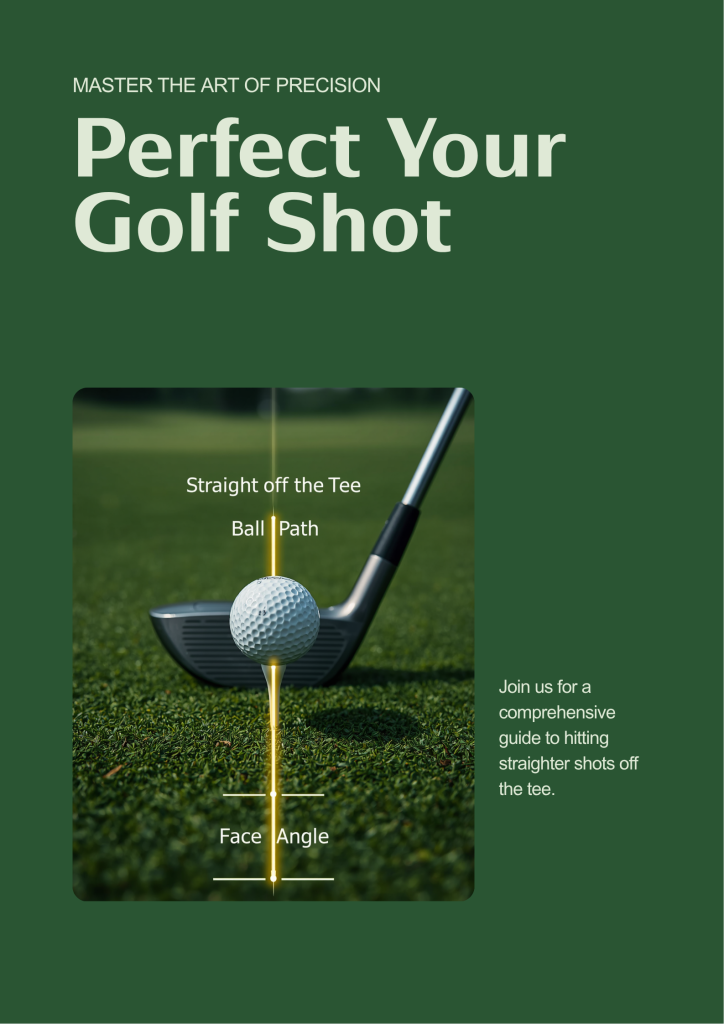
I have spent years watching golfers stand on the tee box, aim down the fairway, and then watch their ball curve into the trees. It is frustrating because you know you can hit it straight. The secret is not one magic move. It is controlling two variables: club path and clubface angle at impact.
Every straight shot happens when those two match. Every miss comes from a predictable mismatch. Let me help you identify which mismatch you have, then give you a fix that works. Now you can learn here the perfect process of how to hit a golf ball straight off the tee.
Step 1: Figure Out What You Are Doing Wrong
Before you change anything, you need to know what you miss. Most golfers fall into one of three categories.
- Slice: The ball starts left of your target and curves right. This means your club path is swinging left (over-the-top) and the clubface is open relative to that path.
- Hook or pull-hook: The ball starts right and curves left hard. This means your path is too far inside, and the face is closed relative to that path.
- Push or pull (straight but off line): The ball flies straight but right or left. Your path and face are matched, but your alignment is off.
If you are not sure, hit five tee shots and write down where each one starts and where it ends. Be honest. That pattern tells you exactly what needs fixing.
Step 2: Fix Your Setup Before You Swing
Your swing cannot correct a bad setup. When I work with students, I check three things first.
Grip
Hold the club in your fingers, not your palms. Look at your left hand (right hand for lefties). You should see two knuckles. The V formed by your thumb and index finger should point toward your right shoulder. A neutral grip like this keeps the clubface from flipping open or closed during the swing.
Ball Position and Shoulder Tilt
For a driver, you need to hit the ball on the upswing. Place your feet together with the ball in the middle, then take a small step toward the target with your front foot and a big step away with your back foot. That sets the ball off your front heel.
Now take a club and hold it against your sternum. If the shaft points at the middle of your stance, you are too level. Tilt your upper body away from the target until the shaft points at the ball. You should now see the underside of the golf ball. That tilt lets you hit up on it, which produces a higher launch and less spin.
Alignment
Pick an intermediate target two feet in front of the ball on your target line. Align your feet, hips, and shoulders parallel to that line. Do not aim your body at the flag – that causes a compensational swing that leads to slices.
Step 3: Swing Adjustments for Your Miss
Now we get to the actual swing. The fix is different depending on whether you slice or hook.
For Slicers
You are swinging over the top and hitting the outside of the ball. Change your visual. Imagine the ball is a soccer ball, and you want to curve it to the left. You would strike the inside (left side) of the ball.
Do the same in golf. Focus on hitting the inside quadrant of the ball. To help this, keep your back to the target for a split second longer in the downswing. That delays your upper body and lets your arms drop into a better path.
For Hookers
You are swinging too far from the inside, and the face is closing early. You need the opposite feel. Focus on hitting the outside of the ball – the part closest to you.
This might feel like you are cutting across it, but it will shorten your path and keep the face from slamming shut. Also, keep the club in front of your chest during the downswing. If the club gets stuck behind you, the face closes quickly.
Step 4: The Two Drills That Actually Work
You cannot think about all this during a round. You need drills that build feel.
Drill 1: The Inside Quadrant Mark
Take a marker and draw a dot on the inside quadrant of the ball (the side closest to you if you are a slicer, or the far side if you are a hooker). Set the ball on the tee with the dot facing you in your target direction. Now try to strike that dot. You will not hit it exactly, but the intention changes your swing path. Do this for 20 balls each practice session.
Drill 2: Eyes Closed Clubface Feel
Take any club. Close your eyes. Spin the club in your hands and stop when you think the face is square. Open your eyes and check. Do this repeatedly until you can feel square without looking. Now take that same awareness to your swing.
During your practice swings, try to feel where the face is at the top and at impact. This builds the skill of controlling the face, which is why good players can hit it straight even under pressure.
Three Myths That Keep Your Drives Crooked
Let me clear up some bad advice you have probably heard.
Myth 1: Keep your head down
When you keep your head down, your shoulders cannot turn fully. You end up lifting your arms and coming over the top. Instead, let your head rise naturally with your shoulder turn. Keep your eyes on the ball, but do not force your chin into your chest.
Myth 2: Swing slower to hit it straight
A slow swing with a bad path and open face still produces a curve. Speed is not the problem. The ratio of path to face is the problem. Fix the mechanics first, then let your natural speed come back.
Myth 3: A straight ball flight means you have a good swing
You can hit it straight with a bad path and a closed face that cancel each other out. That kind of straight shot is weak and inconsistent. Real straightness comes when you can control the face relative to a neutral path. That is what we are building here.
Frequently Asked Questions
How many balls should I hit practicing these drills before I see a difference?
Stick to 20 to 30 quality repetitions with one specific feel per session. Do not change the feel mid-session. After three or four practice sessions, you should see a noticeable change in ball flight.
Can I use these same principles for hitting straight with irons?
Yes, with one difference. For irons, the ball should be back in your stance so you hit down on it. The path and face relationship is the same, but the “inside quadrant” visual moves slightly because you are hitting the ball with a steeper angle.
I hit a push-slice (starts right, curves further right). What is different?
That is an open face with a path that is already left of the target. The fix is the same as a regular slice, but you must first square the face before addressing the path. Use the eyes-closed drill to get the feel of a neutral face, then work on the inside quadrant visual.
What about hitting from a sidehill lie off the tee?
Keep your path and face fundamentals the same, but adjust your aim. If the ball is above your feet, it wants to fade – aim slightly left. If the ball is below your feet, it wants to draw – aim slightly right. Do not change your swing mechanics because of the lie.
Conclusion
Every golfer wants to see the ball fly straight down the fairway, but consistency starts with proper fundamentals. From fixing your alignment to controlling your swing path, each small adjustment helps you create straighter, more reliable tee shots.
Practice the drills regularly and trust the process instead of changing techniques too often. With enough repetition and patience, your drives will become more accurate and controlled. That is the real secret behind improving how to hit a golf ball straight off the tee successfully.