
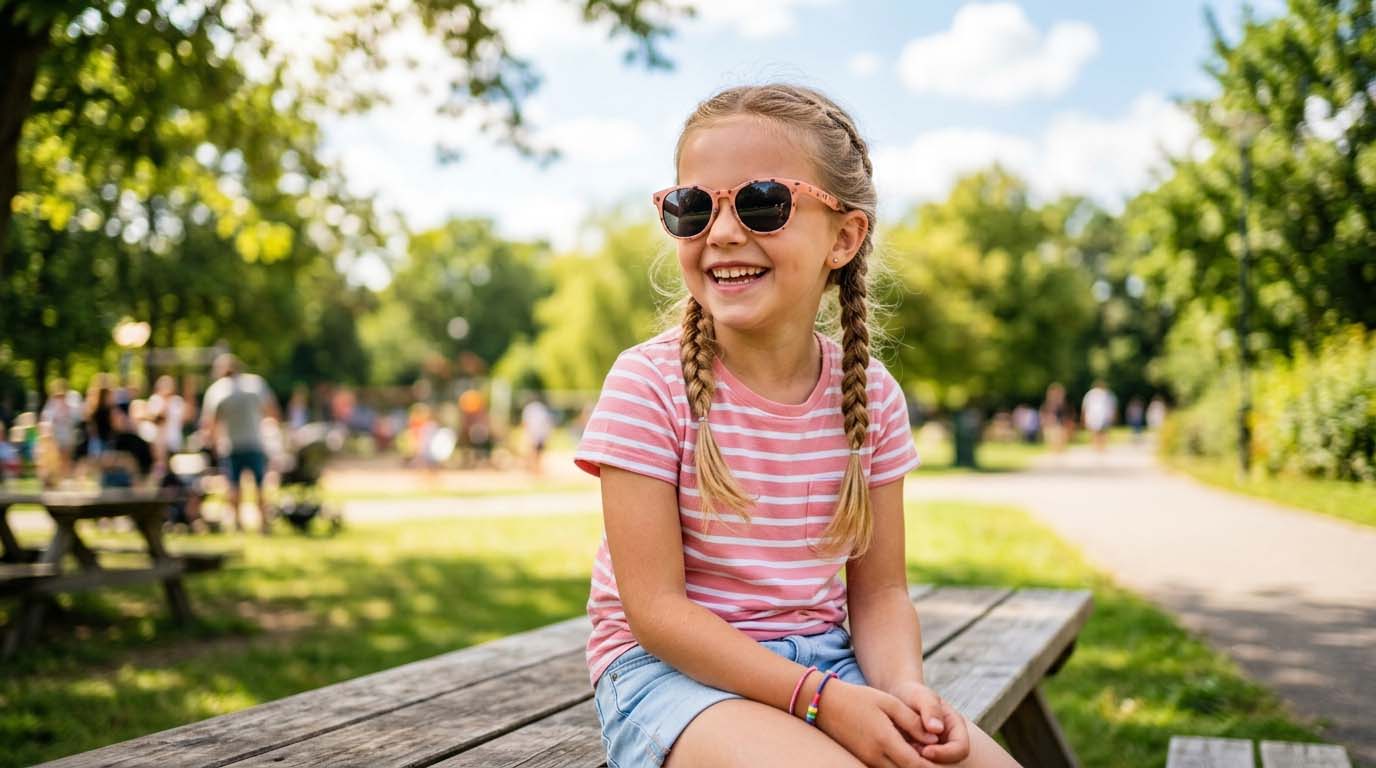
If your baby goes outside without sunglasses, their eyes absorb UV radiation that can cause damage right away and build up over time. In the short term, they can get a sunburn on the surface of the eye called photokeratitis. Over a lifetime, that exposure raises the risk of cataracts, growths on the eye, macular degeneration, and even eye cancer.
The tricky part is that babies cannot tell you their eyes hurt, and most damage shows no symptoms until years or decades later. Because an infant’s eye lets in more UV light than an adult’s, the stakes are higher than most parents realize.
Why Babies’ Eyes Are More Vulnerable to UV Damage
A baby’s eye is not a smaller version of an adult’s eye. It is structurally different in ways that make it much less protected against ultraviolet light.
The lens inside a baby’s eye is nearly clear. An adult lens has yellowed slightly over time, which naturally filters out some UV rays. A baby’s clear lens lets almost all UV radiation pass straight through to the retina at the back of the eye.
Babies also have larger pupils relative to the size of their eyes. A wider opening means more light, and more UV gets in. On top of that, infants have less protective pigment in their eyes. Melanin, the same pigment that colors skin and hair, also helps absorb UV in the eye. Babies have less of it, especially in the first year of life.
Then there is the factor of time. A baby who starts accumulating UV exposure at six months old has decades more lifetime exposure ahead than an adult who starts wearing sunglasses at age 30. Experts estimate that up to 80 percent of a person’s lifetime UV damage to the eyes happens before age 18.
Immediate and Short-Term Consequences of Not Wearing Sunglasses
The most immediate problem is photokeratitis. That is essentially a sunburn on the cornea, the clear front surface of the eye. It happens after just a few hours of intense sun exposure, especially when sunlight reflects off sand, concrete, snow, or water.
An adult with photokeratitis feels like they have sand in their eyes. Their eyes turn red, water excessively, and become extremely sensitive to light.
A baby cannot describe this. Instead, they may squint constantly, rub their eyes, cry more than usual in bright light, or seem fussy for no obvious reason. The symptoms usually appear six to twelve hours after exposure and can last a day or two.
Babies who do not wear sunglasses can also develop temporary blurred vision. The UV radiation causes the cornea to swell slightly, which distorts how light enters the eye. That swelling usually resolves on its own, but while it lasts, the baby sees a less clear world. For a developing visual system, this is not ideal.
Repeated short-term exposure without protection also leads to chronic surface irritation. The conjunctiva, the thin membrane covering the white part of the eye, can become inflamed and red.
Some babies develop a condition called pinguecula, a small yellowish bump on the white of the eye. It is not dangerous, but it is a visible sign that the eye has been taking too much UV.
Long-Term Risks That Build Over a Lifetime
The serious consequences of skipping sunglasses show up years or decades later. This is why many parents do not connect the dots. A baby who never wore sunglasses might seem perfectly fine all through childhood. The damage is invisible until adulthood.
Cataracts are one of the most common results. A cataract is a clouding of the eye’s natural lens. UV exposure accelerates the breakdown of proteins inside that lens, turning it from clear to cloudy over time.
Cataracts are the leading cause of blindness worldwide, and UV exposure is a major risk factor. Starting that damage in infancy means cataracts can appear earlier in life.
Pterygium is another long-term risk. This is a fleshy growth that starts on the white of the eye and can eventually creep over the cornea. If it reaches the center of the cornea, it blocks vision. Pterygium is strongly linked to UV exposure, especially in sunny climates. Once it forms, surgery is the only way to remove it, and it often grows back.
Macular degeneration is usually thought of as an old person’s disease, but it has childhood roots. The macula is the central part of the retina responsible for sharp, detailed vision. \
UV radiation causes oxidative damage to the macula that accumulates over decades. People who spent their childhoods without eye protection are more likely to develop macular degeneration earlier and more severely.
Ocular melanoma is rare but serious. It is a cancer that forms in the cells that produce melanin inside the eye. UV exposure is a known risk factor. While it is uncommon, it is the most common primary eye cancer in adults, and the seeds can be planted early.
The Invisible Injury
This is the hardest part for parents to grasp. If a baby gets sunburned skin, you see the redness and know to take action. Eye damage produces no visible sign at the moment. No redness. No swelling. No complaint from the baby. The eye does not feel pain from UV damage to the retina because the retina has no pain receptors.
A study in the journal Photochemistry and Photobiology found that children under 10 have up to 70 percent more UV transmittance to the retina than adults. That is not a small difference. It means that for every minute a baby spends in the sun without sunglasses, their retina gets significantly more radiation than an adult’s would under the same conditions.
What If My Baby Refuses Sunglasses?
Many parents know sunglasses are important but give up when the baby rips them off every thirty seconds. This is a real problem, but the solution is not to abandon eye protection entirely. It is to layer your defenses.
A wide-brimmed hat is step one. A hat with a brim that goes all the way around blocks UV from above. But it does nothing for light reflecting up from the ground. Sand, water, concrete, and even grass reflect significant UV. A hat alone is not enough.
A UV-protective stroller canopy helps, but most standard canopies are not enough. Many stroller covers block only a portion of UV. You can buy aftermarket mesh covers designed to block 98 percent or more of UV rays. Make sure it wraps around the sides, not just the top, because sunlight comes in from angles.
Timing matters. UV is strongest between 10 a.m. and 4 p.m. Planning outdoor time for early morning or late afternoon reduces exposure even without sunglasses. But UV is still present before and after those hours, especially in summer or near the equator.
UV window film for the car is an often-overlooked layer. Car windows block most UVB but let through significant UVA. Babies in rear-facing car seats often sit in direct sunlight through the side windows. Removable mesh shades or professional UV window film can block almost all of it.
Even with all these measures, some UV still reaches the eyes. Direct sunlight, reflections, and gaps around hats and canopies mean the eyes are never fully covered without sunglasses.
How to Get a Resistant Baby to Wear Sunglasses?
Some babies accept sunglasses easily. Others treat them like an enemy. If you are in the second group, try these steps:
Start indoors. Let the baby handle the sunglasses, chew on them, and get used to the feel. Put them on for thirty seconds inside the house, then take them off. Gradually increase the time over several days.
Use a strap. Sunglasses that stay on with a strap are harder for a baby to pull off. Look for infant-specific models with soft, adjustable straps.
Distract immediately. Put the sunglasses on right before something engaging happens: a walk, a snack, a new toy. The baby may forget about the glasses.
Try different styles. Some babies hate tight frames. Others hate loose ones. Some tolerate wraparound styles better. If one pair fails, try another brand or design.
Model the behavior. Wear your own sunglasses. Babies copy what they see.
Do not force it outside. If the baby is melting down, take a break and rely on the hat and shade until they calm down. Forcing it creates a negative association that makes the next attempt harder.
Myths and Reality About Baby Sunglasses
A few common beliefs keep parents from taking eye protection seriously. Here is the reality behind them.
Myth: Babies do not need sunglasses if they are in the shade.
Shade reduces direct UV but not reflected UV. A baby sitting under a tree at the beach or park still gets UV bouncing off the sand, concrete, or grass. Shade is helpful but not complete protection.
Myth: Only sunny days matter.
Up to 80 percent of UV rays pass through clouds. A cloudy day can feel dim while still delivering significant UV exposure to the eyes. Babies need sunglasses on overcast days too.
Myth: Cheap sunglasses are fine.
Price does not guarantee protection, but the cheapest sunglasses often have no UV rating. If the label does not say 100 percent UVA and UVB protection or UV 400, do not trust them. Worse, dark lenses without UV protection cause the pupil to open wider, letting in more UV than wearing no glasses at all.
Myth: Sunglasses are just for fashion.
For babies, they are medical equipment. The fashion aspect is secondary. A cute pair that does not block UV is worse than useless.
How to Choose Sunglasses for a Baby?
Look for three things on the label: 100 percent UVA and UVB protection, or UV 400. That number means the lenses block wavelengths up to 400 nanometers, which covers both UVA and UVB.
Polarized lenses are not required for UV protection, but they reduce glare. Glare makes babies squint and can make outdoor time unpleasant. Polarization is a nice addition but not a substitute for real UV blocking.
Frames should be flexible and impact-resistant. Babies drop things, throw things, and fall on things. Brittle frames or glass lenses are dangerous. Look for polycarbonate lenses and bendable frames, preferably made of rubber or silicone.
A strap is essential for infants. Ear pieces do not stay on a baby who is lying in a stroller or turning their head. A strap keeps the glasses in place even when the baby is not sitting upright.
Size matters. Adult or toddler sunglasses slip down or leave gaps that let UV in around the edges. Infant-specific sunglasses are designed for smaller faces and sit close to the eyes.
Frequently Asked Questions
Do babies need sunglasses even in the shade?
Yes. Reflected UV from sand, water, concrete, and grass still reaches the eyes. Shade cuts direct UV but does not eliminate exposure.
Can UV damage cause immediate vision problems in a baby?
A single exposure rarely causes permanent vision loss, but it can cause photokeratitis, which leads to temporary pain, redness, and blurred vision. The bigger concern is cumulative damage over years.
Is it safe to use adult sunglasses on a baby?
No. Adult sunglasses do not fit properly, leave gaps for UV to enter, and may break under the rough treatment babies give them. They also rarely have child-safe materials.
Are babies with light-colored eyes at higher risk?
Yes. Lighter eyes have less melanin in the iris and surrounding tissues, which means less natural protection against UV. Light-eyed babies should wear sunglasses consistently.
What if my baby wears a hat but no sunglasses? Is that enough?
No. A hat blocks UV from above but does nothing for UV reflecting off the ground and into the eyes. Sunglasses are the only way to block that reflected light.