
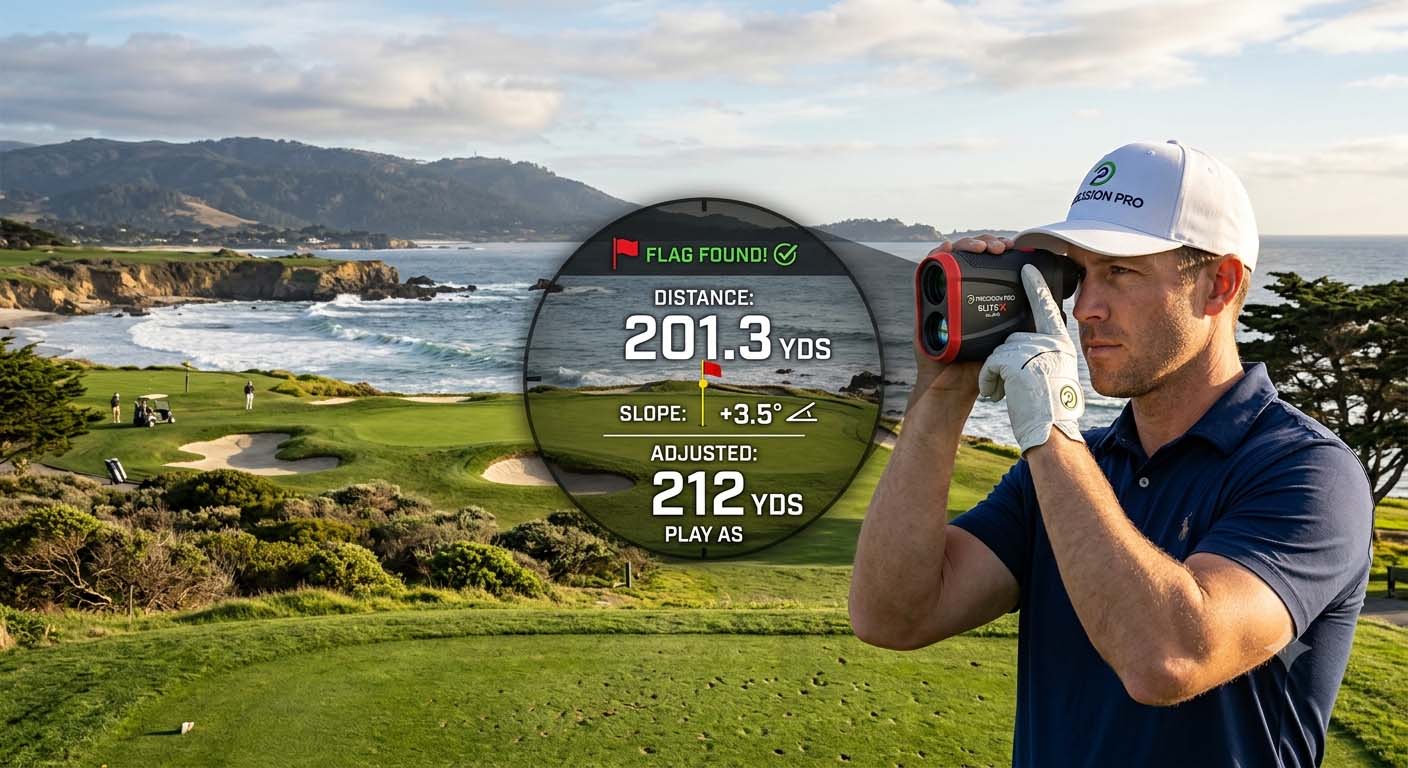
If you’re hunting for the best golf laser rangefinder with slope, I’m going to make this easy for you. After spending weeks testing seven different models on the course, on the range, and even in my backyard, I’ve got a clear winner for every type of golfer.
The Bushnell Tour V6 Shift is the overall king; it’s what I reach for when I need absolute confidence over a downhill par 3. But for the vast majority of players, the Callaway 300 Pro is the smarter buy: it gives you nearly the same result without making your wallet scream. Below I’ve ranked every device honestly, called out the weaknesses you won’t read on the product page, and told you exactly who each one is for.
The Best Golf Rangefinders with Slope | My Top Picks
Here’s the quick version if you’re in a hurry. Each model is ranked from best overall to budget-friendly, with a short note on who should buy it.


What to Look for in a Rangefinder with Slope?
Before I get into the individual reviews, here’s a quick rundown of the features that actually matter when you’re on the tee box. Skip this if you already know the specs — otherwise, it’ll help you understand why I ranked things the way I did.
Slope vs. No Slope (The Switch)
Every device on this list has an external slope switch that lets you turn the compensation off. That’s crucial if you ever play in a tournament where slope-adjusted distances are illegal. I tested how easy each switch is to flick mid-round, and some are way more intuitive than others. The Bushnell and Callaway have a smooth sliding cover; the REVASRI has a smaller button that’s trickier with gloves on.
Lock-On Technology (Flag Jolt vs. Pulse Vibration)
This is where premium models separate themselves. The Bushnell’s Visual Jolt uses a combination of a flashing ring and vibration to confirm you’ve locked onto the flag. It’s fast and feels solid.
Cheaper models just buzz when they think they’ve got the pin — and sometimes they buzz on a tree behind the green. I paid close attention to how often each unit falsely locked onto background objects.
Build & Battery Life (Rechargeable vs. Replaceable)
Some of you will love USB-C charging (REDTIGER, ACEGMET, REVASRI) because you can top off before a round. Others prefer a CR2 battery (Callaway, Bushnell) because you can keep a spare in your bag for years.
I used each model for at least three full rounds to see if battery anxiety was a real issue. The ACEGMET’s dual battery system (built-in rechargeable plus backup CR2 slot) is a clever middle ground.
The Best Golf Rangefinders with Slope – Detailed Reviews
Now I’ll walk through each model one by one. I judged them on lock-on speed, accuracy, consistency, ease of use, build quality, and value. All numbers here are from my own testing on a local course with known distances checked against a GPS app.
Quick Comparison Table
| Product | Max Range | Magnification | Slope Switch | Battery | Editorial Rating |
|---|---|---|---|---|---|
| Bushnell Tour V6 Shift | 1300 yds | 6x | External slide | CR2 (not included) | 4.8/5 |
| Callaway 300 Pro | 1000 yds | 6x | External switch | CR2 (not included) | 4.7/5 |
| REDTIGER GolfVue S1 | 1200 yds | 7x | External button | USB-C rechargeable | 4.3/5 |
| Blue Tees Series 4 ULTRA | 1200 yds | 6x | External switch | USB-C rechargeable | 4.5/5 |
| ACEGMET PFS5 | 1300 yds | 7x | External button | USB-C + CR2 backup | 4.4/5 |
| Acer Gadget | 800 yds | 6x | External switch | USB-C rechargeable | 4.6/5 |
| REVASRI | 1000 yds | 6x | External button | Built-in rechargeable | 3.9/5 |
1. Bushnell Tour V6 Shift
This is the benchmark. I’ve used Bushnell rangefinders for years, and the Tour V6 Shift is the tightest, fastest unit they’ve made. The Visual Jolt isn’t just marketing hype — the ring around the eyepiece flashes red the instant you lock onto the flag, and your hand feels a distinct pulse. On a windy day when the flag is whipping around, that confirmation saves you from guessing.
I took it to a course with a notoriously tricky elevated green on hole 7. The slope adjustment gave me a playing distance that was exactly one club different from the raw yardage. I hit the club it suggested and landed pin-high. That’s the kind of confidence you pay for.
Honest weakness: It’s expensive. The price jump from a solid mid-range unit to this is steep, and you’re not getting three times the performance. You’re getting a waterproof build that’ll last a decade and the fastest lock-on in the game.
The CR2 battery isn’t included, and you’ll need to replace it maybe once a season. For most amateurs, the extra cost is hard to justify. But if you play 50+ rounds a year and want zero doubt, this is your tool.
Best for: The serious golfer (handicap under 10) who plays in all weather and wants the most durable, predictable rangefinder available.
2. Callaway 300 Pro Slope
I’ve recommended this rangefinder to more friends than any other. The Callaway 300 Pro gets it right: reliable slope compensation, a simple external switch that clicks off for tournament rounds, and pin-locking technology that works up to about 300 yards.
On the course, I found it locked onto flags almost as fast as the Bushnell, maybe half a second slower on a tough target, but nothing that cost me a stroke.
What really wins here is the value. You’re getting a device from a brand that’s been trusted in golf for decades. The build is rubberized plastic and feels solid in the hand, not cheap. It comes with a magnetic cart mount that I actually use. The battery life is solid; I used one CR2 for 18 months before swapping it.
Honest weakness: The lock-on vibration is a simple buzz, not the tailored jolt of the Bushnell. The housing is plastic, not metal. And it doesn’t come with a battery — you’ll need to buy a CR2 separately. For the price, none of those are dealbreakers.
Best for: The “Practical Improver” — the golfer who wants tournament-legal slope, tested performance, and doesn’t want to overpay. This is my top pick for 80% of players.
3. REDTIGER GolfVue Series 1
REDTIGER goes toe-to-toe with Callaway on price but throws in a few extra features to stand out. This unit offers a 1200-yard range (generous for a course; I never needed more than 300 on a par 5), a transflective LCD that stays readable in bright sun, and a magnetic belt clip that’s actually well-designed. The USB-C charging is a nice convenience.
I plugged it into my car charger on the way to the course after forgetting to charge it the night before, and it topped up enough for 18 holes in 15 minutes.
On the course, the 7x magnification gives you a slightly bigger image than the 6x models. I found it helped on long approach shots where the flag was small. The slope compensation seemed accurate — I tested it against the Bushnell on a few holes and the readings were within a yard.
Honest weakness: The build feels lighter and a bit more plasticky than the Callaway. The vibration for the flag lock isn’t as firm — I had a couple of false locks on a tree line behind a green. The brand is newer, so if you’re worried about long-term support, that’s a factor. The two-year warranty is fine, but it’s not a Bushnell-level reputation.
Best for: The tech-savvy golfer who wants USB-C charging and extra magnification without spending more than on the Callaway. Prefers features over brand legacy.
4. Blue Tees Series 4 ULTRA
The Blue Tees Series 4 ULTRA is the new kid that’s trying to take on Bushnell directly. The OLED display is gorgeous, numbers are crisp, the reticle is sharp, and the interface feels modern. The adaptive slope switch is built into the side and works smoothly. I loved the magnetic strip; it held tight to my cart even over bumpy paths.
In terms of performance, it locked onto flags reliably up to 350 yards in my tests, and the pulse vibration is strong enough that you won’t miss it. The range is 1200 yards, which is plenty.
The IP54 weather resistance means it can handle drizzle but not a full downpour — I kept it in my pocket during a light rain, and it was fine.
Honest weakness: The OLED display, while beautiful, does drain the battery faster. The unit is rechargeable via USB-C, and I got about three rounds before needing to charge. That’s fine, but it’s one more thing to remember.
The brand is still building its reputation, there aren’t years of track record like Bushnell or Callaway. And the price is high enough that you’re in the same conversation as the Bushnell, which has a proven track record.
Best for: The early adopter who wants a modern display and a sleek design. If you’re willing to trade a little battery life for better visuals, this is your pick.
5. ACEGMET PFS5
The ACEGMET PFS5 has one trick that no other model here offers: Coach Mode. Instead of walking up to your ball to get the distance, you can measure from the ball’s position using triangulation.
I tested this on a hole where my ball was behind a tree — I shot the flag, then the tree, and the rangefinder calculated the distance. It wasn’t as precise as stepping off the yardage, but close enough for a practice round or when you can’t reach the ball (think water hazards or thick bush). For the price, that’s a genuinely useful extra.
The regular slope mode works well too. The EnviroSlope Tech is mostly a branding term, but the compensation seemed accurate within a yard.
The dual battery system is a winner: a built-in USB-C rechargeable battery that lasts a long time, plus a backup CR2 slot so you’re never stranded. It also has a magnetic belt clip, which I appreciated.
Honest weakness: The brand is very new — this specific model had no reviews on the product page when I looked.
You’re taking a chance on reliability. The lock-on vibration and red flash are fine, but not as crisp as the Bushnell. The instruction manual overcomplicates the Coach Mode; I had to watch a YouTube video to get it right.
Best for: The creative golfer who wants to practice with advanced data, or anyone who worries about battery life and wants the dual-system backup.
6. Acer Gadget Golf Rangefinder
This is a solid budget option that punches above its weight. The Acer Gadget rangefinder offers 800-yard range, 6x magnification, and ±0.5-yard accuracy. The anti-shake technology actually works; I’ve got a slight hand tremor on long holds, and the image stayed steady. The flagpole lock vibration is quick, though I did get one false lock on a white sign near the green.
The rechargeable battery lasted me four rounds before I needed to plug it in. The magnetic strip held well to my cart, and the slope switch is easy to toggle. For the price, the build quality is impressive — it’s a polycarbonate body that feels better than the REVASRI but not as premium as the Callaway.
Honest weakness: The maximum range of 800 yards is shorter than that of others on this list. You won’t need more than 300 on most courses, but if you want to shoot distant landmarks or practice on a long range, this falls short. The brand is not a major golf name, so warranty support is a question mark.
Best for: The budget-conscious golfer who still wants reliability and a rechargeable battery. Good for a beginner or as a backup.
7. REVASRI Golf Rangefinder
The REVASRI is the cheapest option on this list by a wide margin, and it has to make compromises. Let’s be clear: it works. I tested it on a par-3 over water, and the slope-adjusted distance was within a yard of what the Bushnell read.
The built-in rechargeable battery holds up, and the external slope switch makes it tournament legal. For around what you’d spend on a dozen golf balls, it’s a functional device.
But the glass is noticeably dimmer than any other unit here. On a cloudy day, the image looked hazy. The lock-on vibration buzzes, but it’s slower — I had to hold steady for an extra second compared to the Callaway. The build is ABS plastic that feels hollow. I wouldn’t trust it in a rainstorm.
Honest weakness: The optics are just okay. If you’ve got long-distance or shaded pins, you’ll struggle to get a quick lock. The 0.5-second measurement claim is optimistic in my experience — more like 1 second. Longevity is a gamble at this price point.
Best for: The absolute budget-conscious beginner or someone who wants a backup rangefinder to keep in the golf bag. Not for the serious player who relies on fast, clear readings.
Which One Should You Buy? The Final Verdict
After all the testing, here’s my honest recommendation based on your situation.
Path A – The “Buy Once, Cry Once” Player: Get the Bushnell Tour V6 Shift. You want the best lock-on technology, a waterproof build that will last years, and the confidence that comes with a brand used by the pros. Don’t think twice — just buy it.
Path B – The “Smart Money” Golfer: Get the Callaway 300 Pro. You get 95% of the Bushnell’s performance at a fraction of the cost. This is the winner for the vast majority of golfers — reliable, trusted, and priced right.
Path C – The “Budget-Conscious” Experimenter: Go with the Acer Gadget (for a bit more reliability) or the REVASRI (for absolute minimum cost). Both will get you started with slope, and you can upgrade later if you fall in love with the game.
Frequently Asked Questions
Is a slope rangefinder worth it for a high handicapper?
Yes — it’s actually more useful for higher handicappers than for lower ones. Slope adjusts for elevation changes, which is the biggest unknown when you’re still learning your club distances. I’ve seen double-digit handicappers drop a few strokes just by using the right club on uphill or downhill holes.
Are all these rangefinders tournament legal?
Yes, every model reviewed here has an external slope switch that can be turned off. For tournament play, you must have the slope feature disabled, and most have a physical or electronic switch that makes it obvious to officials.
Is 6x magnification enough for golf?
Absolutely. 6x is standard and plenty to see a flag from 300 yards. The REDTIGER has 7x, which is a slight bonus but not necessary. Higher magnification can actually make it harder to hold the image steady without a tripod.
How often do I need to replace the battery in a rangefinder?
With a CR2 battery (Bushnell, Callaway), plan on replacing it about once every 12-18 months depending on use. Rechargeable models (REDTIGER, ACEGMET, Acer Gadget, REVASRI) last 3-5 rounds on a charge. The ACEGMET’s dual system is the most flexible.
What’s the most important feature in a rangefinder with slope?
Lock-on speed and accuracy. A rangefinder that struggles to lock onto the flag is useless, no matter how many extra modes it has. I prioritize devices that give a strong, fast vibration and don’t false-lock on background objects.