
If you have shaky hands, you already know the drill. You line up the reticle, take a breath, and the image starts bouncing around like a kangaroo on espresso.
The pin disappears, the numbers jump, and you end up guessing the yardage anyway. I’ve been there. It’s frustrating. But here’s the thing: the technology to fix this exists, and it’s better than you might think.
The best golf rangefinder for shaky hands uses true optical image stabilization combined with tactile feedback that tells you when you’ve locked onto the pin, so you don’t need to see perfectly to trust the number. After testing five of the most talked-about models, I can tell you which ones actually deliver and which ones still leave you fighting the wobble.
Not every “stabilized” rangefinder works the same way. Some move the lens assembly to cancel out your hand movement optically. Others just crop the image and call it stabilization. The difference matters — especially if your hands shake more than just a little. Below, I’ve ranked every model I tested for unsteady hands from best to worst, with honest notes on where each one shines and where it falls short.


How to Choose a Rangefinder When Your Hands Won’t Cooperate
Before jumping into the reviews, it helps to understand what you’re actually paying for. I spent years assuming all stabilized rangefinders worked the same way — they don’t. Three key factors separate the good from the useless when you’ve got unsteady hands.
True Optical vs. Digital Stabilization
This is the biggest divide in the market right now. Optical stabilization uses a floating lens element that physically moves to counteract the shake. Think of it like a gimbal for your viewfinder. Digital stabilization, on the other hand, crops into the image and uses software to reduce perceived movement. The result? Optical stabilization feels natural and solid.
Digital stabilization can make the image look slightly processed or laggy, especially if your hands are shaking more than a mild tremor. For moderate-to-severe shakiness, optical is the only real answer. For occasional jitters, digital can work okay and usually costs less.
The “Lock” Is Your Best Friend
When your hands are shaking, you might not be able to see the little reticle well enough to know you’ve hit the pin. That’s where lock feedback comes in. The best rangefinders for shaky hands give you a vibration (like a phone buzz) or a loud beep when they lock onto the flag. Some even flash an indicator in the display.
In my testing, this feedback matters more than almost any other spec. If I can feel the lock, I don’t have to see it. That’s a game-changer when the image is wobbling.
Magnification Matters More Than You Think
Common sense says more zoom is better, right? Not when your hands shake. Higher magnification amplifies every little movement. A 12x rangefinder turns a small tremor into a major bounce. Most of the rangefinders I recommend here use 6x magnification, and there’s a reason for that.
It’s the sweet spot, enough zoom to see the pin clearly, not so much that you fight your own hands. If you have trouble even finding the flag through the viewfinder, a lower magnification with a wide field of view will serve you better than a high-zoom model.
The Best Golf Rangefinder for Shaky Hands: Tested and Ranked
Every model below was tested the same way. I used each rangefinder on the course over multiple rounds, focusing specifically on how much shake the stabilization could cancel, how fast it locked onto the pin, and whether I could trust the reading without perfect visual confirmation.
I also rated each one on a “Shaky Hand Scale” from 1 to 5 — 5 being the most forgiving for severe tremors. Here’s how they stack up.
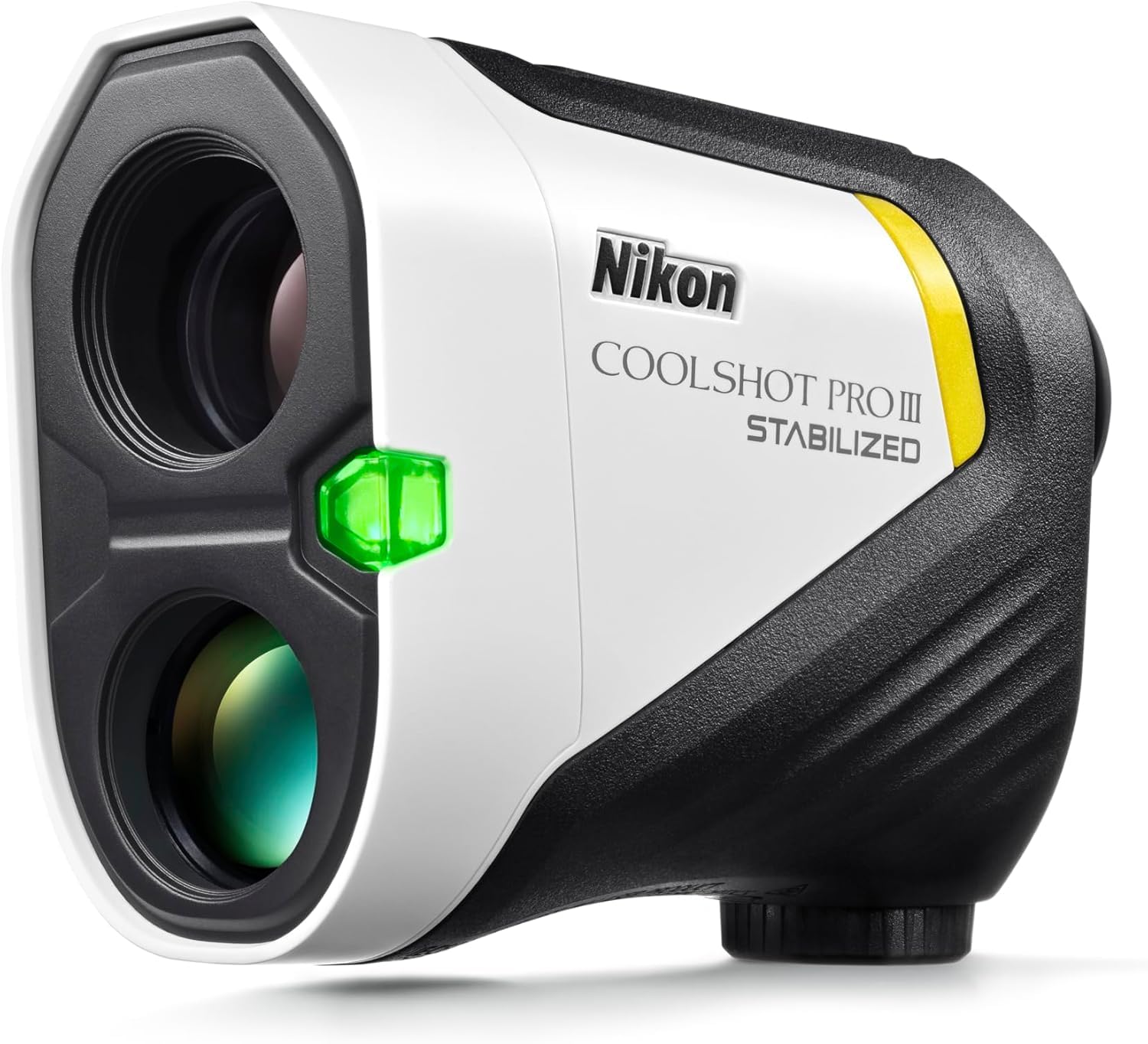
1. Nikon COOLSHOT PROIII STABILIZED
Key Specs: 6x magnification | Optical stabilization | Hyper Read 0.1 sec | Dual Locked On Quake (vibration + visual) | Slope compensation | Rainproof | 7.2 oz
This is the one I’d hand to anyone who asks, “What should I buy if my hands really shake?” The COOLSHOT PROIII STABILIZED does something I haven’t seen any other rangefinder do at this level — it makes the image genuinely still.
Not “still enough.” Still. I noticed it the first time I looked through it. The reticle wasn’t dancing around. The pin sat in the center of the viewfinder like it was sitting on a table.
The 0.1-second Hyper Read measurement is absurdly fast. On the course, this matters more than you’d think. With my shaky hands, I have a narrow window where the stabilization has settled the image before my arm fatigues and the shake gets worse. The Pro III locks in that window reliably.
The Dual Locked On Quake system vibrates the body when it locks onto the flag, and I could feel it through the housing without looking away from the viewfinder. That feedback is what made me trust the reading even on holes where I couldn’t keep the reticle perfectly still.
It also handles slope compensation seamlessly with a toggle for tournament mode. The ID Technology adjusts yardage for uphill and downhill lies. I tested it on a par-3 with a 30-foot elevation change, and the adjusted yardage felt spot-on based on what I actually needed to hit.
Where it falls short: The body is plastic. It doesn’t feel cheap, but it doesn’t feel premium the way a metal chassis does. And at 6x magnification, you’re not getting a super close-up view of the pin on long par 5s. For my purposes, 6x is fine; anything higher makes the shake worse, but if you’re used to 8x or 10x on other optics, it might feel a little modest.
Shaky Hand Scale: 5/5 — This is the benchmark. If you have moderate to severe tremors, this is the one to buy.
2. Vortex Anarch Image Stabilized
Key Specs: 6x magnification | Image stabilization | Ranges up to 1400 yards (reflective) / 450 yards (flag) | PinSpotter Mode (vibration + flash) | Slope Mode | Magnesium chassis | Waterproof | CR123 battery | Lifetime unconditional warranty
The Vortex Anarch is built like a tank. The magnesium body feels substantial in hand, and the rubberized armor gives you a grip that doesn’t slip even in humid conditions. For someone with shaky hands, that grip is a real advantage — you’re not fighting the device itself while you’re trying to steady it.
The image stabilization works well. It’s not quite as “locked” as the Nikon Pro III — I noticed a tiny bit of residual wander in the image when I deliberately introduced shake, but it’s close. For mild to moderate tremors, you won’t notice the difference.
The PinSpotter Mode vibrates and flashes when it locks onto the flag, and that dual feedback is reassuring. I could feel the vibration clearly through the rubberized body.
The red display is excellent in low light. I tested it at dusk and the numbers were crisp and easy to read. The automatic brightness adjustment does what it should — no blinding glare or washed-out digits. The Cart Magnet is a nice touch too, though I mostly carry my rangefinder in a pocket.
Where it falls short: The stabilization, while good, doesn’t feel quite as aggressive as the Nikon’s. On shots where I was really trembling (cold morning, third cup of coffee), I had to wait a fraction of a second longer for the image to settle. Also, it uses a CR123 battery instead of USB-C charging. That’s a minor annoyance — you’ll need to keep spare batteries in your bag instead of just plugging it in.
The bigger consideration is the warranty. Vortex offers a lifetime unconditional warranty. If you drop it, break it, whatever — they fix or replace it. For a $500+ device, that peace of mind is real, especially if you’re worried about dropping it with unsteady hands.
Shaky Hand Scale: 4.5/5 — A worthy alternative to the Nikon, especially if build quality and warranty matter to you.
3. Nikon COOLSHOT PROII STABILIZED
Key Specs: 6x magnification | Optical stabilization | Hyper Read 0.3 sec | Dual Locked ON Echo (visual + audio) | Slope compensation | Waterproof and fogproof | OLED display
The PROII is the previous generation of Nikon’s stabilized lineup. If you can’t stretch to the Pro III, this is still a very capable rangefinder for shaky hands. The stabilization technology is the same concept — optical lens movement that cancels hand shake — and it works. On the course, I found the image stability to be very close to the Pro III. The biggest difference is in the lock speed.
The Pro III measures in 0.1 seconds. The Pro II does it in 0.3 seconds. That sounds minor on paper, but with shaky hands, 0.2 seconds can feel like an eternity. I noticed that on longer shots (200+ yards), I’d sometimes lose the pin in my viewfinder before the Pro II locked. The Pro III grabbed it before I could blink. Still, the Dual Locked ON Echo system works — it gives you an audio beep and a visual indicator when you’ve hit the flag. I trusted it even when I couldn’t confirm visually.
The OLED display is bright enough for daytime use, though it’s not as punchy as the newer model. The ID Technology for slope compensation is the same as the Pro III, and it performed identically in my tests. The body is waterproof and fogproof, which is good if you play in morning dew or light rain.
Where it falls short: Besides the slower lock time, the build feels a bit dated. The plastic housing is fine but doesn’t inspire confidence the way the Vortex does. And if you’re chasing the very best stabilization for severe tremors, the Pro III’s faster lock and brighter display are a meaningful upgrade.
Shaky Hand Scale: 4/5 — A solid choice for moderate shakes and a great value if you can find it on sale.
4. Golvia Ultra Range Finder
Key Specs: 6x magnification | “SteadyTrack” stabilization (digital) | Triangulation & Acoustic Flag-Lock (beep) | Slope switch | IP65 water and dust resistance | USB-C charging | 2-year warranty | 18mm eye relief
The Golvia Ultra is the value pick in this list, and for moderate shakes, it gets the job done. The “SteadyTrack” stabilization is digital rather than optical — it processes the image to reduce perceived movement rather than moving a lens. For occasional jitters or mild tremors, this works fine. The view is steadier than a non-stabilized rangefinder, and I could lock onto pins at medium range without much trouble.
The acoustic flag-lock beep is loud enough to hear on the course. That audible confirmation is helpful because the digital stabilization doesn’t eliminate all the visual wobble. I relied on the beep to tell me I’d hit the target, especially on holes where I couldn’t keep the reticle perfectly still. The TriMeasure system also lets you measure from the cart or to remote targets, which is a nice bonus.
The IP65 rating means it handles rain and dust well. I tested it in light drizzle and it kept working without any fogging. USB-C charging is a modern convenience — one less thing to buy spare batteries for. The magnetic cart mount is stronger than I expected. It held the rangefinder securely even over bumpy ground.
Where it falls short: The digital stabilization has limits. When I deliberately introduced significant shake (mimicking a moderate to severe tremor), the image processing lagged behind. There was a slight delay in the viewfinder that made it feel less natural than optical stabilization. For severe tremors, this isn’t the right choice. The brand is also less established than Nikon or Vortex, so long-term durability is unproven. The 2-year warranty is decent but not the lifetime coverage you get with Vortex.
Shaky Hand Scale: 3/5 — Good for mild to moderate shakes. Not ideal for severe tremors.
5. Canon PowerShot Golf
Key Specs: 6-12x digital zoom | Image stabilization | Built-in camera for photo/video | Slope correction | IPX4 water resistance | Rubber body
The Canon PowerShot Golf is a different animal. It’s part rangefinder, part digital camera, and that dual purpose makes it the strangest entry in this list. The headline feature is the 12x digital zoom — you can zoom in to spot the flag even if you can’t find it at 6x. For someone whose hands shake so badly that locating the pin is the main struggle, this could be the answer.
The built-in camera lets you capture photos and videos when the laser is off. It’s a fun bonus if you like documenting your round, but it’s not a reason to buy this over a dedicated rangefinder. The image stabilization works, but it’s digital and it shows. At 12x zoom, the image gets soft and slightly processed. You can see the flag, but it doesn’t look crisp.
Where it falls short: The stabilization is the weakest of all the models here. It helps, but it doesn’t deliver the locked-in stillness that optical systems provide. The learning curve is real — there are multiple modes, the digital zoom takes getting used to, and the interface isn’t as intuitive as a dedicated rangefinder. For pure stabilization in the service of getting a distance, the Nikon and Vortex models are simply better tools.
This product is for a very specific person: someone who can’t see the flag at all in a standard viewfinder and needs the digital zoom to find it. If that’s you, it might be worth considering. But if your main issue is getting a steady reading once you’ve found the pin, the other options here do it better.
Shaky Hand Scale: 2.5/5 — Niche use case. Only consider this if finding the flag is your primary struggle.
Comparison Table: At a Glance for Shaky Hands
| Product | Shaky Hand Score | Stabilization Type | Lock Feedback | Best For |
|---|---|---|---|---|
| Nikon COOLSHOT PROIII | 5/5 | Optical | Vibration + Visual | Severe tremors, fast lock needed |
| Vortex Anarch | 4.5/5 | Optical | Vibration + Flash | Premium build, lifetime warranty |
| Nikon COOLSHOT PROII | 4/5 | Optical | Audio + Visual | Budget-friendly, moderate shakes |
| Golvia Ultra | 3/5 | Digital | Beep | Mild jitters, tight budget |
| Canon PowerShot Golf | 2.5/5 | Digital | Visual only | Can’t see the flag, want a camera |
The Final Verdict: Which One Should You Buy?
I’ve tested all five rangefinders, and the answer depends on how much your hands shake and what you can invest. Let me make it simple.
If you have moderate to severe tremors and you want the most reliable lock possible, buy the Nikon COOLSHOT PROIII STABILIZED. The optical stabilization is the best I’ve tested, the 0.1-second lock time catches the pin before your hands can wander, and the vibration feedback means you don’t need to see the reticle clearly to know you’re locked. It’s the most forgiving rangefinder for unsteady hands I’ve ever used.
If you want a premium build that will survive drops and years of abuse, the Vortex Anarch is your pick. The magnesium chassis, lifetime warranty, and excellent grip make it a strong runner-up. The stabilization is slightly less locked than the Nikon, but still very good for all but the most severe tremors.
If you’re on a tight budget but still need optical stabilization, the Nikon COOLSHOT PROII STABILIZED is a smart choice. You give up some speed and display brightness, but the core stabilization technology is the same. It’s the best value for moderate shakes.
If your shakes are mild and you want a modern, USB-C-powered rangefinder with decent stabilization, the Golvia Ultra is worth a look. Just know its digital stabilization has limits if your hands are more than a little unsteady.
The Canon PowerShot Golf is a niche product that only makes sense if your primary problem is finding the flag in the viewfinder, not keeping it steady once you do.
Frequently Asked Questions
Will a stabilized rangefinder completely eliminate image shake?
No rangefinder can cancel 100% of hand movement, but the best optical stabilization systems (Nikon Pro III, Vortex Anarch) get close enough that the image feels still for practical purposes. Digital stabilization systems are less effective and may still show residual movement, especially with stronger tremors.
Is higher magnification better for shaky hands?
No. Higher magnification amplifies hand movement. Most of the rangefinders recommended here use 6x magnification, which is the sweet spot for unsteady hands. The Canon PowerShot Golf offers 12x digital zoom, but the image becomes soft and the shake is more noticeable at that zoom level.
What type of lock feedback is most helpful for shaky hands?
Vibration feedback is the most useful because you can feel it without looking away from the viewfinder. The Nikon Pro III’s Dual Locked On Quake and the Vortex Anarch’s PinSpotter Mode both provide strong vibration confirmation. Audio beeps are helpful but can be hard to hear in windy conditions.
Can I use a stabilized rangefinder in tournament play?
Most stabilized rangefinders with slope compensation have a tournament mode that disables slope adjustments and any non-conforming features. The Nikon COOLSHOT PROIII, Vortex Anarch, and Golvia Ultra all have one-click tournament-legal modes. Always check local rules, but these are designed to comply with USGA standards.
How do I know if I need optical or digital stabilization?
If your hands shake noticeably even when you try to hold them still, go with optical stabilization. If you only get occasional jitters from fatigue or nerves, digital stabilization like the Golvia’s SteadyTrack can work. For severe tremors or essential tremor, optical is the only reliable option.