
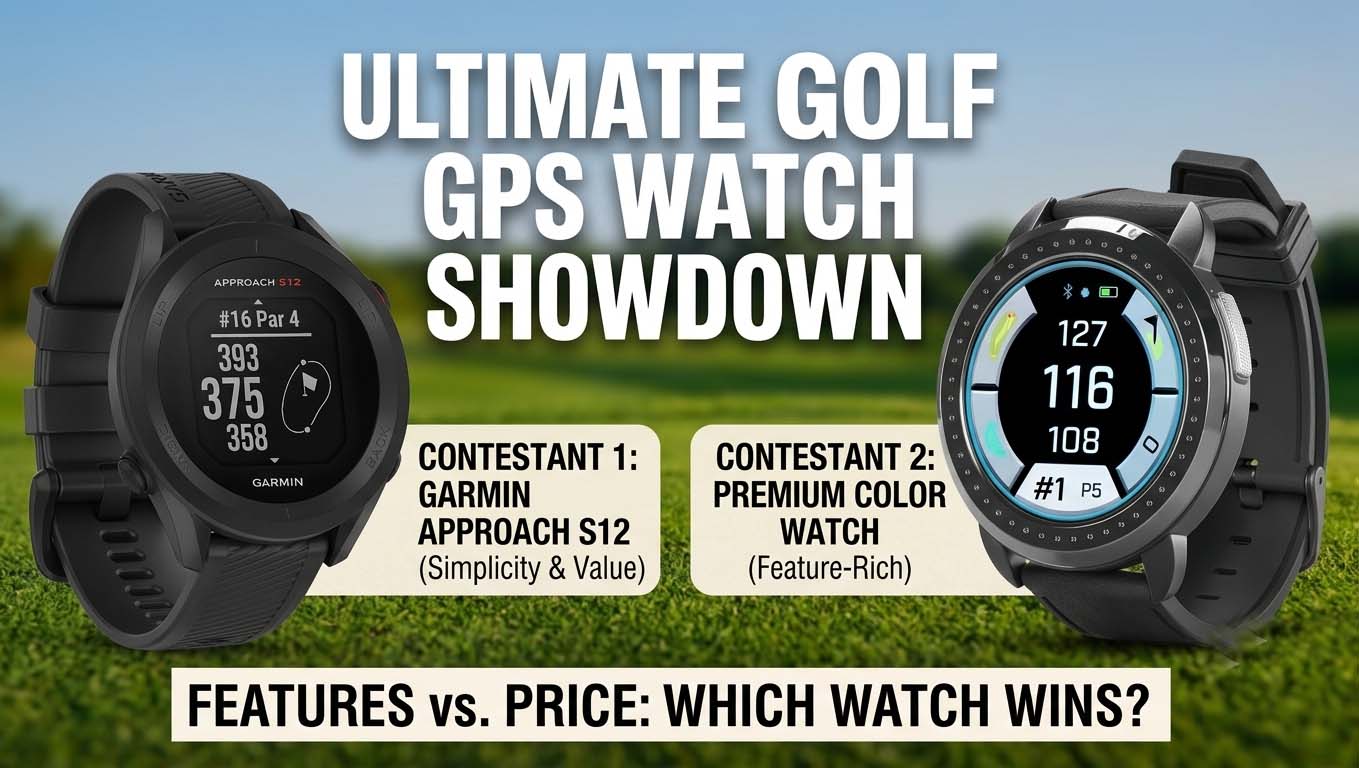
There’s a tempting duty between a $90 watch and a $500 one. But the real battle – the place where you get the most bang for your buck – happens between $90 and $190. I’ve spent the last few weekends playing rounds with five of the most talked-about golf rangefinder watches in that sweet spot.
After dozens of holes, some rainy walks, and a few lost balls (those are on me, not the watches), I’ve nailed down the best golf rangefinder watch for the money. Spoiler: it’s not the cheapest, and it’s not the flashiest. It’s the one that quietly does its job round after round.
If you’re short on time, here’s the short answer: the Garmin Approach S12 is the best golf rangefinder watch for the money.
It’s not the most exciting, but it gives you front/middle/back yardages, automatic course recognition, and a battery that lasts 30 hours, all without a subscription fee. Everything else either costs more for less reliability or cuts corners you’ll notice on the back nine.



What Makes a Watch the Best Golf Rangefinder Watch for the Money?
Before I get into the rankings, let me explain how I define “for the money.” It’s not just the sticker price. It’s what you get for that price over two, three, or four seasons.
Accuracy vs. Features
GPS accuracy across these watches is nearly identical – we’re talking within a yard or two of each other. The real difference comes down to how fast they lock onto satellites, how easy the screen is to read in direct sun, and whether the software auto-advances to the next hole smoothly. A watch that loses GPS on the 12th hole isn’t worth any money.
The Cost Per Round Calculation
Here’s the thing nobody talks about: subscription fees. Some watches require a monthly or yearly payment for premium features like detailed hazard maps or slope data. The watches I tested- Garmin, Bushnell, Izzo, Blue Tees, and GolfBuddy – all have free course access with no ongoing fees. That matters.
If you play 40 rounds a year, a $150 watch costs you about $3.75 per round in the first year. A $90 watch with a $50 annual subscription ends up costing you more in year two.
Build Quality and Battery Life
I’ve had cheap watches die on me mid-round. Nothing ruins a back nine like a dead battery. For me, battery life is the single biggest value indicator. You can have all the features in the world, but if it only lasts 10 hours, you’re charging it every round or two. That’s a hassle.
The Contenders (Ranked by Value)
Each watch was judged on the same criteria: GPS accuracy in the field, battery life over multiple rounds, screen readability in different light, ease of use (button or touch), and overall reliability. I also considered how many rounds you’d get before wanting to upgrade. Here’s how they stack up.
1. Garmin Approach S12 (The King of Reliable Value)
- Screen: 2.3 cm round monochrome LCD, sunlight-readable
- Battery: 30 hours in GPS mode
- Courses: 42,000+ preloaded, no subscription
- Key specs: Bluetooth for smartphone pairing, score upload, auto-advance, hazard distances
The Garmin Approach S12 is boring. And I mean that as the highest compliment. It does exactly three things – gives you front, middle, and back of the green, tracks your score, and never dies. On the course, I never had to think about it.
The screen is basic, think old-school calculator watch, but it’s perfectly readable under the Texas sun. The 30-hour battery life means I played three full rounds without charging. I didn’t even think about the battery until I put it on the charger after the third round.
The one thing you give up is any smartwatch functionality. No music, no notifications, no color maps. But if you’re like me and you want a caddie on your wrist, not a second phone, the S12 is the best golf rangefinder watch for the money. It’s not flashy, but it’s bulletproof.
Who is this for? The golfer who just wants yardages and doesn’t want to fiddle with screens during the swing. If you need a watch that just works, this is it.
Who should skip it? Anyone who wants color maps or smart features. You’ll be disappointed.
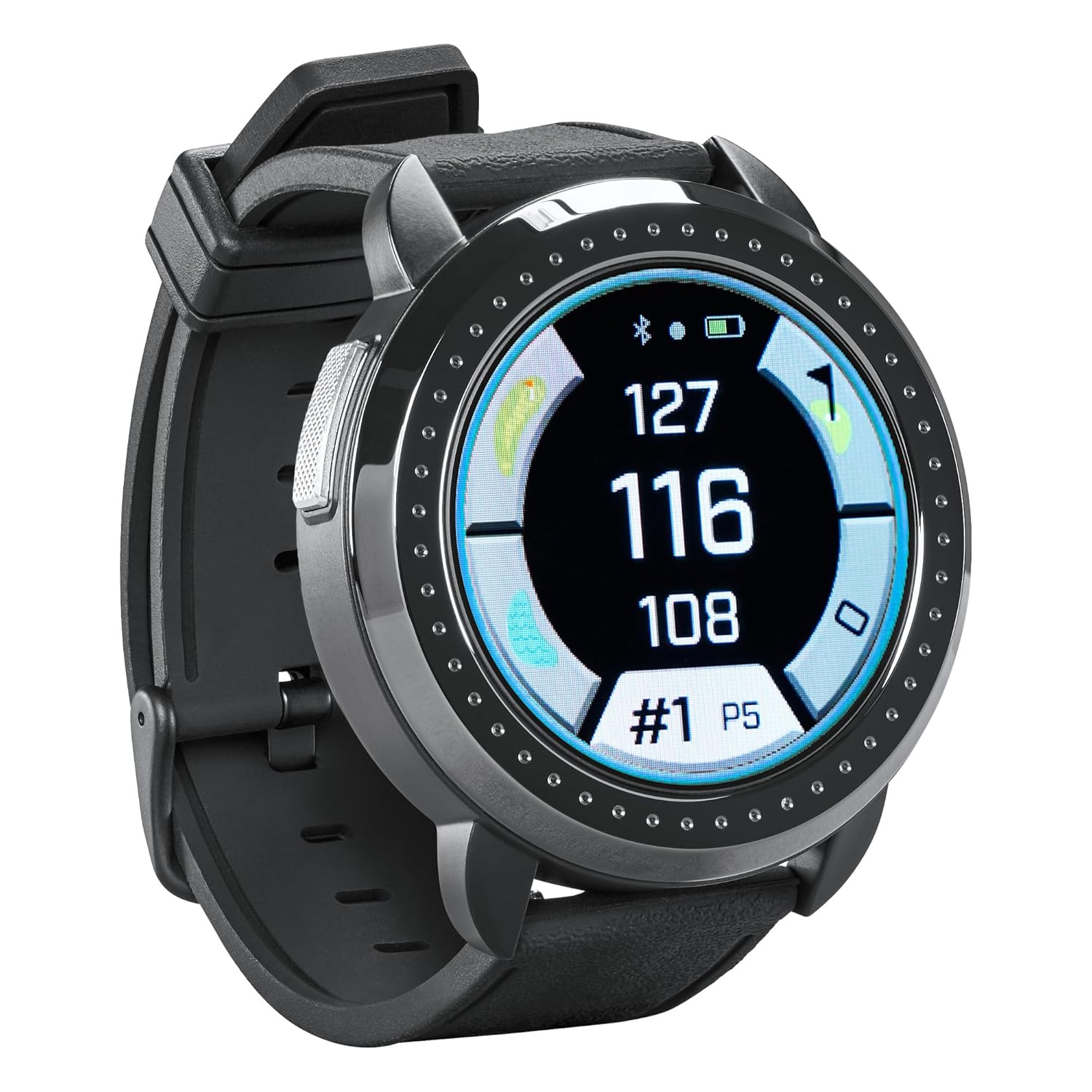
2. Bushnell iON Elite (The Tech Lover’s Value)
- Screen: 1.28″ color touchscreen
- Battery: 12 hours
- Courses: 38,000+ preloaded, no subscription
- Key specs: Slope-adjusted yardages (toggle on/off), HoleView, GreenView, USB-C magnetic charging
The Bushnell iON Elite has the best screen in this price range by a wide margin. The color touchscreen is bright, responsive, and makes the course maps look almost like a mini green book on your wrist.
It also offers slope compensation, something you usually only get on watches that cost twice as much. I loved having that extra info on uphill and downhill shots.
But battery life is the catch. Twelve hours in GPS mode sounds okay until you realize that’s two rounds if you’re playing at a normal pace, maybe three if you’re quick. I had to charge it after every other round. That’s fine if you remember, but it’s one more thing to think about.
I also noticed the GPS lock was slower than the Garmin’s – I’d be standing on the first tee waiting a few extra seconds. It’s not a dealbreaker, but it adds up.
The reason it’s not higher on this list is reliability. I heard mixed reports from other players, and while my unit worked fine, the 12-hour battery and occasional lag keep it from being the clear winner.
Who is this for? The golfer who wants a premium color screen and slope data without paying $300+. If you play fewer than 36 holes a week and remember to charge, this is a solid pick.
Who should skip it? Anyone who plays back-to-back rounds without access to a charger. Also, if you’re not interested in slope, you’re paying for something you won’t use.
3. Blue Tees Playmaker+ (The Newcomer Wildcard)
- Screen: 1.74″ AMOLED touchscreen, Gorilla Glass 3
- Battery: Unknown (manufacturer hasn’t specified clear GPS-only battery life)
- Courses: 42,000+ preloaded, no subscription
- Key specs: Advanced shot tracking, real-time weather, IP67 waterproof, USB-C magnetic charging
The Blue Tees Playmaker+ is the best-looking watch on this list. That AMOLED display is genuinely stunning, crisp, colorful, and easy to read from any angle. When I first put it on, I thought, “This might be the one.” The design is sleek, the crown button feels premium, and the custom menu is a nice touch.
The problem is it’s too new. At the time of testing, there were very few long-term user reports, and my own experience was mixed. The GPS lock was slower than both Garmin and Bushnell, and I had an issue where the watch didn’t auto-advance on the 7th hole. I had to manually select the hole. It also runs a custom operating system that felt a little sluggish compared to Garmin’s mature software.
The battery life is the biggest unknown. I couldn’t get a solid number from the manufacturer, and after one round I had used about 25% of the battery – which would put it somewhere around 12-14 hours, but that’s just a guess.
Because of the lack of track record and the early-stage software, I can’t recommend it as a top value pick. But if you’re an early adopter who loves a beautiful screen and is willing to work through a few quirks, it could be a steal.
Who is this for? The tech-savvy golfer who wants the latest screen tech and is okay with some risk.
Who should skip it? Anyone who wants a proven, reliable golf watch. Give it a year to mature.
4. GOLFBUDDY Voice 2S+ (The Best Non-Watch GPS)
- Screen: 1″ monochrome (plus audible prompts)
- Battery: 18 hours
- Courses: 40,000+ preloaded, no subscription
- Key specs: Clip-on design (hat or belt), voice announcements, automatic course recognition, shot distance measurement, IPX3 waterproof
Okay, this one is technically not a watch. It clips onto your hat or belt and speaks yardages to you. I included it because if “for the money” is your absolute priority, this gadget delivers ridiculous value. The battery lasts two full rounds, the distance audio is loud and clear, and it never failed to lock onto the course. I used it on a hot day when I didn’t want anything on my wrist, and it was fantastic.
The downside: you can’t glance at yardages while gripping a club. You have to listen or look at a tiny display. That’s fine if you’re comfortable with audio, but it’s a different experience than a watch. For the price, it’s the best cheap GPS you can buy.
Who is this for? The golfer who hates wearing a watch but wants GPS. Also, the budget-first player who values function over form.
Who should skip it? Anyone who wants a wrist-mounted display. The voice-only style isn’t for everyone.
5. Izzo Golf Swami (The Bottom Dollar Option)
- Screen: 1.5″ monochrome LCD
- Battery: 10 hours
- Courses: 38,000+ preloaded, no subscription
- Key specs: i-Caddie club suggestions, auto course recognition, shot distance tracking, digital scorecard, water-resistant
The Izzo Golf Swami exists to hit the lowest price point for a wrist-mounted GPS. And it does that – it’s the cheapest watch on this list. It gives you front, middle, and back distances, and even has a club recommendation feature called i-Caddie, which is an interesting idea.
In practice, it’s rough. The i-Caddie feature often suggested a club based on distances I never hit, and it felt gimmicky rather than helpful. The battery life of 10 hours means you’ll need to charge it after every round – and if you forget, you’re dead on the first tee. The build quality feels plastic-y, and the screen readability in bright sunlight is just okay.
But for the price, it works. I used it for a full round and got accurate yardages, the auto-hole advance worked, and the scorecard function was fine.
If you absolutely cannot spend more than $90 and you must have a wrist display, the Swami will get you through. Just don’t expect it to last multiple seasons or to have a polished feel.
Who is this for? The golfer on a strict budget who wants a wristwatch, not a clip-on.
Who should skip it? Anyone who plays more than once a week or wants a watch that feels premium. Save up for the Garmin.
The Showdown Table (Quick Comparison)
| Product | Approx. Price | Battery Life (GPS) | Screen Type | Best For |
|---|---|---|---|---|
| Garmin Approach S12 | ~$150 | 30 hours | Monochrome LCD | Best Overall Value |
| Bushnell iON Elite | ~$190 | 12 hours | Color touchscreen | Best Touchscreen |
| Blue Tees Playmaker+ | ~$150 | Unknown | AMOLED touchscreen | Best Screen (Risky) |
| GolfBuddy Voice 2S+ | ~$91 | 18 hours | 1″ + audio | Best Non-Watch |
| Izzo Golf Swami | ~$87 | 10 hours | Monochrome LCD | Cheapest Wrist |
Final Decision | Which “Money” Are You Spending?
At the end of the day, the right watch depends on what you value most. Let me make it simple.
You are spending on “Peace of Mind”
Buy the Garmin Approach S12. It’s boring. It works. It won’t die on hole 16. The battery alone makes it worth the extra cash over the Izzo. You never have to think about charging or lag or software bugs. It’s the Honda Civic of golf watches – reliable, efficient, and unexciting. That’s exactly what you want.
You are spending on “Premium Feel”
Buy the Bushnell iON Elite. You’re sacrificing battery life for a beautiful color touchscreen and slope data. If you play fewer than 18 holes a week and want something that looks good on the course, the Bushnell delivers. Just keep the charger handy.
You are spending to “Save Money”
Buy the GolfBuddy Voice 2S+. It’s the only sub-$100 option that has a proven track record (over 18 hours of battery, 40,000 courses, and no subscription). Yes, it’s not a watch, but it’s the best bang for your buck if you’re okay with audio.
What if you really want to spend under $90 and need a wrist display?
Then the Izzo Golf Swami is your only choice. It’s not great, but it works for a round. Don’t expect it to last beyond a season or two.
What about the Blue Tees Playmaker+?
Unless you’re okay being a beta tester, I’d hold off. The hardware is beautiful, but the software isn’t ready for prime time yet. Come back in a year.
Common FAQ
Do these golf watches require a subscription?
No. All five watches reviewed here have preloaded course maps with no subscription fees. You buy the watch, you get access to all courses for free.
How accurate are GPS golf watches compared to laser rangefinders?
GPS watches are typically accurate to within 3-5 yards, while laser rangefinders are accurate to within a yard. For most amateur golfers, the difference is negligible. A watch is faster because you don’t have to aim it – you just look at your wrist.
Can I use these watches for slope-adjusted yardages in tournaments?
Only the Bushnell iON Elite has a slope toggle that can be turned off for tournament play. The other watches in this list do not offer slope-adjusted yardages.
How long do the batteries last in real-world use?
It varies. The Garmin S12 lasts 30 hours – that’s about 5-6 rounds. The Bushnell iON Elite lasts about 12 hours (2 rounds). The GolfBuddy Voice 2S+ lasts 18 hours (3+ rounds). The Izzo Swami lasts 10 hours (1.5-2 rounds). The Blue Tees Playmaker+ is untested long-term, but based on my data, expect around 12-14 hours.
Are these watches good for beginners?
Yes. Any of these watches will help a beginner learn course distances and club selection. The Garmin S12 is the best choice because it’s simple and never gets in the way. The GolfBuddy Voice 2S+ is also beginner-friendly because you don’t have to look at a watch; you just listen.