
If you have a low nose bridge, you know the exact moment of panic. You’re standing over the ball, driver in hand, and you feel it — the slow, inevitable slide of your sunglasses down your nose.
By the time you reach the top of your backswing, they’re sitting on your cheeks. By impact, you’re either squinting or your head has shifted to compensate. Either way, the shot is compromised.
This isn’t a problem with “bad” sunglasses. It’s a problem with fit. Standard frames are built for an average nose bridge height. If your bridge sits lower, those glasses don’t have anything to grip. They pinch, they fog, they slide. And on a golf course, that’s not just annoying — it’s a performance killer.
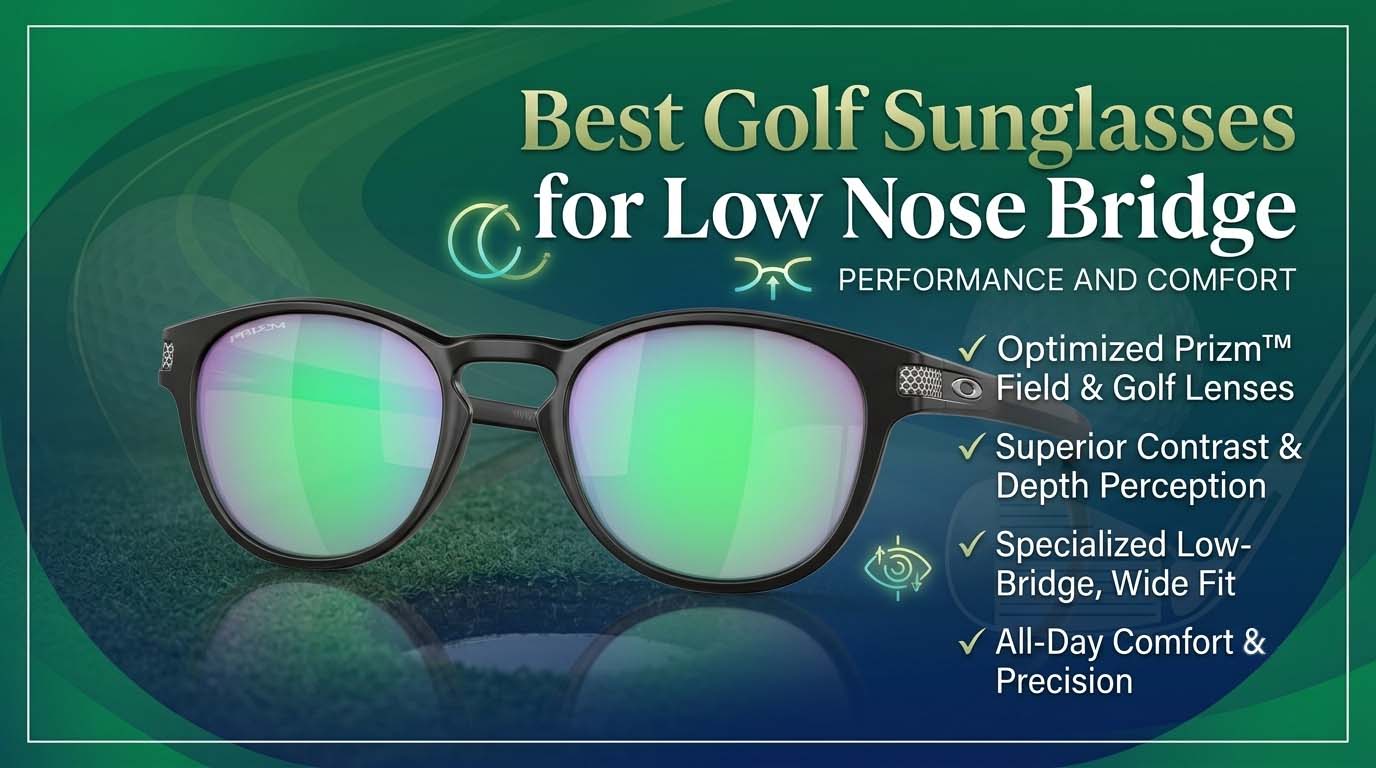
After testing multiple options specifically for their fit on a low nose bridge and their performance during a full swing, I found one clear winner. If you want the short answer, the Oakley Latch Low-Bridge Fit with Prizm Golf lenses is the only pair I’ve used that solves both the fit problem and the vision problem at the same time.
But let me walk you through exactly why that is, what to look for, and whether it’s the right choice for you.
Our Top Picks For The Best Golf Sunglasses for Low Nose Bridge

The Real Problem: Why Your Sunglasses Slide on the Course
Understanding why standard sunglasses fail is the first step to finding ones that work. It’s not about the brand or the price tag. It’s about geometry.
Most frames are designed with a nose bridge that sits relatively high. For someone with a standard or high nose bridge, the frame rests comfortably on the sides of the nose. But for a low nose bridge, common among people of Asian, African, and Hispanic descent, that same frame doesn’t make proper contact.
Instead of resting on the nose, the frame sits too low. The lenses end up touching your cheeks. And the moment you tilt your head down to look at a golf ball, gravity takes over.
Now add a golf swing to that equation. You’re rotating your torso at speed, looking down, then looking up to follow the flight. Any slippage means your optical center shifts. Your head may subconsciously lift or tilt to keep the lenses in front of your eyes.
And that changes your spine angle. A changed spine angle means a topped shot, a slice, or just a swing that feels wrong.
For me, this was the most frustrating part. I’d hit three or four good holes, then on the fifth tee, my glasses would slide, I’d try to push them up mid-swing, and the whole round would unravel. It wasn’t until I started paying attention to “low bridge fit” as a specific design feature that things changed.
What to Look For When Shopping?
Here are the criteria I used to evaluate every pair. These aren’t nice-to-haves. They’re what separate a pair that works from one that doesn’t.
- Frame Geometry: Look for “Low Bridge Fit” or “Asian Fit” in the product description. This means the lenses are cut higher and wider. The frame sits higher on the face, so the nose pads actually make contact with your bridge.
- Nose Pad Design: Adjustable nose pads are ideal. They let you fine-tune the grip. But integrated saddle pads — like you see on the Oakley Latch — can also work if they’re designed for a lower bridge.
- Lens Technology: For golf, standard tinted lenses aren’t enough. You want contrast-enhancing lenses that help you read the green and see the fairway undulations. Prizm Golf is the gold standard here.
- Weight and Grip: Heavy frames bounce on the downswing. Lightweight materials like O-Matter (Oakley’s proprietary frame material) stay put.
- Durability: A golf bag takes abuse. You need lenses that are impact-resistant and frames that won’t warp over time.
The Top Pick: Oakley Latch Low-Bridge Fit
The Oakley Latch Low-Bridge Fit is my top pick for one simple reason: it’s the only pair I’ve found that combines a dedicated low-bridge frame geometry with a golf-specific contrast lens. Most “low bridge” sunglasses have generic lenses. Most “golf” sunglasses don’t address the fit problem. This one does both.
The Fit: Engineered for Low Bridges
Oakley’s “Low-Bridge Fit” designation isn’t a marketing tag. It’s a real change in frame geometry. The lenses are cut higher and wider compared to the standard Latch. This means the frame doesn’t sit on your cheekbones. Instead, the lens’s optical center stays aligned with your eyes.
When I first put them on, I noticed it immediately. No pinching on the sides of my nose. No feeling that they were going to slide off. The frame sits flush but not tight. The O-Matter material is lightweight and stress-resistant, so it doesn’t warp or lose its shape over time. I’ve worn mine through a dozen rounds, and they feel the same as the first day.
The interior latch feature, which lets you clip the glasses to your shirt, is a practical bonus. I used to toss my glasses in my bag between shots. Now I clip them to my polo collar, and they’re secure. It’s a small thing, but it keeps them safe and within reach.
The Lens: Prizm Golf Changes How You See the Course
This is the part I was skeptical about before trying them. I’ve worn polarized lenses on the course for years. I thought they did the job. But Prizm Golf is different.
The Prizm Golf lens is tuned to enhance contrast between the green of the fairway and the brown of the rough. It also makes undulations on the green pop. I noticed it most on the first hole of my second round with them.
I was on the fringe, about 20 feet from the pin, and I could see a subtle break to the right that I would have missed with my old polarized lenses. I read it correctly and made the putt. That’s not a coincidence — that’s the lens working.
The 30% light transmission is designed for low to medium light conditions. Early morning rounds, overcast days, these are perfect conditions for Prizm Golf. They’re not ideal for full midday sun, but I haven’t found that to be a problem. They still block glare well enough to be comfortable.
The lenses are made of Oakley’s Plutonite material, which is impact-resistant and blocks 100% of UVA, UVB, UVC, and blue light up to 400nm. Combined with High-Definition Optics (HDO), the clarity is sharp from every angle. No distortion at the edges of the frame.
Specs At a Glance:
- Model: OO9349 Latch Low-Bridge Fit
- Lens: Prizm Golf (30% light transmission)
- Frame Material: O-Matter (lightweight, stress-resistant)
- Lens Material: Plutonite (impact-resistant, 100% UV protection)
- Unique Feature: Interior latch for shirt attachment
- Included: Micro bag and cleaning cloth
The Weakness: It’s a Specific Look
I want to be honest here. The Oakley Latch has a round frame style. It’s a specific aesthetic, a bit retro, a bit modern. If you prefer classic wraparound or aviator styles, this might not be your look. It took me a couple of rounds to get used to seeing them on my face.
Also, this is a premium product. The price reflects the lens technology and the dedicated fit. For a golfer who plays twice a year, this is overkill. You’d be fine with a cheaper pair that happens to fit. But for the serious golfer who plays weekly and wants every edge, the investment is justified.
How to Choose: The Low Nose Bridge Checklist?
If you’re not ready to commit to the Oakley Latch, or if you want to understand why it’s the best option, here’s the checklist I used to evaluate it. Use these criteria for any pair you consider.
Frame Geometry Is Non-Negotiable
If the frame isn’t designed for a low bridge, nothing else matters. “Asian Fit” or “Low Bridge Fit” should be in the product title or description. Standard frames will slide, no matter how much you adjust the nose pads.
Lens Technology for Golf Specificity
Prizm Golf is superior to standard grey or brown lenses for reading greens and fairways. It filters specific wavelengths to enhance contrast between grass tones. If you’re serious about improving your green reading, this matters.
Weight and Durability
Heavy frames bounce. O-Matter is stress-resistant and lightweight. That combination means the frame stays put during your swing and doesn’t deform after a season in your golf bag.
UV Protection Is Standard
100% UV protection is non-negotiable. Oakley’s Plutonite lenses exceed the standard, but any quality golf lens should offer this.
Who Should Buy the Oakley Latch Low-Bridge Fit
Buy it if: you play at least once a week. You care about your score. You’ve struggled with sunglasses sliding during your swing. You want a lens that genuinely helps you read the green. The Prizm Golf lens is not a gimmick; it’s a real advantage for low to medium light conditions.
Skip it if: you’re a casual golfer who just needs basic sun protection. You hate the round frame aesthetic. You need a wraparound style for maximum peripheral vision. Or you’re on a tight budget and can’t justify the premium price.
For me, the Oakley Latch Low-Bridge Fit solved a problem I’d been dealing with for years. I no longer worry about my glasses moving mid-swing. I can focus on my shot. And seeing the breaks on the green more clearly has genuinely saved me a few strokes per round. If that sounds like what you need, it’s worth trying.
Frequently Asked Questions
What does “Low Bridge Fit” mean?
It means the frame is designed with lenses cut higher and wider to accommodate a nose bridge that sits lower on the face. Standard frames often rest on the cheekbones of someone with a low bridge, causing slipping.
Can I use these for driving or just golf?
You can use them for driving, but the Prizm Golf lens is optimized for low to medium light conditions on a golf course. For everyday driving, you might prefer a lens with higher light transmission or different contrast tuning. They work fine, but they’re purpose-built for the course.
How do the Prizm Golf lenses compare to standard polarized lenses?
Polarized lenses reduce glare from horizontal surfaces like water or sand. Prizm Golf lenses enhance contrast between shades of green, helping you see undulations on the green and differences between the fairway and the rough.
They are not mutually exclusive; you can have polarization and contrast enhancement in one lens.
Are these impact-resistant?
Yes. The lenses are made of Oakley’s Plutonite material, which exceeds ANSI Z87.1 impact resistance standards. They are suitable for sports use and can handle being dropped or bumped.
Conclusion: Stop Fighting Your Sunglasses
A low nose bridge shouldn’t be a barrier to finding sunglasses that stay put during a golf swing.
The Oakley Latch Low-Bridge Fit is the only pair I’ve tested that combines a dedicated low-bridge frame with a golf-specific lens that improves your vision on the course. It’s not the cheapest option, but it’s the one that works.
If you’ve been dealing with sliding glasses and compromised swings, it’s time to stop compensating. Check the current price on Amazon and get back to focusing on your game.