
You know the moment. You finish a hole, hop in the cart, and turn onto the paved path. The sun is high. The concrete hits you like a camera flash. You squint, you wince, and by the back nine your eyes are shot.
That’s the real problem with cart paths. It’s not just brightness. It’s the harsh, flat glare that comes off asphalt and concrete. Water hazards are bad, sure, but they’re one shot per hole. Cart paths are every single ride. Every walk between holes. The whole round.
You’ve probably heard the debate. Polarized lenses kill glare, but they might mess up your ability to read greens. So which side wins? For the average golfer who rides a cart or walks a course with paved paths, the answer is clearer than you think. Polarized golf sunglasses for cart paths are not only fine — they’re the better choice for most of us. The putting concern is real for tour-level players, but for the rest of us, the comfort and clarity of a glare-free round outweigh the nuance.
I’ve spent time with two very different options: a purpose-built sport frame that handles sweat and fog, and a dirt-cheap three-pack you can stash in every bag. Here’s what I found and which one belongs in your cart.
Quick Picks: Best Polarized Golf Sunglasses for Cart Paths


Why Cart Path Glare Is a Different Animal
Most discussions about golf sunglasses focus on reading greens or tracking your ball in flight. Those are fair concerns. But cart path glare is a different beast altogether. Concrete and asphalt reflect light more harshly than grass or even water. The surface is rough, it scatters light in unpredictable ways, and you’re exposed to it for minutes at a time — not just during a single shot.
That constant glare adds up. By the 14th hole, your eyes are tired. You’re squinting more. Your head might even ache. I’ve had rounds where I walked off the course feeling like I’d been staring into a flashlight for four hours. That’s not a focus issue. That’s a comfort issue, and it affects every part of your game.
Polarized lenses cut through that reflected light. They filter out the horizontal light waves that bounce off flat surfaces, which is exactly what a cart path is. The result is a calmer, clearer view of the path ahead and everything around it.
The Putting Myth: Should You Worry?
Here’s the concern you’ve heard: polarized lenses can mask the subtle sheen on the green that tells you which way the grain runs. Some tour pros avoid polarized for this reason. It’s a valid point at the highest level.
But here’s the honest truth for the rest of us. If you’re reading 10-foot putts for a club championship, you might notice a difference. If you’re playing for fun on weekends, chasing a personal best, or just trying to survive a hot afternoon, the net benefit of polarized is massive. You get reduced glare, better contrast on the grass, and less eye fatigue. The trade-off is a minor loss of green-reading nuance that most of us can’t reliably use anyway.
I’ve played rounds with both polarized and non-polarized lenses on the same course. Did I miss a putt because of the polarization? I honestly couldn’t tell you. But I can tell you that my eyes felt fresher on the back nine with the polarized pair. That’s a trade I’ll take every time.
What to Look For in a Pair for Cart Path Duty
Not every polarized lens is the same. After spending time with both options, I found four features that matter most for the cart path golfer.
Lens Material and Tint
Polycarbonate is tougher than standard TAC lenses. It’s more impact-resistant and less likely to scratch if you drop them on the cart path. TAC lenses are fine for light use, but they’re not as durable. For tint, brown or copper lenses enhance contrast on grass, which is a nice bonus. Grey is neutral and works well too.
Weight and Grip
Heavy glasses slip. They bounce when you look down to putt. They leave marks on your nose. A lightweight frame with grippy nose pads is a game-changer for all-day wear. Hydrophilic rubber that grips harder when you sweat is ideal.
Ventilation
Fog is the enemy. Walking from an air-conditioned clubhouse into humid air, or picking up the pace between shots, can fog up non-vented lenses fast. Vented lenses let air flow through and prevent that.
Value
Golf sunglasses take abuse. They get scratched, dropped, stepped on, left in the cart. Spending a fortune on a single pair might not make sense if you treat them like gear rather than jewelry. A durable mid-range option or a cheap multi-pack both have their place.
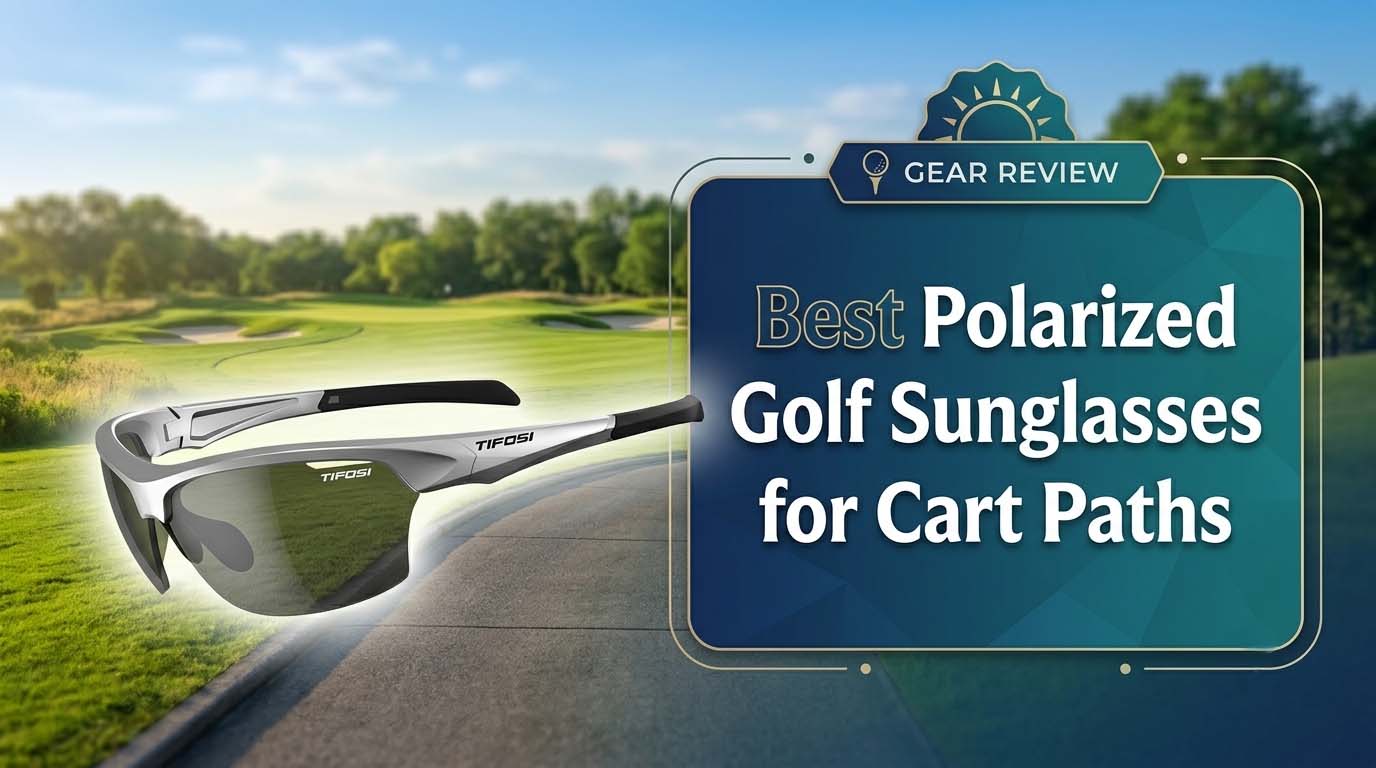
1. Tifosi Intense Sport Sunglasses — Best Overall for Cart Path Golf
Key Specs:
- Frame material: Grilamid TR-90 (durable, flexible)
- Lens material: Polycarbonate (shatterproof, scratch-resistant)
- Weight: 23 grams
- Ventilation: Yes, vented lenses
- Nose pads: Hydrophilic rubber (grips more when sweaty)
- Fit technology: Glide technology for anti-bounce
I’ll be honest — I didn’t expect much from a pair at this price point. But the Tifosi Intense surprised me on the first round. The first thing I noticed was the weight. Or rather, the lack of it. At 23 grams, you forget you’re wearing them. That matters when you’re going from the cart to the tee box to the green and back again for 18 holes.
The vented lenses are the real star here. I’ve had cheap polarized glasses fog up the moment I step out of an air-conditioned car. These don’t. The vents let air circulate, and I never had to wipe them mid-round. That alone makes them worth considering for cart path use, where you’re constantly moving between hot and cool environments.
But the feature that sold me was the nose pads. They’re made of a hydrophilic rubber that actually grips harder when you sweat. By the back nine, when my face was glistening, the glasses stayed put. No sliding down my nose. No pushing them back up after every shot. They just stayed where I put them.
The Glide technology is a nice bonus. It’s designed to prevent bounce when you look down, which is exactly what you do when you’re lining up a putt or checking your stance. The frames are flexible too — Grilamid TR-90 bends without breaking, so if you sit on them or drop them on the cart path, they’re more likely to survive.
Is there a downside? The frame is a general sport design, not golf-specific. That means the look is more athletic than classic. If you want a traditional aviator or wayfarer style, this isn’t it. But for function, this is the pair I reach for every time I head to the course.
Who it’s for: The golfer who wants one reliable pair that handles glare, sweat, fog, and all-day comfort without spending a fortune. If you ride a cart on paved paths and play in the middle of the day, this is the one.
Who it’s not for: If you prefer a classic fashion look or need a non-polarized lens for tour-level green reading, look elsewhere.
2. Fanshen Square Polarized 3-Pack — Best Budget Option for Cart Paths
Key Specs:
- Frame material: Lightweight plastic
- Lens material: TAC polarized
- Weight: Not specified (feels heavier than the Tifosi)
- Ventilation: No
- Nose pads: Soft nose pads
- Includes: 3 pairs, soft pouch
Let me be upfront. The Fanshen 3-pack is not the same quality as the Tifosi. The frame is heavier plastic, the lenses are standard TAC instead of polycarbonate, and there’s no ventilation. But for the price, you get three pairs of polarized sunglasses that actually work.
The polarization is effective. I tested them on a bright afternoon with long stretches of cart path, and they cut the glare just fine. The TAC lenses do the job for casual use. The fit is comfortable enough, with soft nose pads and spring hinges that keep the pressure off your temples.
Where they fall short is the details. The lack of ventilation means they fog up if you’re moving between temperature zones. I had to wipe them a few times during the round. The heavier frame also means they bounce more when you look down. It’s not a dealbreaker, but it’s noticeable compared to the Tifosi.
So why would you choose these? Three reasons. First, you get three pairs. You can keep one in your cart bag, one in your car, and one as a backup. You’ll never be caught without sunglasses. Second, the price is low enough that you don’t worry about losing or scratching them. Leave them in the cart, toss them in the bottom of your bag, hand a pair to a friend — it doesn’t matter. Third, the polarization is genuine. For the cost of a single round of golf, you get three pairs of functional sunglasses.
Who it’s for: The casual golfer who wants a no-worry solution. The person who loses sunglasses regularly. The golfer who wants to stash a pair in every bag and never think about it again.
Who it’s not for: If you play in high humidity, sweat a lot, or need maximum durability and anti-fog performance, spend a bit more on a single quality pair.
Head-to-Head: Tifosi Intense vs. Fanshen 3-Pack
| Feature | Tifosi Intense | Fanshen 3-Pack |
|---|---|---|
| Weight | 23g (ultra-light) | Heavier, not specified |
| Lens Material | Polycarbonate (shatterproof) | TAC (standard) |
| Ventilation | Yes, anti-fog vents | No |
| Grip | Hydrophilic nose pads | Soft nose pads |
| Frame | Grilamid TR-90 (durable) | General plastic |
| Best For | Active, all-day wear | Budget, backup, sharing |
Which One Goes in Your Cart Bag?
If I had to pick one pair to recommend for the golfer who plays on courses with cart paths and wants a single reliable solution, it’s the Tifosi Intense. The weight, the grip, the ventilation — everything about it is designed for active use. It handles the specific pain point of cart path glare without introducing new problems. You don’t have to think about it. You just put them on and play.
The Fanshen 3-pack is the right call for a different kind of golfer. If you lose sunglasses, scratch them, or just want to have a pair in every bag without caring about the cost, this is a smart buy. The polarization works, and the three-pack means you’re always covered. Just know that you’re trading durability and anti-fog performance for that value.
Either way, the key takeaway is this: don’t let the putting myth stop you from trying polarized. For the cart path golfer, the comfort of a glare-free round is real. The fear of losing the ability to read greens is mostly theoretical. Try a pair. You’ll probably wonder why you waited so long.
Frequently Asked Questions
Will polarized sunglasses affect my putting?
For most amateur golfers, the effect is negligible. Polarized lenses can reduce the subtle sheen on greens that helps read grain, but unless you’re playing at a high competitive level, the benefit of reduced glare and eye fatigue far outweighs any minor loss of green-reading nuance. I’ve used polarized for dozens of rounds and never felt like my putting suffered.
Can I wear polarized sunglasses on the golf course if I ride a cart?
Absolutely. In fact, cart path glare is one of the best use cases for polarized lenses. The constant reflected light from concrete and asphalt causes eye strain and headaches over 18 holes. Polarized lenses filter that glare and keep your eyes fresh throughout the round.
What color lens is best for golf?
Brown or copper lenses are best for golf because they enhance contrast against green grass, making it easier to read breaks and spot the ball in the air. Grey lenses are a good neutral option. Green lenses offer versatility. Avoid yellow or blue tints for general golf use.
Are cheap polarized sunglasses good enough for golf?
Yes, with caveats. Cheap polarized sunglasses like the Fanshen 3-pack effectively reduce glare, which is the main job. However, they may lack durability, ventilation, and grip features that make a difference over 18 holes. For casual use, they’re fine. For regular play, a mid-range pair like the Tifosi Intense offers a noticeably better experience.
How do I keep my sunglasses from fogging up on the course?
Look for vented lenses, which allow airflow to prevent fog buildup. The Tifosi Intense has this feature. If your sunglasses don’t have vents, try anti-fog wipes or sprays, and avoid moving quickly between air-conditioned spaces and humid outdoor air.