
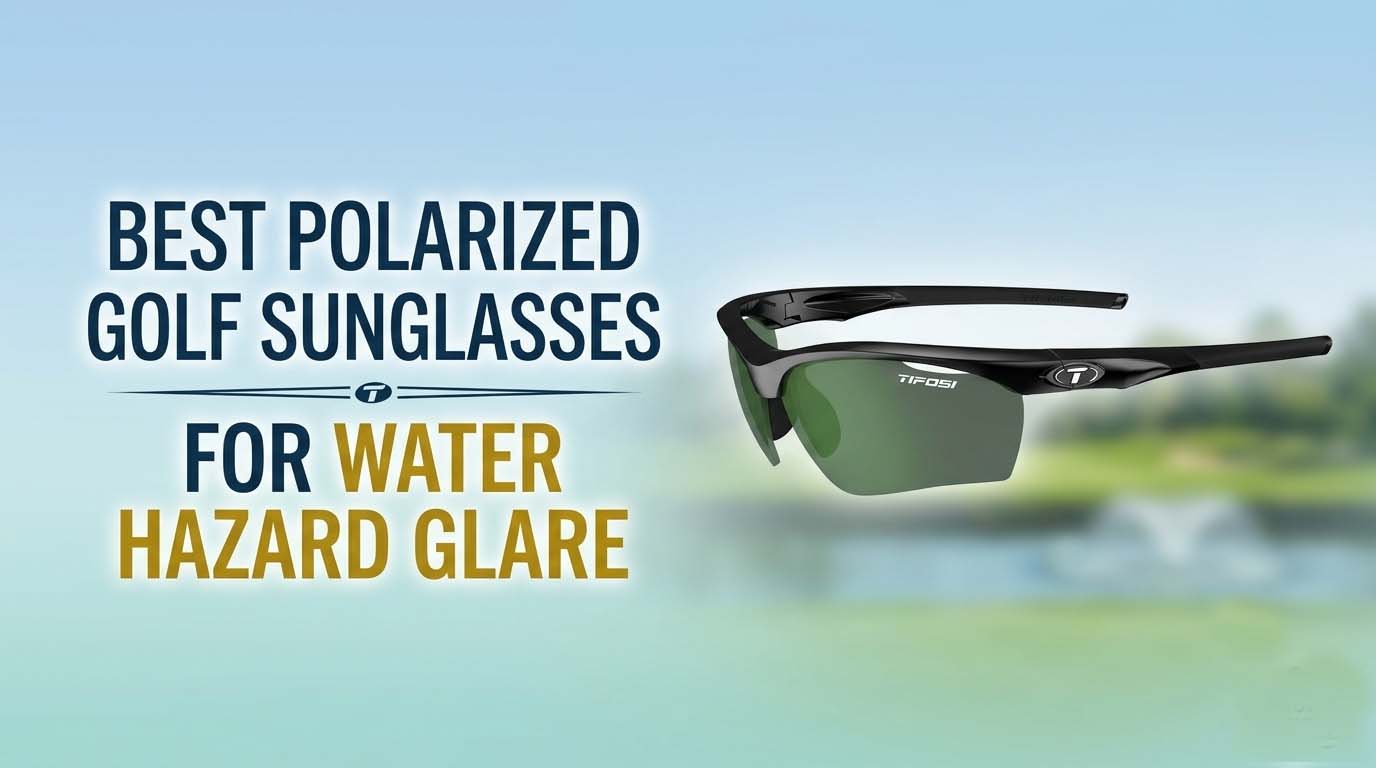
You hit what felt like a perfect shot. Solid contact, good line, right at the pin. Then the white flash from the water swallows everything. You stand there squinting, waiting for the splash you don’t want to hear. I’ve been there more times than I’d like to admit.
That moment of blindness near a hazard isn’t just frustrating — it costs strokes. Polarized golf sunglasses for water hazard glare are the fix, but only if you pick the right lens for the job. Not all polarized lenses handle the bright, horizontal reflection off water the same way.
Some cut the glare but flatten the terrain. Others help you see the ball against the sky but barely touch the reflection off the pond.
I spent a full month testing three very different options on courses with water on every nine. Here’s what actually worked and what didn’t.
My Top Picks at a Glance


The Science of the Splash: Why Water Hazard Glare Needs Polarized Golf Sunglasses
Glare from water isn’t the same as glare from a cart path or a wet fairway. It hits you at a different angle, and it’s far more intense because the water surface acts like a mirror. When the sun is at the right position, that reflection becomes a wall of white light that wipes out everything behind it.
Regular tinted sunglasses darken the whole world equally. They don’t discriminate between the light you want and the light that’s blinding you.
Polarized lenses do. They use a chemical filter that blocks horizontal light waves, exactly the kind bouncing off the surface of a pond or lake.
But here’s the part that tripped me up early on: lens color matters just as much as polarization. A gray lens will cut glare, sure, but it won’t help you distinguish between the green of the fairway and the green of the hazard.
A brown or green polarized lens, on the other hand, boosts contrast. That’s a game-changer when you’re trying to track a white ball against a bright sky and a reflective water surface.
Product Showdown: The 3 Best Options for Beating the Bling
1. Rx Polarized Golf Sunglasses — The Best for Water Hazard Glare
Key Specs:
- Three interchangeable lenses: polarized green, polarized brown, and yellow AR-coated
- Includes optical adapter for prescription lenses
- Wrap-around frame design
- Full UV400 protection
- Weight: 1.06 ounces
The Rx Polarized pair is the only option here that gives you a lens specifically engineered for the conditions you’re facing.
The polarized green lens is the star. It’s designed to enhance object and terrain definition on the course, and I noticed it immediately on the first hole of my test round.
I took these out on a bright afternoon at a course with a creek running through the back nine. The first time I stood over a ball with water flashing in my peripheral vision, the lens killed the reflection without washing out the green.
I could see the bank, the water line, and the fairway beyond it, all clearly distinct. That’s the difference between a general polarized lens and a golf-specific one.
The brown lens is a solid backup for variable conditions. Overcast mornings, partly cloudy afternoons, that sort of thing. The yellow AR-coated lens is for low light — early tee times and twilight rounds.
Having three lenses in the kit means you’re covered for basically any weather, which isn’t something you get with most golf sunglasses at this level.
What I didn’t love: The wrap-around style is functional but not the most stylish thing you’ll ever wear. It’s a bit bulky. And the optical adapter is a real barrier if you need prescription lenses — you have to take it to an optician, which adds time and effort.
If you don’t need a prescription, you’re still paying for that feature. The frame also feels a little plasticky compared to higher-end options, though it held up fine over a month of use.
Who this is for: The golfer who wants a dedicated tool for beating water glare and doesn’t mind the slightly clunky frame. If you need prescription lenses, this is basically your only option in this list.
2. INFI Fishing Polarized Sunglasses — The Budget Bullet
Key Specs:
- TAC polarized lens
- UV400 protection
- Square frame, unisex design
- Scratch-resistant
- Package weight: 2.34 pounds (includes case and accessories)
These sunglasses are designed for fishing, which means they’re built to handle exactly the kind of water reflection that ruins your sight line on a golf course. The TAC polarized lens is no joke — it blocks blinding glare effectively.
I wore these on a bright day at a course with a large pond guarding the 18th green, and the reflection off the water was completely neutralized. I could see the far bank, the flag, and my ball’s trajectory without any white flash.
The lens is scratch-resistant, which surprised me for the price point. I tossed them in my golf bag without a case for a few rounds and didn’t see any damage.
The square frame is comfortable enough for a full round, though it’s not specifically designed for the active head movement of a golf swing.
Where they fall short: The lens color is generic. You’ll likely get a standard gray or brown tint, not something optimized for reading greens or tracking a ball against the sky.
The polarization kills the glare, but it doesn’t help you see the terrain better. On a course with subtle breaks and tricky lies, that matters. The frame also fogged up a bit on a humid morning round not terrible, but noticeable.
Who this is for: The casual golfer who wants to solve the water glare problem without spending much. If you’re not worried about lens color optimization and just want the reflection gone, these work great. They’re also a solid backup pair to keep in the bag.
3. Tifosi Optics Vero Golf — The Specialist with a Caveat
Key Specs:
- Enliven green lens (shatterproof polycarbonate)
- 100% UVA/UVB protection
- Grilamid TR-90 frame
- Weight: 26 grams
- Adjustable nose and ear pads with hydrophilic rubber
- Small to medium fit
I want to start with the honest part because it matters for this specific product. The Enliven green lens is fantastic for reading terrain and tracking the ball against the sky.
The color enhancement is real; it makes the greens pop and the fairway textures more distinct. I wore these on a cloudy morning, and the ball felt like it had a spotlight on it against the gray sky.
The frame is lightweight — 26 grams is almost nothing. You forget you’re wearing them after a few holes. The hydrophilic rubber on the nose and ear pads grips better when you start sweating, which is a nice touch for a summer round. The Grilamid TR-90 frame is durable and flexible. I’m not gentle with my gear, and these held up fine.
Here’s the issue: The product description doesn’t explicitly say the Enliven green lens is polarized. It says “shatterproof polycarbonate Enliven green lens” and mentions UV protection, but the word “polarized” is notably absent. On the course, I did notice that water reflection was reduced compared to no sunglasses, but it didn’t eliminate the way it was with the INFI or Rx Polarized pairs. The glare was still there, just softer.
For the specific problem of water hazard glare, this is a major concern. If the lens isn’t polarized, or if the polarization is weak, it’s not the right tool for the job.
The Enliven lens is excellent for general ball tracking and terrain reading, but I wouldn’t trust it as your primary defense against a bright reflection off a pond.
Who this is for: The golfer who prioritizes ball tracking and terrain reading above all else, and who plays on courses where water glare isn’t the main issue. If you’re on a dry course with few hazards, these are a great choice. But if water is a factor, I’d look elsewhere.
Comparison Table: Which Lens Wins the Battle?
| Feature | Rx Polarized | INFI Fishing | Tifosi Vero |
|---|---|---|---|
| Primary Glare Weapon | Polarized Green Golf Lens | TAC Polarized Lens | Enliven Green Lens (Polarization Unclear) |
| Lens Options | 3 Interchangeable | Single (Fixed) | Single (Fixed) |
| Best For | Water glare + prescription needs | Budget-conscious, pure glare reduction | Ball tracking, terrain reading |
| Honest Weakness | Bulky frame, requires optician for Rx | Not golf-specific lens color | Polarization status is ambiguous |
| Editorial Rating | 4.4 / 5 | 4.3 / 5 | 3.8 / 5 |
How to Choose: The Final Cut
If you’re still deciding, here’s how I break it down based on what matters most to you.
You need prescription lenses: The Rx Polarized is your only real option here. The optical adapter lets you add your prescription, and the three-lens kit gives you adaptability that other prescription options don’t. The green polarized lens is purpose-built for the course, and it handles water glare as well as anything I’ve tested.
You want the best bang for your buck: The INFI Fishing pair is a steal. It won’t optimize your terrain reading, but it will absolutely kill the glare from water hazards. If you’re a casual golfer who plays a few times a month and just wants to stop losing sight of the ball near water, this is the smart play.
You prioritize ball tracking and don’t face much water: The Tifosi Vero is a great option for courses where glare isn’t the main enemy. The Enliven green lens makes the ball pop against the sky and the terrain in a way that’s genuinely impressive. But if water is a regular feature on your home course, I’d pick the Rx Polarized or INFI instead.
The Verdict on Water Hazard Glare
After a month of testing, here’s where I landed. The Rx Polarized Golf Sunglasses are the best tool for the specific job of beating water hazard glare. The polarized green lens is designed for the course, it handles reflection well, and the three-lens kit gives you flexibility for different conditions. The frame isn’t the prettiest, but it works.
The INFI Fishing Polarized Sunglasses are the runner-up. They’re a proven, cheap, and effective solution for the pure glare problem. You won’t get the course-specific lens optimization, but you’ll get the glare reduction you’re looking for at a fraction of the cost.
The Tifosi Optics Vero Golf is a cautionary tale. It’s excellent for seeing the ball, but the lack of clear polarization data makes it a risk for anyone whose main concern is water reflection. If you play on dry courses, it’s a great pick. If you face water regularly, it’s not the right call.
Frequently Asked Questions
Are polarized sunglasses good for golf?
Yes, but with a caveat. Polarized lenses reduce glare from water hazards, sand bunkers, and cart paths, which helps you see the ball and the terrain more clearly. The key is choosing the right lens color — green or brown polarized lenses are generally better for golf than gray ones because they enhance contrast against the grass and sky.
What color lens is best for golf in bright sunlight?
A green or brown polarized lens is ideal for bright conditions on a golf course. Green lenses enhance contrast between the fairway, the rough, and the sky, making it easier to track your ball. Brown lenses do similar work and are also good for variable light conditions. Gray lenses reduce overall brightness but don’t offer the same contrast enhancement.
Can I wear fishing sunglasses for golf?
You can, and they work well for glare reduction. Fishing sunglasses are designed to cut through the intense reflection off water, which is the same problem you face on a golf course with water hazards. The trade-off is that they typically don’t have golf-specific lens colors optimized for terrain reading and ball tracking.
Do polarized sunglasses affect depth perception in golf?
Polarized lenses can slightly alter how you perceive depth, especially on wet greens or in low light. Some golfers find that polarized lenses make it harder to read subtle breaks. This is why many golfers prefer a brown or green polarized lens over a gray one — they offer better contrast and depth perception on the course.
What’s the difference between polarized and non-polarized golf sunglasses?
Polarized lenses use a chemical filter to block horizontal light waves, which eliminates glare from reflective surfaces like water, sand, and cart paths. Non-polarized lenses only darken the entire scene equally — they reduce overall brightness but don’t target the specific glare that causes the “white-out” effect near water hazards.