
How Golf and Fishing Sunglasses Differ in Their Core Visual Priority
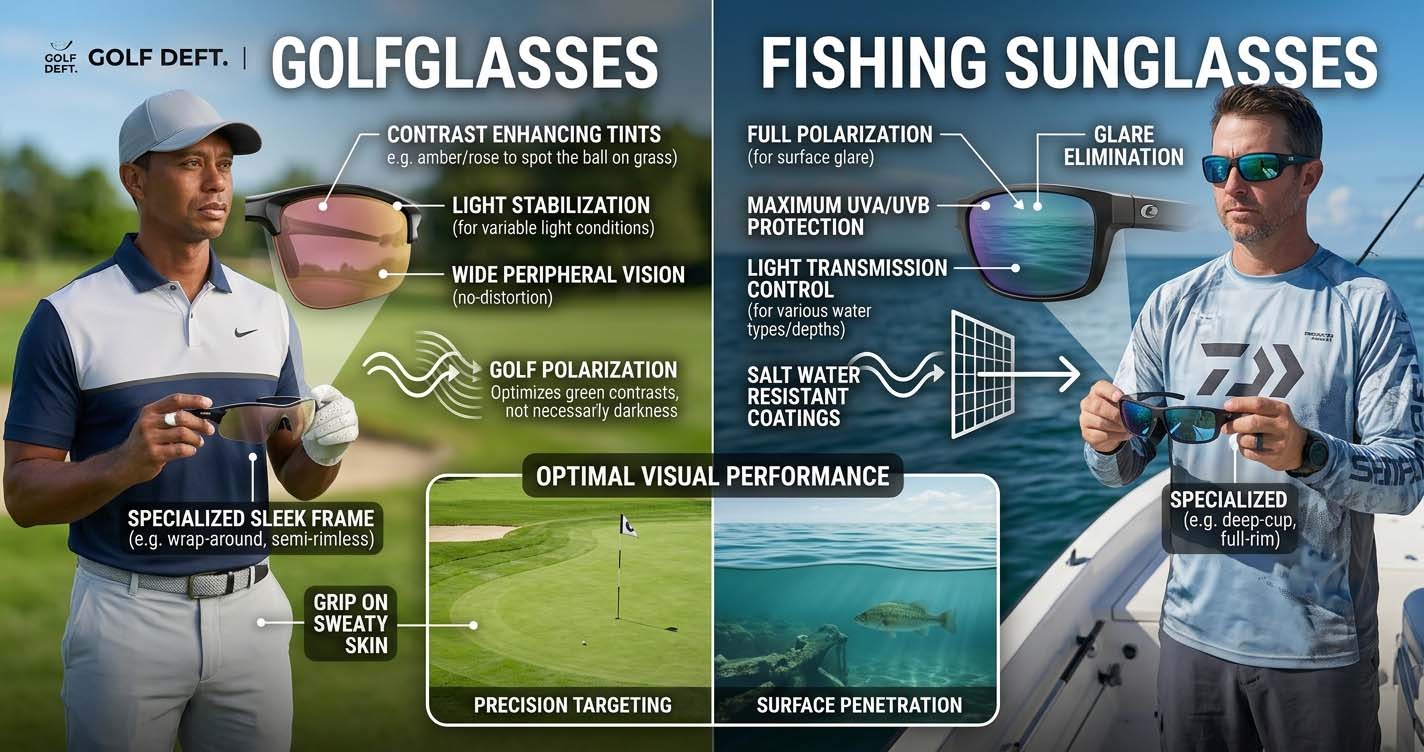
Every sport has one visual demand that matters more than any other. For golf, it is reading the land. For fishing, it is seeing into the water. That difference drives everything else about the lens.
Golf sunglasses use a rose or copper tint. That color boosts the contrast between shades of green. It helps you see the grain on a putting green, the subtle break that tells you where the ball will roll. A good golf lens makes shadows pop so you can judge the depth of a bunker or the slope of a fairway.
Fishing sunglasses use a copper or grey tint with strong polarization. The goal is to cut through the glare on top of the water so you can see what is underneath.
A bass hiding near a log, a rock shelf you do not want to hit with your propeller, the bottom contour that tells you where to cast. Without that underwater view, you are fishing blind.
Think of it this way. Golf lenses are tuned to see the land. Fishing lenses are tuned to see through the water. One pair cannot do both jobs perfectly.
Why Polarization Matters More for Fishing Than Golf?
Polarization cuts horizontal glare. On the water, that glare is everywhere. It bounces off the surface and blocks your view of everything below. A polarized fishing lens eliminates that reflection. You see the fish and the structure, not the sun bouncing back at you.
On a golf course, strong polarization can work against you. It flattens out the subtle undulations in the green. It washes out the shadows that tell you how deep a bunker is or how much the fairway slopes.
Many of the best golf lenses, like the ProGolf Rose from PROGEAR, use partial polarization or no polarization at all. They keep those depth cues intact.
I have watched a golfer put on a heavy polarized fishing lens and then three-putt four times in a row because he could no longer read the breaks. That is not a bad lens. It is the wrong lens for the job.
If you fish competitively, you need full polarization. If you golf competitively, you need to be careful about how much polarization you use. A copper polarized lens with a lighter tint can work for both at a recreational level, but it is a compromise either way.
Lens Tint and Light Transmission – A Side-by-Side for Typical Conditions
Visible Light Transmission, or VLT, is the percentage of light that reaches your eye. A lower number means a darker lens. Here is how it plays out in real conditions.
Bright sunny day on the course. You want a VLT between 15 and 25 percent with a rose tint. The PROGEAR ProGolf Dark Rose delivers 19 percent VLT. That is dark enough for a bright day, but still lets enough light through to read the greens. The rose tint sharpens the contrast between the fairway and the rough.
Overcast morning on the lake. You need a lighter lens with a VLT between 30 and 50 percent. An amber or copper tint works best because it boosts contrast in low light. A grey tint would make everything look flat and grey. You lose the ability to spot fish in the murky water.
Hazy afternoon with high glare for either sport. This is the hardest condition to cover. A copper polarized lens with a flash mirror coating comes closest to working for both. The copper tint gives you some contrast on the grass. The polarization cuts the glare on the water. The mirror coating reduces overall brightness. It will not be perfect for either sport, but it will be usable for both.
Here is a quick comparison of how the two sports stack up.
| Condition | Golf Lens | Fishing Lens |
|---|---|---|
| Bright sun | Rose, 15-25% VLT | Grey or copper, 12-18% VLT |
| Overcast | Copper, 30-40% VLT | Amber, 30-50% VLT |
| High glare | Polarized copper, 20-30% VLT | Polarized grey, 15-20% VLT |
Frame Fit and Stability – From Tee Shot to Casting Retrieve
Lenses matter, but the frame is what keeps them on your face. A bad fit ruins the experience, no matter how good the optics are.
Swing Stability
Golf requires a frame that stays put during a full rotation. When you swing a driver, your head turns and your body twists. A loose frame slides down your nose or shifts sideways. That distraction can throw off your timing. Look for wrap frames with rubberized temples that grip your head.
PROGEAR calls this SecureGrip technology. It uses a textured rubber pad on the inside of the temple arm to lock the frame in place. I have worn these through a full eighteen holes without having to push them back up once.
Water Resistance and Venting
Fishing involves splashes, sweat, and sudden temperature changes. A cold drink in a hot boat fogs up your lenses in seconds. Look for frames with vented designs that let air circulate.
Hydrophobic coatings on the lens help water bead up and roll off instead of sitting on the surface. Some fishing frames even float. That is a nice safety net if you drop them over the side.
Helmet and Hat Compatibility
Fishermen wear brimmed hats to block the sun from above. The frame temples need to be low-profile so they do not dig into the hat band. Golfers wear visors or caps. The same issue applies.
A thick temple arm creates a pressure point that hurts after a few hours. Thin, flexible temples made from TR90 material solve this problem. They are lightweight and bend slightly to conform to your head.
Weight and Long Wear
A fishing trip lasts all day. A golf round lasts about four hours. In both cases, weight matters. Heavy frames cause fatigue and leave red marks on your nose. Look for TR90 or titanium frames. They are strong but light. The PROGEAR U-1507 weighs less than an ounce. You forget you are wearing them after a few minutes.
Prescription Lenses and Special Needs in Both Sports
If you wear prescription glasses, you already know the struggle. Most opticians will not make wrap lenses for strong prescriptions because the curve distorts the vision. That is frustrating when both golf and fishing demand a secure wrap fit.
For golf, bifocal or progressive lenses can cause problems. The lower portion of the lens is where the reading zone lives. When you look down at your golf ball, you might look through that zone instead of the distance zone.
That blurs the ball and confuses your swing. One customer review on the PROGEAR site mentioned this exact issue. The company remade the glasses as single-vision distance lenses, and the problem went away.
For fishing, progressive lenses work better. You look at the water in the distance through the upper portion. You glance down at your tackle or your rod tip through the middle. The reading zone at the bottom is rarely in use. That makes progressives a natural fit for anglers.
High-index materials are worth the extra cost for both sports. They make the lens thinner and lighter, which reduces distortion at the edges. The PROGEAR ProGolf lenses use MR-7 and MR-8 polymer materials that are forty percent thinner than standard polycarbonate. They also have a higher Abbe value, which means sharper and clearer vision.
If you have a strong prescription over plus or minus six, ask about base curve. A curve of six or less keeps distortion manageable. Anything higher and you will feel like you are looking through a fishbowl.
One Pair for Both – When a Compromise Works and When It Does Not
The question everyone wants answered. Can you buy one pair of sunglasses for both golf and fishing?
Yes, but only if you play both sports at a recreational level. A copper-polarized lens in a medium wrap frame gives you decent performance on the course and on the water. You lose some contrast on the grass because the copper tint is not as specialized as rose.
You lose some underwater visibility because the polarization is not as strong as that of a dedicated fishing lens. But you gain the convenience of one pair that works for both.
The PROGEAR U-1507 with a copper polarized lens is a good example. It has SecureGrip temples for swing stability.
It accepts prescription lenses. It is lightweight enough for all-day wear. It will not win you a tournament or help you catch the biggest fish of the day, but it will get the job done for a weekend round or a casual afternoon on the lake.
If you compete in either sport, do not compromise. A competitive golfer needs a dedicated golf lens like the ProGolf Dark Rose. A serious angler needs a polarized fishing lens with a grey or copper tint. The difference between winning and losing can come down to seeing one extra detail that the wrong lens hides.
Here is the bottom line. If you play both sports less than once a month, get the versatile pair. If you play either sport more than that, get the dedicated pair.
How to Match Your Environment – A Quick Selection Guide?
Not every golf course or fishing spot looks the same. Your local conditions change what lens works best.
Do I need blue-blocking for dawn or dusk fishing? Yes. Blue light scatters more in low light. Blocking it improves contrast when the sun is low on the horizon. Look for an amber or yellow tint with blue-blocking coating.
Will a bronze lens work for wooded golf courses? Yes. Bronze is similar to copper. It boosts contrast in shaded areas where the light is filtered through trees. It works better than rose in those conditions because it does not oversaturate the green.
Are mirrored coatings more useful for fishing or golf? Fishing. A mirror reflects light away from the lens. That helps on open water where the sun bounces off every surface. On a golf course, a mirror coating can create reflections that distract you during your swing. Use it sparingly for golf.
What about photochromic lenses for both sports? They work well if you move between sun and shade frequently. A golfer walking from a bright fairway into a wooded area benefits from a lens that lightens automatically. The same goes for a fisherman moving from open water to a shaded bank. The trade-off is that photochromic lenses do not get as dark as fixed-tint lenses. They are a middle ground that works for many people.
Frequently Asked Questions
Can I use my fishing sunglasses for golf on a cloudy day?
Yes, but only if they have a lighter tint with a VLT above 30 percent and a copper or rose color. Strongly polarized fishing lenses with a grey tint will flatten the terrain and make it hard to read the greens.
What is the best lens material for impact protection on the golf course?
Polycarbonate or Trivex. Both are shatter-resistant and lightweight. Glass offers better optical clarity but is heavier and can break on impact if you take a club to the face.
How do I know if a wrap frame will distort my peripheral vision?
Look for a base curve of six or less. A semi-wrap style works best if you have a high prescription. Some brands like PROGEAR offer a no-distortion guarantee for wrap lenses, which means they use advanced technology to keep the image clear across the lens.
Are there sunglasses that float?
Yes. Some fishing-specific models use acetate or foam-core temples that keep the glasses on the surface if they fall in the water. Golf sunglasses rarely float, but many come with a removable strap or retainer that prevents loss.
My optician says he cannot make wrap sunglasses with my prescription. Is that true?
Not anymore. Most online retailers can handle prescriptions up to plus or minus six in high-index materials. The key is a proper pupillary distance measurement and an optician review. A company like E-Optician has a real optician check every order before it goes to production. That catches issues before the lenses are made.