
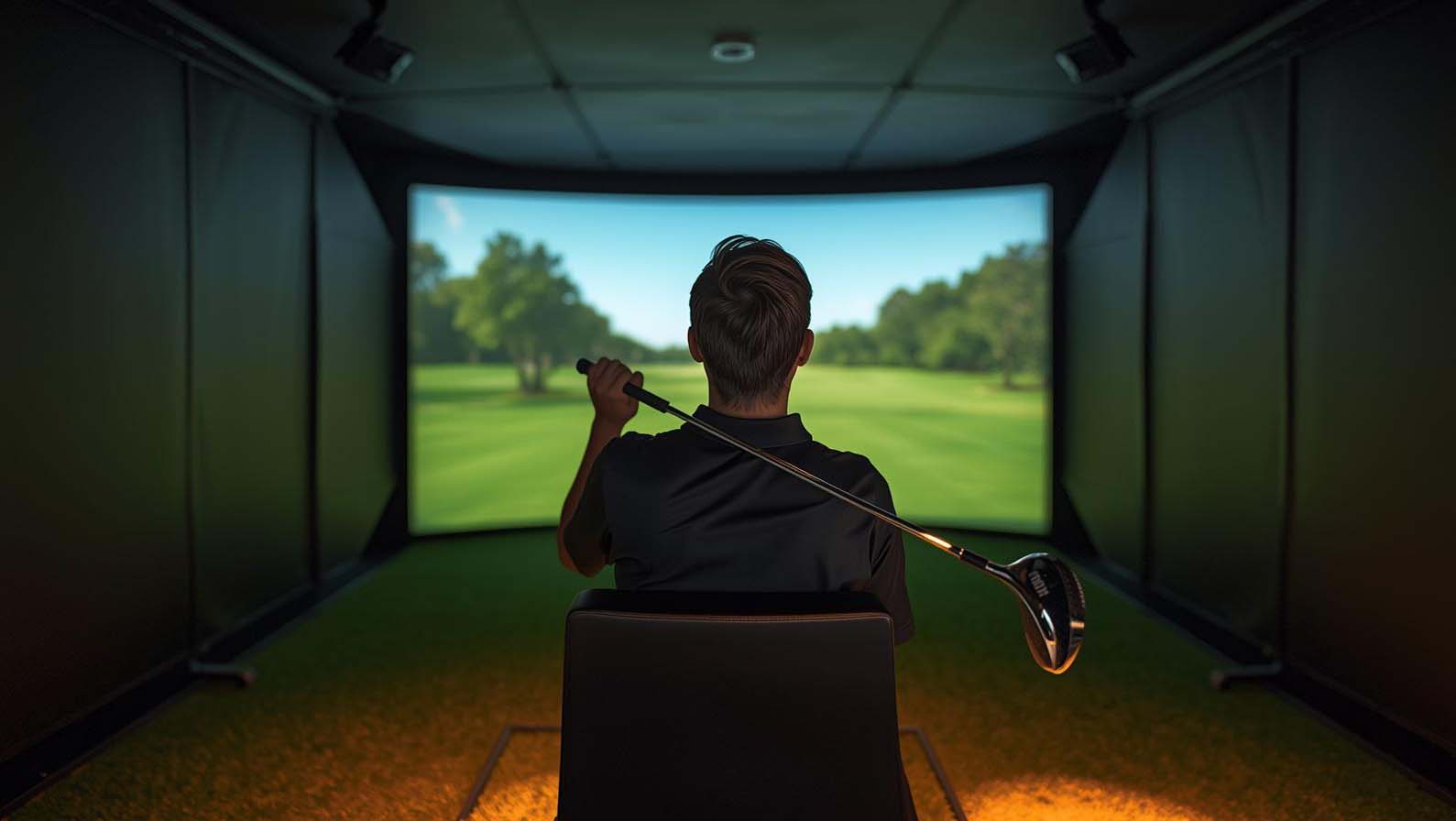
Ceiling height matters because it affects more than just whether your club will hit the roof. It changes how freely you swing, how confident you feel, what launch monitor you can use, where you can mount a projector, and how easy it is to build an enclosure that feels clean and safe.
So, before you buy anything, it helps to know the real number you need and the tradeoffs that come with each option.
In this guide, we’ll break down the best ceiling height for a golf simulator, show you what works at 8 feet, 9 feet, 10 feet, and beyond, and explain how room shape, golfer height, and launch monitor type all come into play. We’ll also cover projector mounting options for very high ceilings, because that is one area where many builds get tricky.
Quick Answer: What Ceiling Height Do You Need for a Golf Simulator?
Here is the simple version:
- 8 feet: generally too low for full swings
- 8.5 feet: borderline, only workable for some golfers
- 9 feet: workable for many home simulator setups
- 10 feet: ideal sweet spot for most golfers
- 12+ feet: excellent, especially for premium rooms and tall players
The key thing to remember is that the highest point of your swing matters more than your height alone. Most golfers need about 6 to 12 inches of clearance above the top of their swing arc so they can swing naturally without feeling cramped.
Why Ceiling Height Matters in a Golf Simulator
Ceiling height is not just a comfort issue. It affects the entire quality of your simulator experience. First, it helps keep your swing safe. If the ceiling is too low, you may worry about hitting it, and that fear alone can change your motion. As a result, you may shorten your swing, flatten your plane, or tense up through impact.
Second, a higher ceiling helps you practice more like you play. When you can swing freely, you get better feedback from your launch monitor and a more realistic feel for driver, iron, and wedge shots. In other words, the room stops forcing you to compensate.
Third, ceiling height affects equipment placement. Projectors, enclosures, lights, and even overhead launch monitors all depend on how much vertical space you have. So, while a room may technically fit a simulator, it still may not be the best environment unless the ceiling height works with the rest of the build.
Ideal Golf Simulator Ceiling Height by Use Case
8 feet ceiling
An 8-feet ceiling is usually too low for most golfers who want to take full swings. You may still be able to use the room for putting, chipping, or very limited practice, but driver swings will often feel restricted. If you’re asking how high does ceiling need to be for golf simulator use with full swings, 8 feet is generally below the comfort zone.
8.5 feet ceiling
An 8.5-feet ceiling can work in certain cases, but it is still a tight fit. Shorter golfers with compact swings may be able to use irons and wedges without much trouble. However, if you are tall, have a steeper swing, or want to hit driver comfortably, this height is still risky. It can be done, but only if you understand the limits.
9 feet ceiling
Nine feet is often the minimum workable range for a home golf simulator. Many golfers can make it work, especially in garages or basements where the rest of the room dimensions are solid. Still, it may feel tight for taller players, and you will want to measure your swing carefully before committing. If you’re wondering how tall of ceilings do I need for golf simulator use in a practical home setting, 9 feet is often the lower end of the answer.
10 feet ceiling
Ten feet is the best all-around choice. It gives most golfers enough room to swing confidently, works well for driver swings, and leaves more flexibility for enclosure height, projector placement, and lighting. If you want a ceiling height that simply makes life easier, 10 feet is the number to aim for.
12 feet or more
With 12 feet or more, you are in premium territory. This is excellent for taller golfers, group use, and more professional-looking installations. You gain much more freedom with swing room and mounting options. However, very high ceilings also mean you need to think harder about projector throw, cable runs, brightness, and mount height.
How Tall of a Ceiling Do I Need Based on My Height and Swing?
Shorter golfers
If you are shorter and have a more compact swing, you may be able to use a 9-foot ceiling or even, in limited cases, 8.5 feet. That said, the swing path still matters more than standing height. A shorter golfer with a steep swing can need just as much vertical room as a taller golfer with a smoother motion.
Average-height golfers
For most average-height golfers, 9 to 10 feet is the sweet spot. Nine feet can be enough, but 10 feet is noticeably better. It gives you room to swing without fear and makes the setup feel less like a compromise.
Tall golfers
If you are tall, 10 feet is often the minimum recommendation, and 11 to 12 feet is even better. Taller players tend to have a higher top of swing, and even a small ceiling buffer can make a big difference in comfort. If you regularly play with taller friends or family, the extra height becomes even more valuable.
Steep vs. flat swing plane
A steeper swing plane usually needs more vertical room, while a flatter swing can sometimes work in tighter spaces. That said, you should never force a flatter swing just to fit the room. A simulator should support your natural motion, not change it.
Driver vs. irons
Driver swings almost always need more room than wedge or iron swings. If you only plan to work on irons, a lower ceiling may be manageable. But if you want full bag practice, especially with driver, you should target 10 feet whenever possible.
Golf Simulator Ceiling Height by Room Type
Garage golf simulator ceiling height
Garages are one of the most common golf simulator spaces, and ceiling height is usually the first thing people check. In many garages, 9 to 10 feet is the goal. You also need to watch out for garage door tracks, openers, lights, and anything hanging down from the ceiling. In fact, a garage that looks tall enough at first glance can still be too cramped once you account for those obstacles.
Basement golf simulator ceiling height
Basements can be great simulator spaces, but beams, ducts, pipes, and finished ceilings can reduce usable height fast. Even when the total ceiling is close to 9 or 10 feet, the lowest obstruction is what really matters. So, if your basement has a beam running through the hitting area, measure that spot carefully before buying anything.
Spare room or bonus room
A spare room or bonus room can make an excellent simulator space if the height is right. These rooms often give you a cleaner setup than a garage, and they may be easier to finish nicely. However, you still need enough wall length for the screen and enough depth for the launch monitor and the golfer’s position.
Dedicated simulator room
If you have a dedicated room with 10 feet or more of ceiling height, you are in a strong position. This gives you room to build a more polished setup with improved enclosure options, cleaner projector placement, and greater guest comfort.
Multi-use room or high-ceiling room
Very high-ceiling rooms are great for swing freedom, but they can be harder to design well. In those spaces, retractable enclosures, wall-mounted projectors, and hidden hardware often make the most sense. That way, the room still feels usable when the simulator is not in use.
How Much Clearance Above Your Swing Do You Need?
A good rule of thumb is to leave 6 to 12 inches of clearance above the highest point of your swing. This gives you enough room to swing naturally without worrying about ceiling contact. If you are uneasy about hitting the ceiling, that nervousness can affect your swing even if the room technically fits.
For the best results, measure your swing while wearing your normal golf shoes and using your actual stance width. Then check the top of your backswing and the highest point of your follow-through. Many golfers focus only on the backswing, but the follow-through can also surprise you.
How to Measure Your Room Correctly Before Buying a Golf Simulator
Ceiling height alone is not enough. You should measure the whole space before you make any purchase. Here is the simple way to do it:
- Measure the floor-to-ceiling height at the exact hitting area.
- Check for beams, garage door tracks, lights, ducts, or anything else that lowers clearance.
- Measure the width of the wall where your impact screen or enclosure will go.
- Measure the depth from the screen to the hitting position.
- Account for mat thickness, because that raises your stance a little.
- Estimate your highest swing point with a driver in hand.
- Add at least 6 to 12 inches of safety clearance above that point.
- Confirm projector throw distance and mount location before finalizing the layout.
When people ask how high a ceiling should be for a golf simulator, the real answer is that the room needs to work as a whole. A good build is about height, width, depth, and equipment placement all at once.
What Launch Monitor Type Works Best for Different Ceiling Heights?
Overhead launch monitors
Overhead systems can be excellent because they stay out of your hitting area. They are often found in premium simulator builds and training bays. Still, they need enough ceiling structure and installation space, so they usually make more sense in rooms with 10 feet or more of height.
Side-mounted camera systems
Side-mounted camera systems are usually more space-efficient. They work well in tighter rooms because they do not need overhead mounting. If your ceiling is on the lower side, this type of monitor is often a smart choice.
Radar-based systems
Radar systems are often more demanding in terms of room depth than ceiling height. If you have a long room but only average ceiling height, radar can still be a strong option. Just make sure the hitting area and ball flight space are sufficient.
All-in-one simulator units
All-in-one systems can reduce clutter and simplify setup, which is helpful when the room is tight or multi-use. They still need proper clearance for your swing, but they often cut down on extra hardware that would otherwise compete for space.
Projector Mounting Options for Golf Simulators with High Ceilings
This is where very high ceilings create a new kind of challenge. If your room has 18 or 20 feet of ceiling height, you may have plenty of swing room, but you still need a smart way to mount the projector. Dropping a long pole from the ceiling may work, but many people do not want that look. That is why wall mounts, shelf mounts, and boom arms are so popular.
Ceiling mount
A ceiling mount is the cleanest solution in many rooms. It keeps the projector centered and out of the way. However, when the ceiling is very high, you may need a long drop, which can look bulky and require secure installation.
Wall mount
Wall mounting is often the best answer for high ceilings. You can place the projector on a shelf or bracket behind the golfer or along a side wall, as long as the throw distance and angle work. This is a practical choice when you want to avoid long hanging hardware.
Shelf mount
A shelf mount is simple and budget-friendly. It can work well if the projector sits at the right height and still gives you the image size you need. Just be sure the shelf is solid and positioned so it does not create shadows.
Drop-down mount
A drop-down mount is useful when you need the projector lower than the ceiling but still want a fixed installation. It can be a clean compromise in rooms with high ceilings or sloped layouts.
Boom arm
A boom arm can swing the projector into position when you need it and tuck it away when you do not. This is a smart solution for shared spaces, and it matches the kind of real-world idea many golfers talk about when they are trying to keep the room looking neat.
Retractable or hidden projector setups
Retractable or hidden setups are ideal for multi-use rooms. They keep the space open when the simulator is off and help the room look less like a permanent golf build. If you care about aesthetics, this route can be a very good fit.
No matter which option you choose, make sure the projector image is large enough, bright enough, and properly aligned before you lock in the final mounting spot. Also, keep shadowing in mind. A projector behind or too low near the hitting area can cast shadows, especially if the golfer stands between the projector and the screen.
What If Your Ceiling Is Too Low for a Golf Simulator?
If your ceiling is too low, do not force a full swing just to make the room work. Instead, narrow the setup to what the space can safely handle. For example, you can focus on putting, chipping, or irons-only practice. That way, you still get useful reps without worrying about ceiling contact.
You can also make a few adjustments. A lower-profile mat can help slightly, and a compact swing may work better than a long, upright one. Choosing a side-mounted launch monitor instead of an overhead system may also simplify the build. In a tight room, these small choices matter.
Most importantly, do not let a simulator room force a bad swing habit. If the ceiling is too low for full swings, it is better to build around that limitation than to fight it every time you practice.
What If Your Ceiling Is Very High?
Very high ceilings are a blessing for swing comfort, but they also bring a few new challenges. The biggest one is projector placement. Once the ceiling gets much taller, ceiling mounts can become awkward, and cable routing can turn into a project of its own.
Lighting is another issue. With more vertical space, you may need better brightness and smarter fixture placement to keep the screen image clear. Acoustics can also change in a tall room, since sound has more space to bounce around.
The good news is that high ceilings give you flexibility. You can use wall mounts, boom arms, drop mounts, or retractable systems to keep the room functional and clean. If the room is truly large, you may even want to have a professional help with installation so the final setup looks polished and works the way it should.
Best Ceiling Height for a Golf Simulator: Final Recommendation
If you want the shortest possible answer, here it is: 10 feet is the best ceiling height for most golf simulator builds. It is high enough for full swings, comfortable enough for most golfers, and flexible enough for common enclosure and projector setups.
9 feet is often workable, especially in garages, basements, and tighter home rooms. 8.5 feet is borderline and usually only works for some golfers with compact swings. On the other hand, 12 feet or more is excellent if you have the space and want a more premium, open feel.
At the end of the day, the best ceiling height is the one that lets you swing naturally, safely, and confidently without changing your motion. If you can do that, your simulator room is on the right track.
FAQ
How high of a ceiling do you need for a golf simulator?
Most golfers should aim for 10 feet if possible. Nine feet can work for many setups, while 8.5 feet is only borderline usable for some players. The exact answer depends on your height, swing plane, and whether you want to hit driver comfortably.
How tall of ceilings do I need for a golf simulator?
For a comfortable home simulator, 9 to 10 feet is the most common recommendation. If you are tall or have a steeper swing, 10 feet or more is better. If your room is lower than 9 feet, you will likely need to limit the type of practice you do.
How high should a ceiling be for a golf simulator?
Ten feet is the ideal ceiling height for most golfers. It gives you enough clearance to swing freely and helps avoid the tension that comes with tighter spaces. If you cannot reach 10 feet, 9 feet may still be workable.
How high does a ceiling need to be for a golf simulator?
The ceiling needs to be high enough to give you about 6 to 12 inches of clearance above the top of your swing. For many golfers, that means 9 to 10 feet. For taller players or those with a more vertical swing, more height is better.
How high ceiling for indoor golf simulator?
For an indoor golf simulator, 10 feet is the best target. It provides a good mix of comfort, safety, and flexibility. If your room is only 9 feet high, you may still be able to make it work with the right setup.
Can I use a golf simulator with an 8-foot ceiling?
Usually, not for full swings. An 8-foot ceiling is generally too low for driver and can feel cramped even with irons. You may still be able to use the space for putting, chipping, or very limited practice.
Is 9 feet enough for a golf simulator?
Yes, 9 feet is enough for many golfers, especially in a carefully planned setup. However, it can still feel tight for taller players or anyone with a steep swing. Measuring your actual swing arc is the best way to know for sure.
Is 10 feet enough for a golf simulator?
Yes, 10 feet is the ideal sweet spot for most home golf simulator setups. It gives you the best balance of comfort, safety, and equipment flexibility.
Do high ceilings help with golf simulator setup?
Yes, high ceilings help a lot with swing freedom and comfort. They also make room for more flexible mounting options. However, very high ceilings can make projector placement, cable routing, and image sizing more complicated.
What is the safest clearance above my golf swing?
A good target is 6 to 12 inches above the highest point of your swing. That buffer helps you swing freely without worrying about brushing the ceiling or changing your motion.
Should I choose a wall mount or ceiling mount projector for a high ceiling room?
In many very high ceiling rooms, a wall mount or shelf mount is easier and cleaner than a long ceiling drop. The best choice depends on your throw distance, screen size, and how you want the room to look when the simulator is not in use.
If you are still deciding how high of ceiling for golf simulator use is right for your room, the safest move is to measure carefully and build around the highest point of your actual swing. That one step will save you a lot of trouble later and help you choose the right launch monitor, projector mount, and enclosure for your space.