
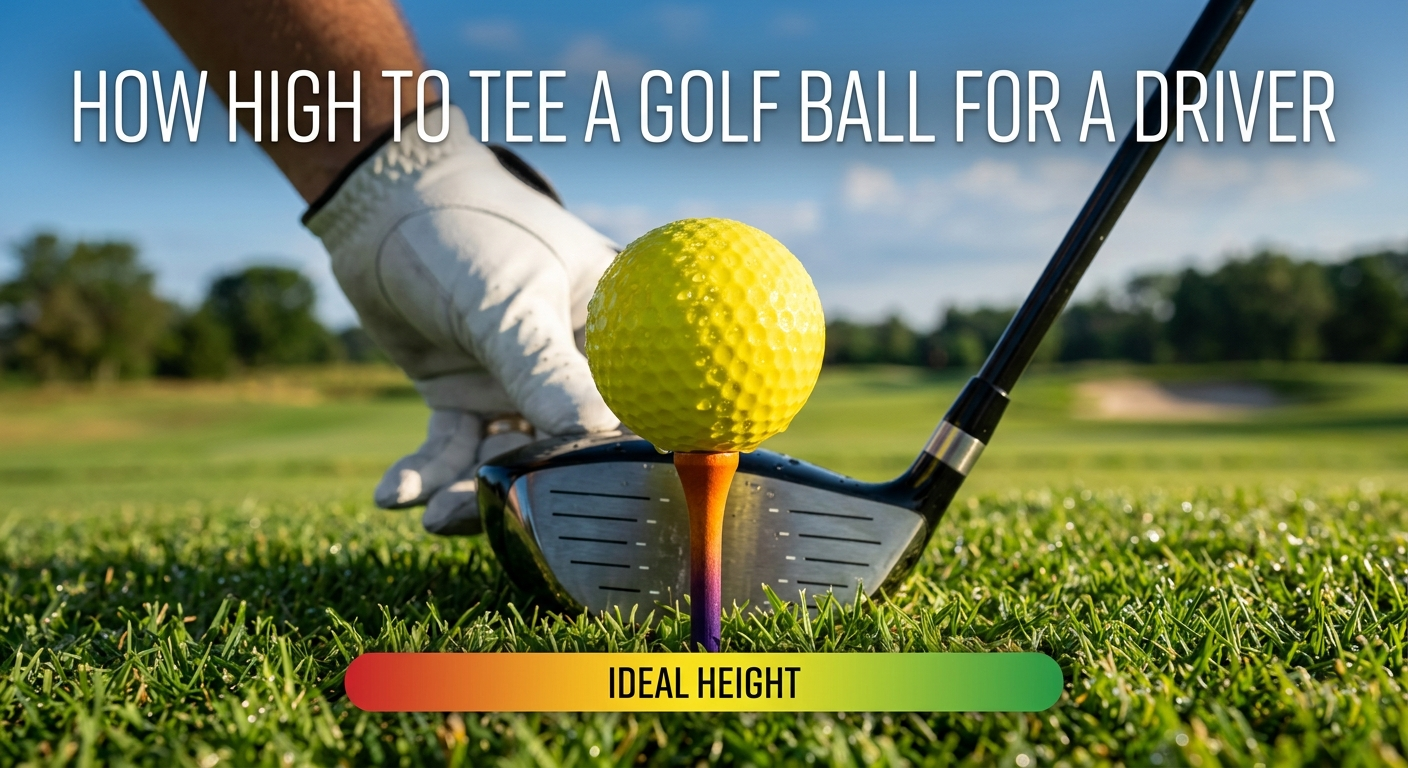
Every golfer wants more distance off the tee. You can buy a new driver, take lessons, or hit the gym. But there is one adjustment that costs nothing and takes five seconds: changing your tee height.
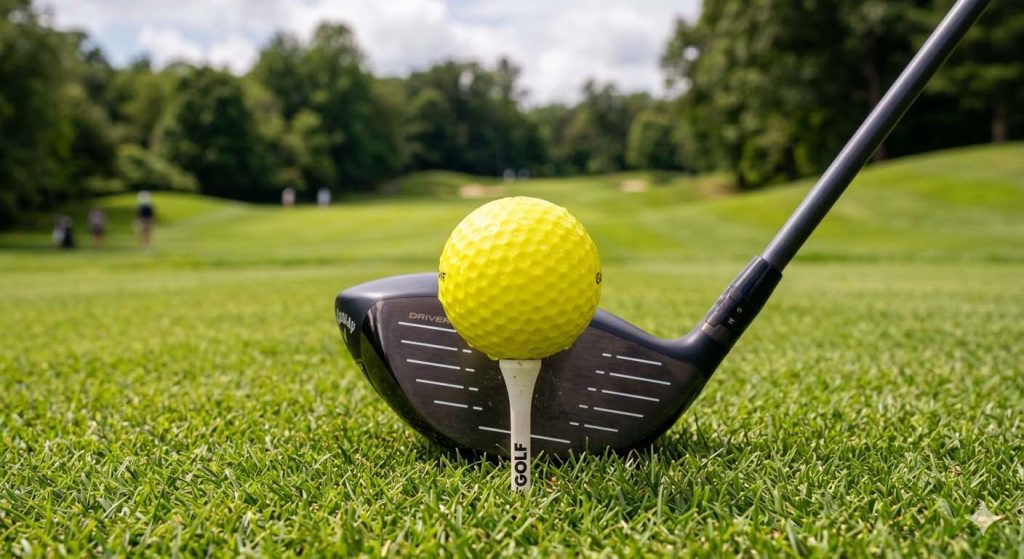
Here is the baseline rule that works for most players. The top of the golf ball should be level with the top edge of your driver’s crown. When you address the ball, you should see exactly one half of the ball above the top line of the clubface.
This rule works because it puts the clubface’s center in the best position to hit the ball. The gear effect — the way the face twists at impact — creates the most energy transfer and the least side spin when impact happens near the center.
But here is the truth: this rule is a starting point, not a universal law. Your driver, your swing, and even the wind can change what “perfect” looks like for you.
The Baseline Rule and Why It Works
Before we get into adjustments, you need to understand why the half-ball-above-the-crown rule exists.
A golf ball is 1.68 inches in diameter. A modern driver’s face is roughly 2 to 2.5 inches tall. When you tee the ball so half of it sits above the crown, the ball’s center lines up with the center of the clubface. That is where the driver produces the most ball speed and the lowest spin.
This also explains why the old advice about teeing the ball low was wrong. When you tee the ball too low, you hit the ball with the top of the face. That reduces ball speed and increases spin, robbing you of distance. The 2006 experiment from GOLF Magazine showed that a medium or high tee height gave players an average of 12 more yards compared to a low tee.
How Driver Size Changes Your Tee Height?
Modern drivers are almost all 460 cubic centimeters. This is the maximum allowed by golf’s rules. Drivers from 15 or 20 years ago were often smaller, around 380 to 420 cc. That change matters for tee height.
A 460cc driver has a taller face than an older 380cc model. The taller face shifts the center of the face upward. This means you can tee the ball slightly higher with a modern driver and still hit the center of the face.
Here is a simple comparison: Driver Size
| 460cc (modern) | Face height | Ball above crown |
| 440cc (older) | 2.2 inches | Half the ball above crown |
| 380cc (vintage) | 2.0 inches | Three-fifths of ball above crown |
| 380cc (vintage) | 1.8 inches | Two-thirds of ball above crown |
If you use a 460cc driver, the half-ball rule works perfectly. If you use an older or smaller driver, you might need to tee the ball a tiny bit higher to get the same effect.
How Your Swing Changes Tee Height?
Your swing is the most important factor. Specifically, your angle of attack — whether you hit up or down on the ball — determines where you should set the tee.
If You Hit Up on the Ball
Most good players hit up on the driver. They catch the ball on the upswing. This creates a higher launch angle and lower spin. If you hit up on the ball, you want a higher tee. The upward path means the clubhead is rising as it meets the ball. A higher tee puts the ball in the path of the rising clubhead, which helps you hit the center of the face.
Try this: tee the ball so the bottom edge of the ball is slightly above the top edge of the face. This is the “high” setting from the 2006 study. The entire ball sits above the crown. This gives you the best chance to catch the ball with the center of the face on the upswing.
If You Hit the Ball
Some players, especially those who use the same swing for driver and irons, hit down on the driver. This creates a steep angle into the ball. If you hit down, a high tee can cause pop-ups — shots that balloon into the air and lose distance.
For a downward swing, start with the baseline rule. If you see pop-ups, lower the tee so only one-third of the ball is above the crown. This makes you hit the ball lower on the face, which reduces launch and spin. The result is a lower, more penetrating ball flight.
How Loft Changes Your Tee Height?
Driver loft matters because it changes the launch angle. A 9.5-degree driver launches the ball lower than a 10.5-degree driver. Tee height is one way to adjust for this.
Tee Height for a 9.5-Degree Driver
A lower-lofted driver needs help getting the ball in the air. You should use a higher tee. Aim for the “high” setting where the bottom of the ball is just above the top edge of the face. This adds about 2 to 3 degrees of effective launch angle. It helps you hit the ball on the upswing, which is exactly what a low-lofted driver needs to maximize carry.
Tee Height for a 10.5-Degree Driver
A 10.5-degree driver already generates a good launch angle. You can use a more moderate tee height. Start with the baseline rule — half the ball above the crown. If you see the ball launching too high and losing distance, lower the tee slightly. If you see the ball launching too low, raise it. The 10.5-degree driver gives you more room to adjust because it is already close to the ideal launch window for most players.
Tee Height for a 12-Degree Driver
If you use a high-loft driver like a 12-degree model, you are already generating a lot of launch. A high tee might cause too much spin. Start with a lower tee height — only one-third of the ball above the crown. This keeps launch in check and reduces spin. You might lose a small amount of carry-on perfect hits, but you will get more roll and more total distance.
The Launch Angle Connection
Tee height directly affects your launch angle. The ideal launch angle for a driver is between 10 and 15 degrees. But your exact target depends on your clubhead speed. Clubhead Speed
| 95 mph or less | Ideal Launch Angle | Tee Height Suggestion |
| 95-105 mph | 14-16 degrees | High (ball above crown) |
| 105 mph or more | 12-14 degrees | Mid (half ball above crown) |
| 105 mph or more | 10-12 degrees | Low to mid (one-third to half above crown) |
If you have a slow swing speed, a higher tee helps you launch the ball higher. If you have a fast swing speed, a lower tee keeps the ball from ballooning.
How to Test Your Ideal Tee Height on the Range?
You do not need a launch monitor to find your perfect tee height. Try this three-step test.
First, choose three tee heights. Use the baseline rule for your middle setting. Set the low setting about one-quarter inch lower. Set the high setting about one-quarter inch higher.
Second, hit five balls at each height. Pay attention to where the ball contacts the face. Use a dry-erase marker or impact tape to mark the face. You want a contact near the center. If you see marks high on the face, your tee is too high. If you see marks low on the face, your tee is too low.
Third, look at ball flight. A low-ball flight with too much spin means you need a higher tee. A ball that balloons and loses distance means you need a lower tee.
Troubleshooting Common Problems
Here is a quick guide to fixing common issues with tee height.
Pop-ups (sky marks on the driver). Your tee is too high. Lower it by one-quarter inch.
Low stingers that run through the fairway. Your tee is too low. Raise it by one-quarter inch.
Slides that slice to the right. You are hitting the ball with the heel of the face. Tee the ball slightly higher. This helps you hit the center.
High hooks that curve left. You are hitting the ball with the toe of the face. Tee the ball slightly lower. This helps you hit the center.
Inconsistent contact. Check your tee height against the baseline rule. Then check your ball position. The ball should be inside your front heel for the driver.
The Indoor vs Outdoor Test
If you don’t have a launch monitor, you can judge tee height with a simple tool. Take an alignment stick and place it on the ground next to your driver. The stick should touch the ground at your ball position. Now look at where the center of the ball sits relative to the top of the driver’s face. If the center is even with the top of the face, your tee height is correct.
You can also use the “shadow test” on a sunny day. Set up your driver behind the ball. Look at the shadow of the ball on the face. If the shadow covers the center of the face, your tee height is good.
Frequently Asked Questions
Is there a difference in tee height for a 460cc vs 440cc driver?
Yes. A 460cc driver has a taller face, so you use the baseline rule. A 440cc driver has a shorter face, so you may need to tee the ball slightly higher to get the same effect.
Does tee height affect slice or hook spin?
Yes. If you hit the ball too high or low on the face, you create gear effect spin. A high-impact point creates a hook. A low impact point creates a slice. Proper tee height reduces both.
Should I tee the ball higher when playing into the wind?
No. Wind increases the effect of spin. If you tee the ball too high into the wind, the ball balloons and loses distance. Use the low to mid setting.
What is the 70/30 rule in golf?
The 70/30 rule is an alternative tee height guide. It says 70% of the ball should be above the crown for a high launch, and 30% for a low launch. This is a simplification. Use the baseline rule and adjust from there.
How do pros tee up their driver?
Most pros tee the ball so the equator of the ball is just above the top edge of the driver face. This is the same as the mid-to-high setting. They rarely use a low tee because it limits their ability to hit up on the ball.
Summing It Up
The right tee height is not a single number. It is a range that changes with your driver, your swing, and the conditions. Start with the baseline rule — half the ball above the crown. Then use the troubleshooting guide to find your personal sweet spot.
A simple test on the range takes ten minutes. The results can add ten or more yards to your drives without changing your swing. That is one of the best bargains in golf.