
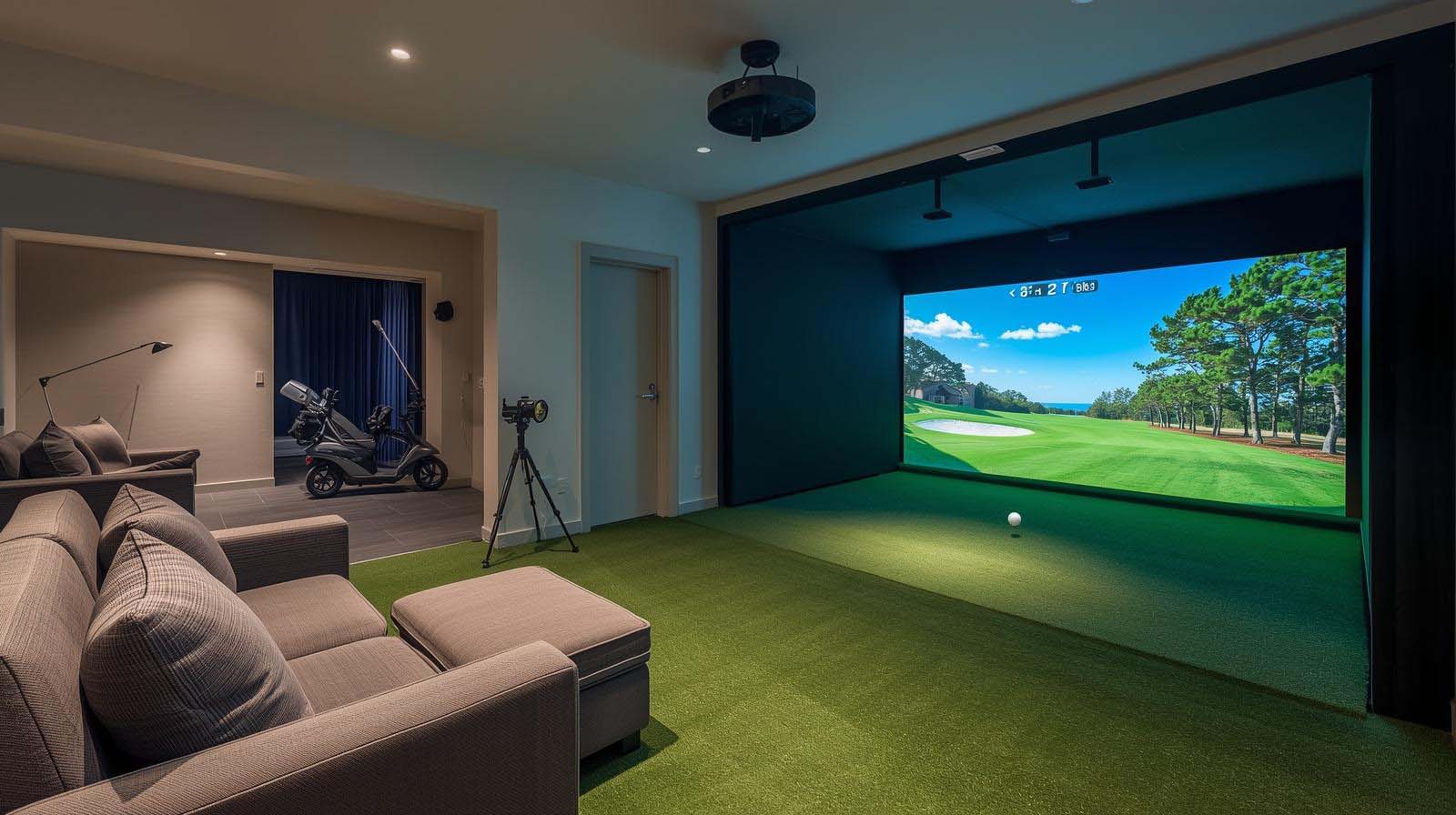
In this guide, we’ll walk through the main ceiling-height considerations for a golf simulator, look at what matters in tighter or taller rooms, and show you how to measure the space the right way. We’ll also cover garage setups, indoor rooms, and what to do if your space is close but not quite ideal.
Perfect Answer: The Ideal, Minimum, and Maximum Ceiling Heights
If you want the fast answer, here it is: around 10 feet of clear height is a common target for many home golf simulators. For a lot of players, that gives enough room to swing naturally without feeling boxed in. If you’re taller than average, prefer a more upright swing, or want extra comfort on driver swings, more ceiling height can help.
On the other hand, 9 feet may work in some setups, especially if the room is well planned and the golfer is not especially tall. By comparison, 8-foot ceilings are often too tight for full swings, although some shorter players may still use them for limited practice, especially with irons or wedges.
So, if you’re trying to decide how tall ceilings you need for a golf simulator, the simplest way to think about it is this: more clear height is generally better, 9 feet can be workable in some rooms, and 8 feet is restrictive. That gives you a solid starting point before you measure the rest of the space.
Why Ceiling Height Matters So Much
Ceiling height matters because a golf simulator is more than a screen and a launch monitor. It’s a swing environment. When that environment feels tight, your body notices. At first, it may be subtle, but it can affect your posture, your takeaway, your backswing, and even your follow-through.
It’s also worth remembering that the club moves in an arc, and low obstructions can get in the way of that motion. That’s why it’s smarter to measure the actual usable space in the hitting area instead of relying only on the total ceiling height on paper.
There’s a mental side to this, too. If you’re even a little worried about hitting the ceiling, your swing can tighten up. You may shorten the backswing, flatten the plane, or slow your motion without meaning to. In that case, the simulator may fit on paper but still not feel like real golf.
In short, enough height does two things at once. First, it reduces the chance of contact with the ceiling or other obstructions. Second, it helps your swing feel more natural. Both matter if you want a simulator you’ll actually enjoy using long term.
How to Measure Your Room Correctly?

Measuring a room for a golf simulator takes more than checking the ceiling with a tape measure. Start by measuring from the finished floor to the lowest obstruction in the hitting zone. That might be the ceiling itself, but it could also be a beam, a garage door track, a light fixture, or an HVAC duct.
Then, look at the whole swing area, not just one spot. You need enough room for setup, backswing, impact, and follow-through. It’s common for golfers to measure the center of the room and assume they’re fine, only to realize later that a light fixture near the mat cuts into the usable height.
Here’s a simple checklist to follow:
- Measure the full ceiling height from the finished floor to the ceiling.
- Find the lowest obstruction in the hitting zone.
- Check for lights, beams, pipes, ductwork, sprinklers, fans, and garage door rails.
- Measure the space where your feet, ball, and club will actually move.
- Confirm that your impact screen and enclosure will fit without reducing swing clearance.
Once you do that, you’ll have a much clearer answer to the question of how much height clearance you need for a golf simulator. And that answer will be based on real space, not just a guess.
How Golfer Height and Swing Type Affect the Required Height
Not every golfer needs the same ceiling height. Body size and swing style can make a real difference. A shorter golfer with a compact swing may feel comfortable in a room that feels cramped to a taller player. Likewise, a golfer with a flatter swing plane may need less vertical clearance than someone with a more upright motion.
Taller golfers, golfers with more upright swings, and players who want extra comfort on full swings may prefer more clearance. Club choice matters too. If your simulator is mainly for wedge practice, you can sometimes get by with less height than a setup built for full-bag play. But if you want the freedom to hit driver, fairway woods, and hybrids without worry, you should plan for more ceiling, not less.
That’s why a room can seem fine when you stand in it, then feel too low once you start swinging. The club doesn’t move straight up and down. It travels through space in an arc, and that arc needs room to breathe.
Garage Golf Simulator Height Requirements
Garages are where many people try to build a simulator, and they’re also where height issues show up most often. That’s because a garage ceiling may include garage door tracks, openers, lights, storage racks, or beams that hang lower than the ceiling itself.
So, when people ask what ceiling height do you need for indoor golf simulator setups in a garage, the answer is not just about the number on the wall. You need to measure the lowest usable point in the swing zone. If a light fixture or garage door rail drops into that space, that becomes the real ceiling height for your simulator.
For that reason, a garage that is “10 feet high” on paper may not actually give you 10 feet of usable golf space. Once you account for the lower obstructions, the workable clearance may be less. That’s why careful measuring matters before you buy your enclosure, mat, or launch monitor.
If your garage is also a shared space, a retractable setup can be a smart move. It lets you use the room for golf when you want it, then free up the space when you don’t.
What Ceiling Height Do You Need for an Indoor Golf Simulator?
The same general rules apply to basements, bonus rooms, and spare bedrooms, but the obstacles can look different. In a basement, for example, you may have ductwork, support beams, or low-hanging pipes. In a bonus room, you might deal with sloped ceilings that reduce height on one side. In a spare room, ceiling fans or lighting can get in the way.
That’s why the best answer to how much ceiling height do you need for a golf simulator isn’t just a single number. It’s really a mix of clear height, usable width, and safe swing space. A room can be tall enough and still feel awkward if the walls are too close or the obstructions are poorly placed.
Also, keep in mind that “roof height” and “wall height” are not the same thing as usable simulator height. The number that matters is the distance from the finished floor to the lowest point that could interfere with your club or your body. That’s the number that decides whether the room truly works.
What If Your Ceiling Is Too Low?
If your room is under 10 feet, don’t panic. Plenty of golfers still build useful simulator setups in tighter spaces. The key is being honest about your goals. If you want full swings with a driver and maximum comfort, a low ceiling may be a deal-breaker. But if you mainly want iron practice, putting, or shorter controlled swings, the room might still work.
Here are a few practical options if the ceiling is on the low side:
- Focus on wedges and irons instead of full driver swings.
- Use a more compact swing if that feels natural for your body type.
- Choose a space-saving simulator layout with fewer obstructions.
- Look at retractable enclosures if the room serves multiple purposes.
- Rework lighting and storage to recover a few extra inches of clearance.
At the same time, there are cases where it’s better to walk away. If you can’t swing without worrying about the ceiling, the space is probably too tight for long-term enjoyment. A simulator should make practice easier, not more stressful.
Best Golf Simulator Setups for Lower Ceilings
If your room isn’t perfect, the right setup style can make a big difference. Compact systems are often easier to place in tight spaces because they don’t demand the same room geometry as larger setups. That can be a real advantage when every inch counts.
For garages, retractable enclosures are especially useful. They let you create a clean simulator bay when you want to play, then pull everything back when you need the space for cars, storage, or family use. That kind of flexibility is one of the better solutions for homeowners who want golf without giving up the room entirely.
Common Mistakes People Make When Estimating Ceiling Height
One of the biggest mistakes is measuring only the highest point of the room and ignoring the lowest obstruction. A garage door rail or a hanging light can turn what looks like a good space into a tight one very quickly. That’s why the lowest point always matters most.
Another common mistake is forgetting about the club itself. A golfer may fit comfortably while standing still, but once the driver starts moving, the swing arc can rise higher than expected. That’s especially true for taller players or anyone with a more upright plane.
People also often assume that 9 feet is always enough. Sometimes it is. Often it isn’t. It depends on your body, your swing, and the room around you. That’s why a simple yes-or-no answer without context can be misleading.
Finally, many buyers choose equipment before confirming that the room actually fits. That can lead to expensive frustration later. Measure first, then choose the simulator. It’s always the safer order.
People Also Ask
How much height do you need for a golf simulator room?
For most golfers, a golf simulator room should have enough clear height to allow a comfortable swing, and around 10 feet is a common target.
How tall ceilings do you need for a golf simulator?
Many golfers prefer about 10 feet of clear height, though some can make 9 feet work, and taller players may prefer more.
How much ceiling height is required for a golf simulator?
The best answer is usually around 10 feet of clear height for a full-swing setup. Less than that may still work, but it depends on your swing and your room layout.
What height roof do you need for a golf simulator?
You need enough roof height to give your swing clear space and avoid low obstructions, which often means around 10 feet for many players.
What ceiling height do you need for an indoor golf simulator?
Indoor golf simulators usually work best with generous clear height, and around 10 feet is a common planning target.
How much height clearance do you need for a golf simulator?
Enough clearance to swing comfortably without hitting the ceiling or any low obstructions.
How tall of walls do you need for a golf simulator?
The walls need to support the full usable height of the room, but what matters most is the clear space above the golfer, not wall height alone.
Is an 8-foot ceiling enough for a golf simulator?
Usually not for full swings. In some cases, it can work for shorter golfers or very controlled practice, but it is generally too tight for driver use.
Is a 9-foot ceiling enough for a golf simulator?
Yes, sometimes. A 9-foot ceiling can work for some golfers, especially if the swing is compact and the room has no extra obstructions.
Is a 10-foot ceiling enough for a golf simulator?
Yes. For many golfers, 10 feet is a strong target because it provides a comfortable blend of safety, freedom, and realism.
Do taller golfers need more ceiling height?
Often yes. Taller golfers may prefer more clearance for the best experience.
Can you use a golf simulator in a garage with low ceilings?
Sometimes, yes, but it depends on the actual usable clearance. Garage door tracks, lights, and storage can quickly reduce the space, so measuring carefully is essential.
Final Recommendation: What Height Should You Aim For?
If you want the most practical answer, aim for about 10 feet of clear ceiling height. That’s a common starting point for many golfers because it gives you enough room to swing naturally without constantly worrying about contact. It also leaves some margin for different clubs, different swing styles, and the small setup differences that come with a real home build.
If your room is closer to 9 feet, it may still work, especially if you’re not especially tall and you’re comfortable with a more compact setup. If your room is only 8 feet, it’s usually too tight for full golf simulator use. And if you have more height, you may enjoy more flexibility, more comfort, and a better overall experience.
So, when people ask how much height you need for a golf simulator, the honest answer is this: the more usable clear height you have, the better the simulator will likely feel. Measure carefully, watch for obstructions, and choose a setup that fits your room instead of fighting it. That way, your simulator will feel like a place to play golf, not a place to avoid the ceiling.