
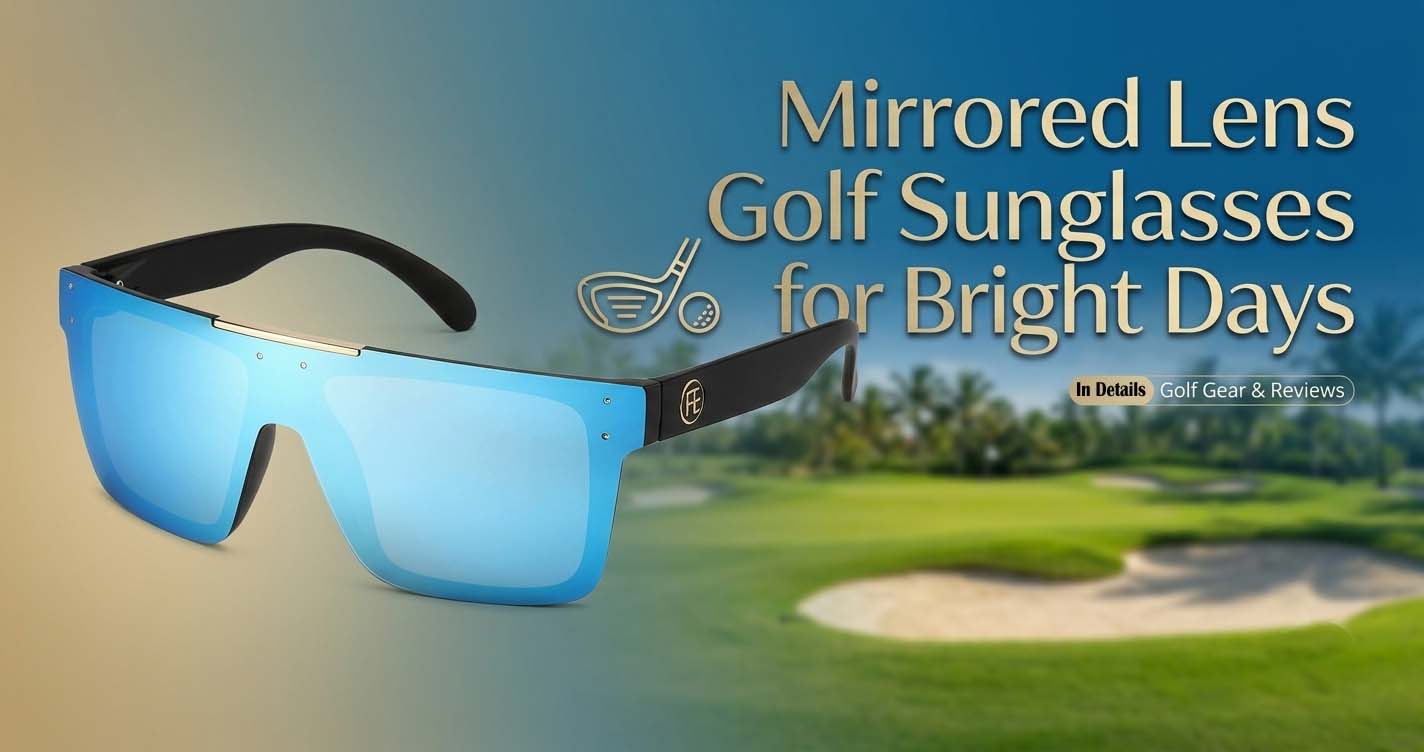
You’re standing on the tee box. The sky is white-hot. The fairway is a wash of green. And that ball you just hit? You lost it in the sun before it even landed. I’ve been there more times than I’d like to admit. Squinting doesn’t just hurt your eyes — it hurts your score.
That’s why you’re looking at mirrored lens golf sunglasses for bright days. The mirror coating cuts the harshness. The polarization kills glare off sand and water. It sounds perfect. But then you start shopping and you’re staring at a pair for a few bucks on Amazon next to a pair that costs more than your putter. What’s actually different? Do you need to spend big to see the ball?
I’ve spent the last few weeks testing two very different approaches to this problem. One is a budget-friendly pair from FEISEDY that costs less than a round of golf. The other is the Oakley Prizm Dark Golf — the gold standard that serious players swear by. I wanted to know exactly what you gain and what you give up at each price point. Here’s what I found.

Why Mirrored Lenses Work So Well for Bright Day Golf
Let’s get the science out of the way in plain language. A mirrored lens is just a standard lens with a thin reflective coating on the outside. That coating bounces a portion of light away before it ever reaches your eye. On a cloudless summer day, that makes a real difference. Your pupils don’t have to crank down as hard, and you don’t get that squint-fatigue by the back nine.
But here’s the part that matters for golf specifically. The sky is a huge white-blue dome. The fairway is green. The sand is bright white. A cheap lens treats all of those colors the same — it just darkens everything. A good golf lens, on the other hand, manages contrast. It makes the green pop a little more so you can read the fairway better. It makes the ball stand out against the sky. That’s the difference between a general-purpose sunglass and a golf-specific tool.
What to Look For in a Mirrored Golf Lens for Bright Sun
Before I get into the reviews, here are the four things I judged every pair on. If you understand these, you can evaluate any pair of sunglasses yourself.
Visible Light Transmission (VLT)
VLT is the percentage of light that passes through the lens. For bright sun, you want something between 10% and 20%. Below 10% starts to feel like dusk. Above 20% and you’re still squinting on a cloudless day. The sweet spot for bright-day golf is right around 12–15%.
Polarization
Non-negotiable. Polarization cuts the horizontal glare that bounces off water, sand, and cart paths. Without it, you’re still fighting reflections. Every pair I tested is polarized, but not all polarization is created equal — cheap polarizing film can distort the image slightly.
Base Tint vs. Mirror Coating
This is the part most people get wrong. The mirror is just the coating on the outside. It’s the base tint underneath that actually changes how you see the course. Grey base tint is neutral — it darkens everything evenly. Brown, copper, or rose base tints enhance contrast, making greens look greener and helping the ball pop against the sky. For golf, a contrast-enhancing base tint is a real advantage.
Fit and Lens Curvature
A flat lens won’t distort your view, but it also won’t block peripheral light or wind. A wrap-around lens keeps the sun out of the sides of your eyes. But the trade-off is that curved lenses can introduce slight distortion, especially on cheap pairs. For a golf swing, you also need the frame to stay put. If the glasses slip when you rotate, they’re useless.
The Premium Standard: Oakley Prizm Dark Golf
Key Specs: VLT ~10% | Base tint: Deep grey-green (contrast-optimized) | Polarized | Sport wrap frame | Plutonite lens material
I’ll be honest — I didn’t want to like these as much as I do. The price tag makes you wince. But after a few rounds in full sun, I understood why they cost what they do.
The first thing I noticed was how the ball looked against the sky. On a bright day, a white ball against a white sky usually blends in. With the Prizm Dark Golf lens, the ball had a slightly sharper edge. It wasn’t dramatic — it’s not like the ball glowed — but it was enough that I stopped losing it in my peripheral vision. That alone saved me a few strokes over the round.
The contrast tuning is real. The fairway looked richer, and the greens had a bit more depth. I could see subtle breaks that I normally miss. The VLT sits right around 10%, which is perfect for the brightest days. Anything darker and you’d lose shadows. Anything lighter and you’d still be squinting.
The frame is a sport wrap, which means it hugs your face. No slipping during the swing. No wind in the eyes. The Plutonite lens material is optically clear — no distortion at all, even in the periphery. I wore them for four hours straight and forgot I had them on.
The honest downside: The price. These are expensive, and if you’re the type of golfer who loses things, this hurts. Also, the deep tint means they’re not great for partly cloudy days or late evening rounds. They’re a specialist tool for bright sun.
Who this is for: The serious golfer who plays 50+ rounds a year, cares about reading greens, and hates losing the ball in the sky. These are a tool, not an accessory.
The Budget Contender: FEISEDY B2990
Key Specs: VLT ~15–18% (estimated) | Base tint: Grey (neutral) | Polarized | Oversized square frame | Plastic frame with metal hinges | Weight: 1.02 oz
I picked up a pair of these after seeing them pop up in every budget sunglasses roundup. The price is so low that I figured either they’d be terrible or surprisingly good. Turns out, they’re surprisingly good — with some real limitations.
Design and Fit
The oversized square frame is genuinely stylish. I got a few compliments on the course. They look like they cost way more than they do. The frame is lightweight — just over an ounce — so you don’t feel them on your face. The metal hinges feel solid, and the nose pads are comfortable for a few hours of wear.
But here’s the catch. These are a fashion frame, not a sport frame. The arms are straight, not curved, so they don’t grip your head during a swing. I noticed them shift slightly on my follow-through. Not enough to fall off, but enough to be distracting. If you have a violent swing, this could be an issue.
Lens Performance
The polarization works. Glare off water and sand was noticeably reduced. The mirror coating does its job — on the brightest days, I wasn’t squinting. The UV400 protection is a given, and it’s nice to have confirmation that your eyes are truly protected.
The big limitation is the base tint. It’s a standard grey, which means it darkens everything evenly. The green of the fairway, the white of the sky, the brown of the sand — it all gets the same treatment. There’s no contrast enhancement. Compared to the Oakley, the ball didn’t pop as much against the sky. I could still see it, but I had to track it more carefully.
Also, the lens is flat. That means no peripheral distortion, which is nice. But it also means light comes in from the sides. On a really bright day, I noticed some glare sneaking in around the edges of the frame.
Durability
After a few weeks of use, the frame held up fine. The metal hinges are solid. The plastic frame is stiff, not flexible, but it hasn’t cracked or warped. My main concern is the mirror coating — it scratches easier than the Oakley’s lens. I’ve been careful with them, but I can already see a tiny hairline scratch on the left lens. If you toss them in a bag without a case, they’ll get beat up.
Who This Is For
The casual golfer who plays 10–20 rounds a year and wants to look good on the course without spending a lot. Also great as a backup pair or for the range. If you’re not obsessed with reading greens and just want to stop squinting, these do the job.
Comparison Table: Premium vs. Budget
| Feature | Oakley Prizm Dark Golf | FEISEDY B2990 |
|---|---|---|
| Price Range | Premium | Budget-friendly |
| VLT (Bright Days) | ~10% (Optimized) | ~15–18% (Estimated) |
| Base Tint | Deep Grey/Green (Contrast) | Grey (Standard Neutral) |
| Polarization | Yes | Yes |
| Fit | Sport Wrap (Secure) | Oversized Square (Fashion) |
| Lens Material | Plutonite (Optically clear) | Polycarbonate with mirror coating |
| Best For | Serious golfers, low handicaps, sun-sensitive players | Casual golfers, budget buyers, backups |
Final Verdict: Which One Should You Buy?
I’ve been going back and forth between these two pairs for weeks now, and here’s where I’ve landed.
If you play 50+ rounds a year and you care about every stroke — if you read greens, if you hate losing the ball in the sky, if you want equipment that gives you a real advantage — get the Oakley Prizm Dark Golf. The contrast tuning is a genuine benefit. It’s not marketing hype. You will see the ball better, and you will read greens better. It’s a performance tool, and it earns its place in your bag.
If you play 10–20 rounds a year, you’re more casual, and you don’t want to baby your sunglasses — get the FEISEDY B2990. It does most of the job for a fraction of the price. You’ll stop squinting. You’ll look good. You won’t panic if you scratch them or leave them on the cart. The trade-off is that the color perception is flatter, and you won’t get the same ball-tracking advantage. But for most golfers, that’s a trade worth making.
The honest truth is that the cheap pair does about 85% of what the expensive pair does for about 10% of the cost. That 15% gap is real — it’s the contrast tuning, the optical clarity, and the secure fit. Whether that gap matters to you depends entirely on how seriously you take your game.
Frequently Asked Questions
Are mirrored lenses better for golf than regular dark lenses?
Yes, for bright days. The mirror coating reflects additional light away before it reaches your eye, which reduces eye strain more effectively than a standard dark tint. That extra layer of reflection helps you stay comfortable longer on the course.
What VLT percentage is best for golf in full sun?
Between 10% and 20% is the sweet spot for bright, sunny rounds. Lenses around 10% VLT, like the Oakley Prizm Dark Golf, work best for the brightest conditions. Above 20% and you’ll still find yourself squinting on a cloudless day.
Can I use budget mirrored sunglasses for golf, or do I need golf-specific ones?
You can absolutely use budget options like the FEISEDY for golf. They block UV, reduce glare, and keep you comfortable. The main thing you give up is contrast enhancement — the ability to see the ball more clearly against the sky and read greens better. For casual golfers, the budget option is perfectly fine.
What’s more important for golf — the mirror coating or the base tint?
The base tint matters more for how you actually see the course. The mirror coating reduces overall brightness. The base tint (grey, brown, copper, etc.) determines how colors are rendered. For golf, a brown or copper base tint enhances green contrast, which helps you read fairways and greens. Grey is neutral and works well for general use.
Do I need polarized lenses for golf?
Not strictly, but it helps a lot. Polarization cuts the harsh glare off water, sand, and cart paths. On a bright day, that glare can be distracting and cause eye strain. I wouldn’t buy a pair of golf sunglasses without polarization.