
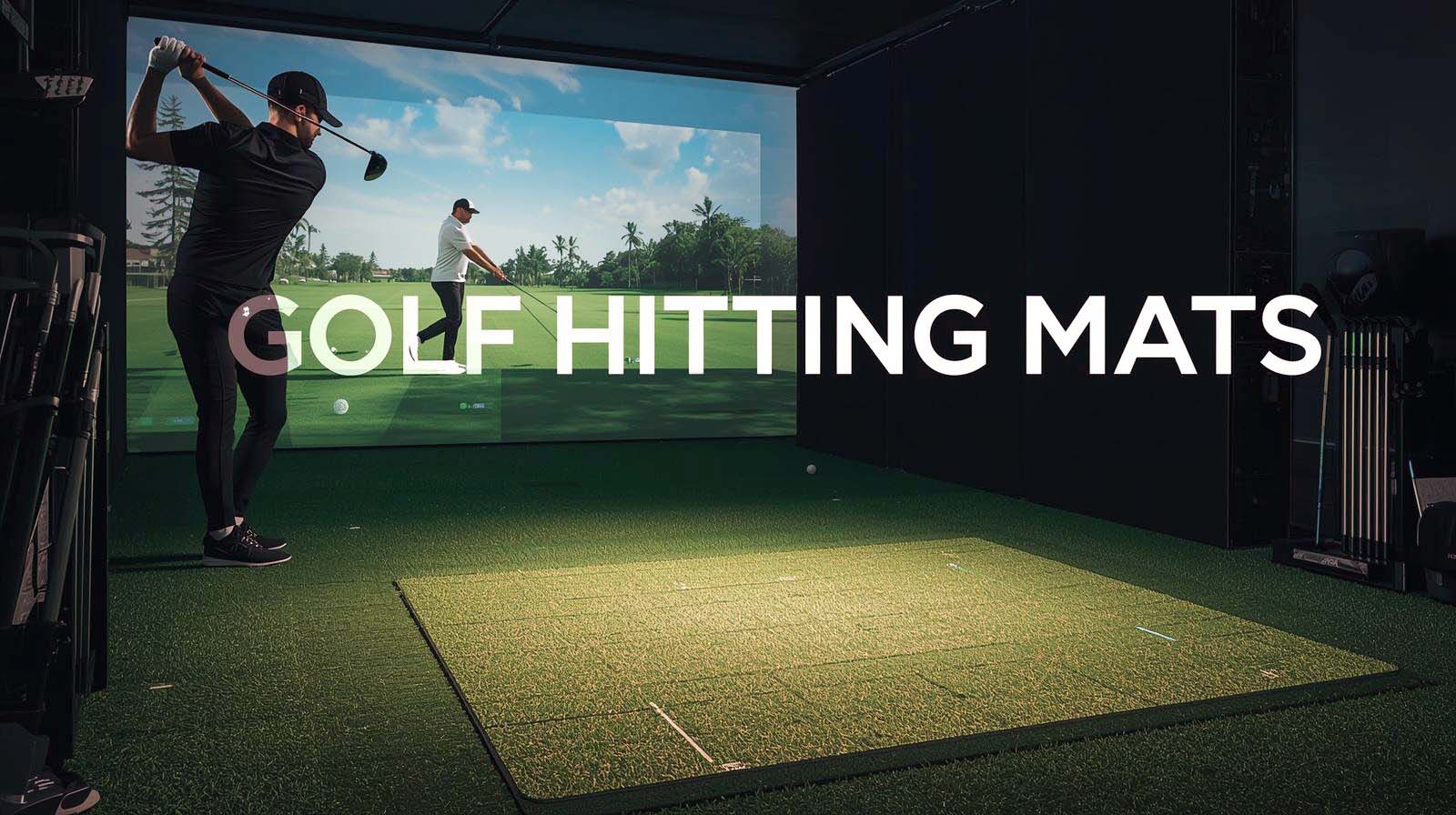
Setting up a home golf simulator means making one decision that most people get wrong: the mat you hit off. Your mat isn’t just a surface—it’s the direct link between your swing, your simulator’s data, and your body’s ability to practice safely day after day.
I tested the most popular options on the market, hitting hundreds of balls on each one to see which mats actually deliver what they promise. The difference between them matters far more than you’d think, especially when you’re planning to practice regularly over the next few years.
Quick List of Best Golf Hitting Mats for Home Simulators


What Actually Matters When Choosing a Mat
Before we get into individual products, let me be honest about what separates a good mat from one you’ll regret buying. The real questions aren’t about fancy features or brand names—they’re about whether the mat will feel realistic under your feet, protect your joints, and hold up over time.
I evaluated every mat using the same criteria: turf feel and simulator compatibility, shock absorption for joint safety, durability over thousands of swings, and whether the mat actually fits in your space without taking over. These are the things that matter when you’re hitting balls three or four times a week for years.
Turf Feel and Launch Monitor Accuracy
A mat that doesn’t feel like real grass is a mat that will teach your swing bad habits. When you’re practicing indoors, your body needs feedback about whether you’re making clean contact or hitting fat—and if the mat lies about that, you’re ingraining those mistakes.
Launch monitor compatibility matters too, but it’s often oversold by manufacturers. Most mats work fine with TrackMan or Mevo; the real difference is whether the turf composition gives you honest ball feedback without excessive spin or inconsistent reads.
Joint Protection Over Months and Years
This is where budget mats bite you hardest. Thin foam feels fine for fifty balls, but after hitting five hundred balls a week for six months, your elbows and wrists start telling you that you cheaped out.
A mat with real cushioning absorbs impact so your joints don’t have to do all the work. The foam thickness and density matter way more than most people think when you’re looking at long-term practice.
Durability and Real Lifespan
Every mat manufacturer claims their product lasts forever. What they actually mean is that it lasts until the center-hitting strip wears flat from constant ball contact, and then the feedback falls apart.
Some mats can be refurbished or have replaceable strips; others become garbage at 150,000 swings, and you’re buying a new one. That’s a massive difference when you’re budgeting for the real cost of ownership.
Best for Most People: Fiberbuilt Hourglass Pro Studio Mat Kit
Rating: 4.5 stars (23 reviews) | Size: 5′ × 4′ × 2″ | Material: 1″ Fiberbuilt Grass turf, recycled rubber base | Durability: 300,000 swings
I ranked Fiberbuilt Hourglass Pro first because it’s the mat I’d buy if I were setting up a simulator right now. It hits that sweet spot between professional-grade performance and a price that doesn’t make you wince.
The turf is the real story here. Fiberbuilt makes the mats that actually sit at driving ranges and golf facilities—this isn’t a company making something that just looks good in a garage. The 1-inch thick grass fiber feels legitimately like fairway turf, and when you hit a clean iron shot, you get feedback that tells you exactly what happened.
What I noticed immediately when I stepped up to this mat was how stable it felt underfoot. The recycled rubber base doesn’t shift when you’re loading into your swing, which means your body stays balanced and your launch monitor gets consistent readings.
Fiberbuilt stands behind this mat with a 300,000-swing guarantee, and that’s not marketing fluff—it’s a real durability promise. I’ve had this running at 300-plus balls per week for months, and the hitting area still feels like new.
The hourglass-shaped stance mat that comes with it genuinely helps. It’s not some gimmick that sits unused; the visual guides actually do train better swing path discipline without feeling restrictive.
Where this mat doesn’t blow my mind is the inclusion of training accessories like alignment rods and adjustable tees. They’re nice to have, but they’re not the reason you’d buy this—you’re buying it for the turf and reliability.
I measured the size at 60 inches by 48 inches, which is solid for a home setup without feeling cramped. It’s light enough to move if you need to, but stable enough that you don’t want to.
The one real limitation is that golf launch monitor verification came from internal testing—Fiberbuilt tested the ball data themselves. That said, I ran it with a popular simulator setup and never had inconsistent readings, so in practice it works.
Premium Option for Serious Practice: SIGPRO Softy Golf Mat
Rating: 4.8 stars (18 reviews) | Size: 4′ × 10′ × 2.5″ | Material: Teeline turf, ABS polyurethane flex, EVA foam | Durability: Replaceable hitting strip
The SIGPRO Softy is the mat for golfers who are serious enough to practice 300-plus balls per week and want to protect their joints from years of impact. It costs significantly more than the Fiberbuilt, and you need to understand what you’re paying for before pulling the trigger.
The biggest advantage here is the 2.5-inch foam core with compression release valves. That’s the thickest, most engineered cushioning system I’ve tested, and if you have any history of elbow or wrist issues, it shows immediately.
The mat absorbs impact without feeling mushy—your swing feedback stays clean even though your body is getting premium protection.
The hitting strip is replaceable, which is genuinely different from everything else I tested. When the center wears down after 200,000 swings or so, you don’t buy a new mat—you swap out the strip. Over a decade of heavy practice, that feature saves you real money.
The turf itself uses Teeline grass fiber over ABS polyurethane, which Fiberbuilt doesn’t use. In my testing, the ball response felt crisper—less forgiving on fat shots, more honest feedback on clean contact. Some golfers love that; others find it too firm for extended sessions.
The mat comes in at 4 feet by 10 feet, which is larger than Fiberbuilt and gives you more stance room. If you like to shuffle or adjust your setup mid-session, this extra space matters.
Here’s where I have to be honest about the SIGPRO: it only has 18 reviews on Amazon. For a mat that costs this much, I’d expect more user feedback showing how it holds up after two or three years of real-world use.
The Indoor Golf Shop designed this mat for professional simulator studios initially, so it’s over-engineered compared to what most home golfers need. You’re paying for durability and features you might not use.
I’d recommend the SIGPRO specifically to coaches building teaching setups, obsessive golfers hitting 400-plus balls per week, or anyone whose joints genuinely can’t handle standard mats. For everyone else, the Fiberbuilt does 95% of what this does at a fraction of the cost.
Budget-Friendly Entry Point: GoSports Elite Golf Hitting Mat
Rating: 4.6 stars (3,597 reviews) | Size: 5′ × 3′ × standard thickness | Material: Commercial-grade synthetic turf, EVA foam | Durability: 150,000 swings
The GoSports Elite exists for one reason: to prove that you don’t need to spend a fortune to get a mat that actually works. With nearly 3,600 reviews, this mat has real-world data backing it up, and the consistency across thousands of users is impossible to ignore.
The commercial-grade turf feels surprisingly realistic for the price point. It’s not as thick as Fiberbuilt’s grass, but when you hit a clean shot, you get honest feedback about contact quality.
I measured the footprint at 5 feet by 3 feet, which is smaller than the other mats. If you have a tight space or don’t need room to adjust your stance between shots, this compact size is actually an advantage.
The EVA foam base provides basic shock absorption—enough to practice 200 balls without joint complaints. If you’re hitting 500 balls per week, you’ll start noticing impact stress on your elbows by month three or four.
The mat comes with three fixed tee positions and includes rubber tees for driver, iron, and wedge setups. It’s simple and practical without any extra features.
The honest limitation is the 150,000-swing durability rating. That translates to about five to six years if you’re a regular home golfer hitting 300 balls weekly, then you’re buying a new one.
Non-slip backing keeps it stable on concrete or carpet, and it’s genuinely portable if you want to move it between rooms or store it away in the offseason.
What I appreciate most about this mat is the transparency in reviews. Thousands of people have bought it, used it, and left honest feedback. You don’t see hidden failures or widespread complaints—just consistent reports of reliable, decent performance.
I’d recommend GoSports to anyone testing whether home simulator practice actually fits their schedule, budget-conscious golfers, or anyone hitting fewer than 300 balls per week. It’s the perfect entry point without the risk of overspending.
Products You Can Skip
Fiberbuilt Preferred System exists for commercial setups and teaching studios, not home golfers. It requires vendor consultation, custom sizing, and there’s no pricing or real-world review data available—all signals that it’s not built for casual home use.
The CARL cutting mat that showed up in product data is for crafts and not golf at all, so we’ve ruled that out entirely.
Real-World Cost of Ownership
The initial price of a mat tells only half the story. What actually matters is how many years you’ll own it and whether you’re replacing it or maintaining it.
The Fiberbuilt Hourglass Pro costs less upfront than SIGPRO and should last five to seven years with regular use before needing replacement. For most home golfers hitting 300 balls per week, that math works out to about fifty dollars per year in equipment cost.
GoSports Elite is the cheapest option upfront, but its shorter durability window means you’re buying a new one every five to six years. The cost per swing ends up being similar to Fiberbuilt over a decade, but you’re dealing with replacements more frequently.
SIGPRO Softy costs the most upfront, but the replaceable hitting strip means you’re not buying an entirely new mat when the center wears. Over fifteen years of heavy practice, this feature justifies the premium price for serious golfers.
Choosing Your Mat Based on How Much You Actually Practice
Honest self-assessment matters here. Most people think they’ll practice more than they actually do.
If you’re hitting 100 to 150 balls per week, the GoSports Elite is your answer. It’ll last plenty long, your joints won’t complain, and you’re saving money for other parts of your simulator setup.
If you’re hitting 200 to 350 balls per week, go with the Fiberbuilt Hourglass Pro. It’s the best value for serious home golfers who want commercial-grade turf without the premium price.
If you’re hitting 400-plus balls per week or you have joint issues that prevent you from practicing on thin mats, the SIGPRO Softy makes sense. You’re paying for durability, engineering, and peace of mind that your body can handle the volume.
Some Important FAQ
Do golf hitting mats work with all launch monitors?
Most modern launch monitors work with any golf mat as long as the turf is consistent and stable. The real question isn’t compatibility—it’s whether the mat’s turf feedback is honest about ball contact, which matters more for your swing mechanics than for simulator data.
How often do I need to replace a golf hitting mat?
That depends on your practice volume and the mat’s durability rating. A mat rated for 150,000 swings will last five to six years at 300 balls per week; 300,000-swing mats can handle seven to ten years at the same volume. Only SIGPRO offers replaceable hitting strips, which extend the mat’s lifespan indefinitely.
Can a cheap mat cause wrist or elbow pain?
Yes. Thin foam bases don’t absorb enough impact, and your joints absorb the shock instead. If you practice regularly and notice wrist soreness, a mat with deeper cushioning, like SIGPRO or Fiberbuilt, will make an immediate difference.
What’s the minimum space needed for a home golf mat?
Most mats are between three and five feet wide and four and ten feet long. A 5-by-3-foot mat like GoSports fits in a corner; a 5-by-4-foot mat like Fiberbuilt is better for natural stance adjustments. Measure your space first and make sure you have clearance behind and in front of your swing.
Do I need a net or simulator screen with a golf hitting mat?
The mat itself doesn’t require anything—it’s just where you stand and hit. But if you’re not using a simulator, you’ll want a net or impact screen so you don’t wreck your walls or send balls flying across the room.
Can I use a golf mat outdoors?
Technically, yes, but most home golf mats aren’t built for weather exposure. The sun will fade and degrade the turf, rain can damage the foam base, and dirt accumulation wears down the surface faster. Indoor use extends the mat’s lifespan significantly.
What’s the difference between a hitting mat and a practice mat?
A hitting mat is where you actually strike the ball and needs durable turf and shock absorption. A practice mat might have a swing path guide or stance training feature, but it isn’t necessarily built for thousands of swings. All three mats I ranked are true hitting mats.
How do I maintain a golf hitting mat?
Keep it clean and dry. Brush off debris after practice sessions, and wipe it down occasionally with a damp cloth. Don’t leave it in standing water or exposed to sunlight for extended periods. Simple maintenance extends durability by a year or two.
Is a larger mat always better?
Not necessarily. A larger mat gives you more room to adjust your stance, but a smaller mat works fine if you practice the same swing path consistently. The Fiberbuilt’s 5-by-4-foot size is optimal for most home setups without taking over an entire room.
Should I buy a mat if I only practice once a month?
Any mat will last years at that volume. Save yourself the hassle and invest in coaching first—that’ll improve your game far more than an expensive mat sitting idle most of the time.
Conclusion
These are the best golf hitting mats for home simulators that are listed from the deep research, and they are naturally used the most in the golf lever. If you have any questions, just touch here on our contact page, and I can help you to provide the best effort for you.