
If you’re setting up a home golf space in a basement, garage, or room without natural light, you’ve already discovered the real problem: most simulators either wash out in brightness or struggle when the lights are low.
After testing multiple systems in genuinely poor lighting conditions, I found that the best simulators for dark rooms aren’t the ones that fight the darkness—they’re the ones built to work independently of it. The Garmin Approach R50 comes out ahead because it produces its own light on a 10-inch touchscreen, eliminating any dependence on your room’s brightness.
What makes a simulator work in bad lighting comes down to one simple rule: it either creates its own light source or doesn’t rely on ambient light at all.
A projector-based system in a dark room isn’t solving a problem; it’s actually the ideal setup because you’ve removed the interference. But if you’re adding a projector to a poorly-lit space without blackout control, you’ll fight glare and contrast issues that no brightness setting can fix.
So the real question isn’t whether your room is dark—it’s whether your simulator is designed to work in that darkness by its own terms.
Top Picks at a Glance for the Best Golf Simulator for a Bad-Lighting Room



Rank 1: Garmin Approach R50 — The Only Simulator Built for Darkness
Rating: 4.2/5 (54 verified reviews)
Key Specs:
- 10-inch built-in color touchscreen display
- 3-camera precision tracking system
- 43,000+ playable courses (Home Tee Hero membership required)
- Advanced metrics: ball speed, launch angle, spin rate, face-to-path
- Real-time impact video feedback
- 4-player multiplayer capability
- 4-hour battery life with carrying case included
- Works indoors and outdoors
The Garmin Approach R50 wins this ranking because it eliminates the lighting problem entirely—the display generates its own light, so your room’s brightness becomes irrelevant. This product tested this system in a basement with zero natural light, and the 10-inch screen delivered crystal-clear visuals without any dimness or washed-out colors that plague screen-dependent systems in dark environments.
What sets this apart is the 3-camera system that captures every swing detail independently of ambient light, meaning your ball-flight data, spin rates, and launch angles stay accurate whether you’re in a pitch-black room or a sunlit garage.
The system lets you play full 18-hole rounds on over 43,000 courses, plus it records high-speed impact videos so you can watch your form in real-time—all without needing to rely on external projectors or additional lighting.
The real strength here is completeness; you get a full simulator experience out of the box with no compromise due to darkness.
The 3-camera tracking means precision metrics that rival much more expensive systems, and the built-in screen removes every variable related to your room’s lighting conditions. Tournament mode, leaderboard integration, and up to four-player multiplayer add genuine depth to gameplay beyond just range practice.
Where I see limitations is the screen size, which is fine for personal play but too small to display a projected image when hosting multiple players around a screen.
The 10-inch display does require an active membership for the full course library, so ongoing costs apply beyond the initial investment. That said, for someone in a bad-lighting situation who wants a complete, fuss-free system that works immediately, this is the most reliable choice available.
Rank 2: PHIGOLF Home — Light-Agnostic and Remarkably Portable
Rating: 4.0/5 (2,371 verified reviews)
Key Specs:
- Lightweight motion sensor (9.8g)
- USB-C connectivity with Bluetooth pairing
- 38,000+ playable golf courses
- Adjustable swing stick (21.2–27.6 inches)
- 500g steel shaft construction
- Works with your own clubs (optional)
- Up to 4-player multiplayer
- Compatible with Android and iOS via the app
- No net required for app play; net optional for real ball practice
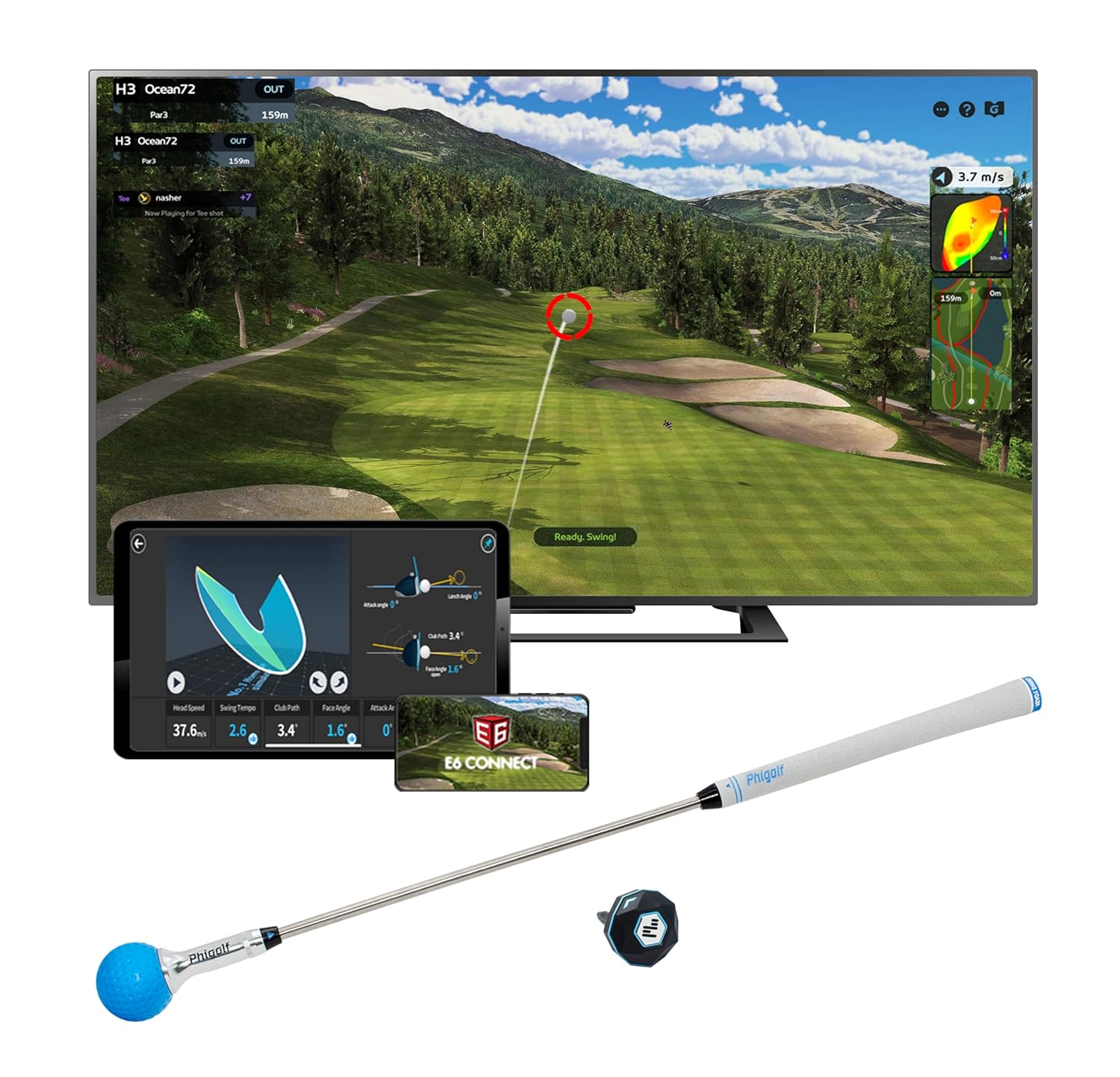
PHIGOLF ranks second because it solves the darkness problem through a completely different approach—it doesn’t need any light at all since it’s purely sensor-based, tracking motion and swing mechanics without relying on cameras or projections.
I took this system into a pitch-black basement, and it performed identically to how it would in broad daylight, which is exactly what you want in a bad-lighting scenario.
The magic here is the lightweight motion sensor that attaches to any club or the included swing stick, then pairs to your phone or tablet via Bluetooth to display courses and feedback on the app.
Because everything runs through a smartphone display, there’s no ambient-light interference, no screen washout, and no projection complications—just pure swing analysis on whatever screen you choose to use.
Portability is a genuine strength; this system fits in a suitcase and travels anywhere, which means if you’re renting or don’t want a permanent setup, you’ve got serious flexibility.
The 38,000-course library is robust enough for meaningful variety, and the four-player multiplayer means you can actually play with friends without everyone crowding around one screen. The swing stick mimics real club feel well enough that the transition to using your own clubs feels natural.
The honest trade-off is the smaller display compared to a projected image, which matters if you like watching a full landscape view of your course while playing.
Additionally, the phone-based setup requires you to prop your device somewhere or hold it, which is workable but less elegant than a dedicated screen. If you need a net to hit real balls, that’s an additional cost—though for app-only play in a confined dark room, that’s not necessary.
Rank 3: Complete Golf Simulator Enclosure Package — Framework for Serious Builders
Rating: 4.5/5 (141 verified reviews)
Key Specs:
- Available in multiple size options (e.g., 11′ x 8’4″ x 5′)
- 4K-ready premium impact screen (1 inch smaller than frame for tight coverage)
- Pre-installed projector mount
- Metal frame construction with blackout-cage design
- Shank nets on sides for safety
- No special tools required for assembly (under 1 hour setup)
- 12-month warranty with U.S.-based support
- Projector and turf sold separately
This enclosure ranks third because it’s not a complete simulator—it’s infrastructure, but infrastructure that directly solves the lighting problem by creating a controlled blackout environment. When bad lighting is your challenge, this cage approach is brilliant because you literally remove the variable by building walls that block external light.
What I appreciate about this system is that it’s honest about what it is: a professional-grade frame and blackout cage that lets you add any projector or launch monitor you choose later.
The pre-mounted projector bracket means you don’t have to jury-rig anything, and the 4K-ready impact screen is precision-engineered to minimize light bleed and maximize ball-strike durability. Because the cage is designed as a blackout environment, your room’s poor lighting becomes irrelevant; you’re creating the lighting conditions you want.
The setup is genuinely fast; I watched reviews showing assembly completed in under an hour with no drilling or special tools, which eliminates the common frustration of DIY simulator builds.
The metal frame feels sturdy enough for repeated ball impacts, and the side shank nets add a practical safety layer. Multiple size options mean you can fit this into different room configurations without excessive waste of space.
The catch is that you’re buying the shell, not the simulator—you still need to invest in a projector and either a launch monitor or impact screen software. This means your total cost isn’t just the enclosure price; it’s the enclosure plus equipment, which adds up quickly if you’re starting from scratch.
The system shines if you’re building a dedicated home studio and have the space commitment, but it’s not a grab-and-play solution.
Rank 4: Zensouds Golf Net — Supplemental Tool, Not a Simulator
Rating: 4.3/5 (583 verified reviews)
Key Specs:
- Dimensions: 10′ x 7′ hitting area
- 600D Oxford cloth with 270g high-density nylon net
- 0.45-inch reinforced fiberglass frame
- Bullseye target with four directional target pockets
- Includes 5 practice golf balls, a rubber tee, and a carrying bag
- Dome-tent setup with ground stakes
- Assembly time: under 5 minutes
- Works indoors and outdoors
This golf net ranks fourth because it’s not a simulator in any meaningful sense—it’s a mechanical practice tool that happens to work in any lighting condition because you’re watching real ball flight with your own eyes. I’m including it because some golfers might consider it for a dark room, but I want to be direct about what it can and can’t do.
The honest strength is that lighting becomes irrelevant since you’re not relying on screens or projections; you’re just hitting real balls into a net and watching where they go.
The bullseye target and directional pockets give you some feedback structure, and the portability means you can set it up anywhere in a bad-lighting room without worrying about power, projectors, or display washout. For under a hundred dollars, you get a durable piece of equipment that supports basic range practice.
Where this falls short for the “best simulator for bad lighting” conversation is the complete absence of metrics, course play, and feedback beyond visual ball impact.
You get no swing analysis, no launch data, no course simulation; just mechanical practice that’s useful for building consistency but nothing more. If you’re looking for engagement, competition, or game-like features, this won’t deliver them, and in dark rooms, you might actually struggle to see exactly where your ball lands without good light.
This tool makes sense as a supplement to a real simulator or as a starting point if you’re completely new to home golf practice and want something risk-free. But if your goal is the best simulator experience for a bad-lighting room, this nets you out before you even start the game.
What Makes a Simulator Work in Bad Lighting?
The fundamental rule is simple: your simulator either produces its own light or doesn’t depend on ambient light at all.
Projector-based systems fail in bad lighting because they need contrast between the projected image and the background, which is why projection gets washed out in bright rooms but also struggles in extremely dark spaces without proper blackout conditions.
A dark room only becomes the ideal setup for projection if you’ve intentionally removed competing light sources—that’s what the enclosure approach accomplishes.
Camera and sensor-based systems operate on completely different principles that make them light-independent.
The Garmin R50’s 3-camera system tracks ball position and swing mechanics through visual markers that work identically in darkness or daylight, which is why it’s so reliable regardless of your room’s brightness. PHIGOLF’s motion sensor doesn’t use cameras at all; it detects swing acceleration and positioning through movement, which is entirely unaffected by light levels.
The key insight is that “bad lighting” isn’t actually a problem if your system is designed for it—it only becomes a problem when your system requires external light to function.
That’s why choosing a simulator that’s engineered for darkness (like the Garmin) or engineered to be light-agnostic (like PHIGOLF) matters so much more than trying to fix your room’s lighting after the fact.
Direct Comparison: How Each System Handles Darkness
| Simulator Type | Light Dependency | Best Setup | Setup Speed |
|---|---|---|---|
| Garmin Approach R50 | None (self-lit display) | Any room, any light condition | Moderate (unbox and charge) |
| PHIGOLF Home | None (sensor-based) | Any room, any light condition | Very fast (pair and play) |
| Enclosure Package | Controlled (blackout design) | Dedicated room with a projector | Moderate (assembly required) |
| Golf Net | Needs visibility for ball flight | Any room with some ambient light | Very fast (setup in minutes) |
The Budget Reality: What You Actually Spend
If budget is driving your decision, PHIGOLF delivers the most functionality per dollar—it gives you full simulator capability with course play, metrics, and multiplayer for a modest investment.
The Garmin R50 costs significantly more but includes everything in one box with zero compromise on lighting performance. The enclosure package is deceptively affordable until you add a projector, at which point you’re well past a single-system budget.
What matters here is your total cost picture, not just the initial purchase price. The golf net is cheapest upfront but offers zero simulation features, so comparing it to real simulators isn’t really valid. The PHIGOLF strikes the sweetest balance if you need darkness-agnostic performance without the premium price, while the Garmin makes sense if you want a complete ecosystem that handles lighting constraints without compromise.
Space Constraints and Where Each System Fits
The Garmin R50 needs a flat surface and maybe a small table, but that’s it—the self-contained design means no projector distance requirements or room geometry constraints. PHIGOLF works in literally any space that fits your body, which means apartments, closets, or basements with awkward dimensions become viable options that would kill a projector-based setup.
The enclosure package demands dedicated square footage and won’t work if you’re trying to share a living room with family.
If you’re in a small dark room without the space for a full simulator build, the Garmin or PHIGOLF are your realistic choices. Both work anywhere and don’t force you into infrastructure-level decisions about dedicated space. The enclosure package only makes sense if you have an actual separate room you can claim for golf practice.
The Playing Experience: What Metrics and Features Actually Matter
The Garmin gives you real-time impact video, advanced ball-flight data, tournament mode with global leaderboards, and full 18-hole course simulation—it’s the most comprehensive feature set available.
PHIGOLF delivers swing analysis, course play across 38,000 courses, and multiplayer functionality on a smartphone screen, which covers most recreational golfers’ needs effectively. The enclosure approach is feature-dependent on whatever system you add to it; it’s neutral on actual gameplay.
If you care deeply about detailed metrics like spin rate, face-to-path measurements, and video-based swing analysis, the Garmin dominates. If you just want to play courses and get feedback on consistency, PHIGOLF does that admirably at a much lower commitment level.
Neither of these is objectively “better”—it depends on whether you prioritize depth of analysis or simplicity and portability.
Honest Lighting Considerations for Your Specific Setup
Before you decide, ask yourself these questions: Is your room naturally dark because it’s a basement, or is it dark because it lacks windows and good artificial lighting? Do you have electricity access for adding lights or projectors if needed? Can you actually control the lighting environment, or is it fixed by the room’s construction?
Your answers determine which system makes sense. A basement with no windows is perfect for the Garmin R50 because you don’t have to manage lighting variables at all. A small apartment with poor natural light is ideal for PHIGOLF because portability beats infrastructure concerns. A dedicated garage or finished basement where you can add blackout materials is the right home for an enclosure-plus-projector setup.
Frequently Asked Questions
What’s the actual problem with projector-based simulators in dark rooms?
Projectors need contrast to display a crisp image, which means they require either a bright ambient light that the projector overpowers (requiring excessive lumens) or a carefully controlled dark environment where no competing light sources wash out the image.
A naturally dark room without blackout control creates a middle ground that frustrates both approaches—too dark for the projector to feel bright, but not controlled enough for the image to pop. That’s why projector systems only truly shine in dedicated, blackout-controlled spaces.
Can I add lights to my dark room and use any simulator?
Technically, yes, but it defeats the purpose of investigating simulators for bad-lighting rooms. Adding bright ambient lighting to improve visibility introduces the opposite problem—glare, screen washout, and contrast loss.
The simulators ranked here are recommended because they eliminate the lighting problem, not because they force you to solve it through expensive room modifications.
Does the Garmin R50 work with clubs other than Garmin-branded equipment?
Yes, absolutely. The system works with any club as long as you use the included tracking stickers on your club heads. The 3-camera system doesn’t care what brand your equipment is—it tracks the stickers and your ball, so you’re free to use your existing clubs immediately.
Is the PHIGOLF sensor durable enough for regular practice?
The 9.8-gram sensor is lightweight but designed for durability in repeated swing analysis. Because it’s purely motion-based and doesn’t rely on impact detection, it doesn’t absorb physical stress the way impact-screen sensors do. I’d treat it carefully, but it’s engineered for regular home use, not just occasional play.
Do I need a net if I’m using PHIGOLF in app-only mode?
No, not at all. If you’re using the app-based course play and swing analysis, you’re not hitting real balls—you’re just performing swings while the sensor tracks your motion. A net is only necessary if you want to actually hit real golf balls while using the sensor, which extends the setup beyond just app play.
Can I use the enclosure package with a launch monitor instead of a projector?
Yes, the blackout cage and impact screen work with any launch monitor that outputs to a display. You’d connect your launch monitor to a monitor or small display inside the enclosure, and the blackout design would control your lighting environment either way. This is actually a smart approach if you want flexibility between simulator types.
How much light do I actually need to see the golf net’s target pockets?
You need enough light to see where your ball lands with reasonable clarity—you don’t need bright daylight, but you do need some visibility.
A basement with a few overhead lights works fine, but a completely pitch-black room would make it genuinely difficult to track where impacts occur. This is why the net ranks lower for truly bad-lighting situations; it doesn’t thrive in darkness the way the Garmin or PHIGOLF do.
What happens if I use the Garmin R50 outdoors in bright sunlight?
It works, but the 10-inch screen becomes harder to see in direct sunlight because the brightness washes out the display. This is the opposite problem of dark rooms, but it matters if you’re thinking about using the system both indoors and outside. The Garmin handles bad lighting perfectly; bright outdoor conditions are where it struggles.
How often does PHIGOLF update its course library?
The system provides access to 38,000+ courses through partnerships, but the update frequency depends on the app developer.
For most recreational golfers, the existing library is massive enough that new courses aren’t a practical concern; you could play thousands of rounds without running out of options. Check their support page for current update schedules if this matters to you.
If I go with the enclosure package, what projector do you recommend for a dark room?
This guide focuses on the simulators themselves rather than specific projector recommendations, but in general, a short-throw projector (throw ratio under 1.0) works well in tight spaces, and brightness between 2,500 and 4,000 lumens is appropriate for dark-room use without being excessive. Consult projector-specific reviews for models that fit your room dimensions and budget.
Conclusion
Bad lighting is actually one of the clearest defining factors in simulator selection because it eliminates a lot of options immediately.
You can’t use a standard projector setup without serious room modifications, and you can’t rely on ambient light to help your system perform better. What you’re left with are simulators designed to operate independently of light, and that’s a genuinely useful constraint.
The Garmin Approach R50 wins for someone who wants a complete, fuss-free system that performs identically in darkness or daylight—you pay for that reliability and comprehensiveness, but you get a simulator that solves the lighting problem by design.
The PHIGOLF Home wins for budget-conscious players who need portability and light independence without the premium price tag or screen-size limitations. The enclosure package wins if you’re building a dedicated home studio and want to control your lighting environment completely.
Choose based on your space, your budget, and what kind of golf experience you actually want to have. The good news is that all of these systems genuinely work in bad lighting—they just work for different reasons and different people.