

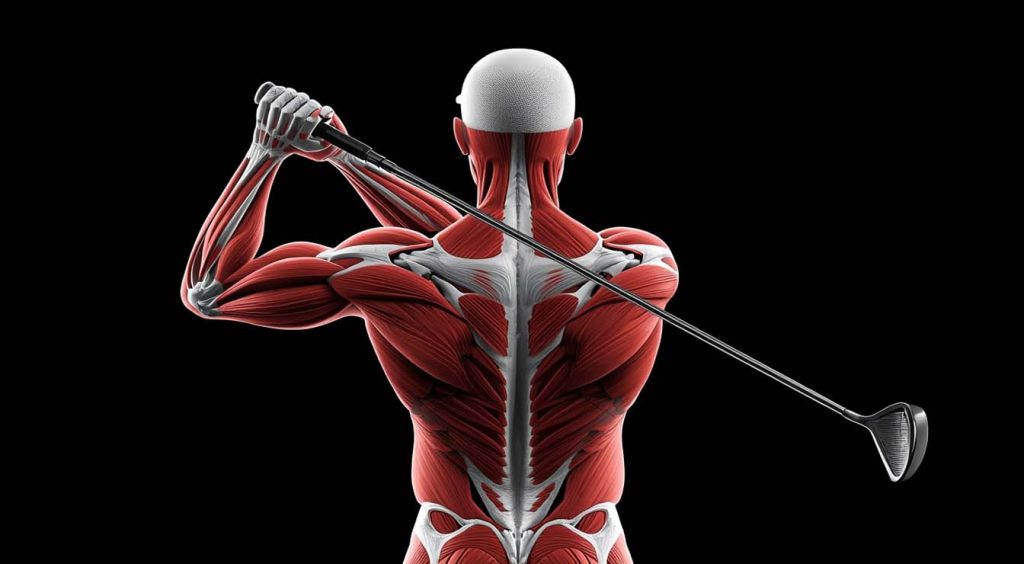
Golf works the entire body, with the most significant demand placed on the core, glutes, hips, back, shoulders, and legs. A correct golf swing activates more than a quarter of the body’s muscles through rotation, balance, and ground force rather than raw arm strength.
Golf is often misunderstood as a light or passive activity. In reality, it is a coordinated, athletic movement that depends on timing, sequencing, and muscular control. When done correctly, golf challenges strength, stability, mobility, and endurance simultaneously.
Why Golf Is Truly a Full-Body Sport?
Golf is built around the kinetic chain. Power does not start in the hands. It begins at the ground, moves through the feet and legs, transfers into the hips, flows through the core, and finally reaches the upper body and clubhead. If one part of this chain breaks down, distance and accuracy suffer.
Unlike running or lifting, golf relies heavily on rotation. Rotational movement places unique demands on the body because muscles must stabilise while turning at speed. This is why golfers often feel fatigue in the hips, core, and lower back rather than just the arms after a round.
Another reason golf works so many muscles is its repetitive nature. A single round includes dozens of full swings, partial shots, chips, and putts. Each motion requires control, posture, and balance, which keeps muscles engaged for hours rather than minutes.
Core Muscles: The Engine Behind Every Swing
The core includes the abdominal muscles, the obliques, the transverse abdominis, and the lower back. These muscles act as the central link between the lower and upper body. Their primary role is not brute force, but stability and controlled rotation.
During the backswing, the core resists unnecessary movement to maintain posture. During the downswing, it transfers energy created by the legs and hips into the shoulders and arms. A weak or inactive core forces golfers to rely on their arms, leading to inconsistent contact and reduced power.
Strong core engagement also protects the spine. Golfers who lack core stability often experience lower back discomfort because the spine absorbs forces it was never designed to handle on its own.
Glutes and Hips: The Primary Power Source
The glutes and hip muscles play the most crucial role in generating power. As the downswing begins, the lead-side glute contracts to rotate the pelvis and shift weight toward the target. This movement creates speed while keeping the body balanced.
Many amateur golfers fail to use their hips correctly. Instead of rotating, they slide or stall, which places extra strain on the lower back. Professional golfers, by contrast, rely heavily on hip rotation and ground pressure to create effortless-looking power.
Well-trained glutes also improve endurance. Over 18 holes, strong hips help maintain posture and consistency, especially late in the round when fatigue sets in.
Back Muscles: Control, Width, and Stability
The muscles of the upper and mid-back, including the latissimus dorsi, rhomboids, and trapezius, control the shoulder turn and arm position. These muscles help keep the arms connected to the torso, which is essential for a repeatable swing path.
During the backswing, the lats help create width and depth. During the downswing, the back muscles help control the club’s path and prevent over-the-top movement. Without adequate back engagement, swings often become arm-dominant and inconsistent.
Back strength also plays a key role in injury prevention by supporting the shoulders and spine during rotation.
Legs: Balance, Stability, and Ground Force
The legs provide the foundation of the golf swing. The quadriceps and hamstrings stabilise the body while allowing smooth weight transfer from the trail side to the lead side. This subtle shift is essential for solid contact.
As fatigue builds, leg stability often declines. This is why many golfers struggle with balance and ball striking toward the end of a round. Strong legs allow golfers to maintain posture and tempo from the first tee to the final putt.
Chest, Arms, and Forearms: Speed and Precision
The chest muscles activate strongly during the downswing to bring the arms toward the ball. Proper chest rotation helps square the clubface naturally, reducing the need for last-second hand manipulation.
The arms guide the golf club, while the forearms and wrists manage grip pressure and face control. These muscles work continuously throughout a round, especially during short shots where precision matters most. Excess tension slows the swing, while poor control leads to inconsistent strikes.
Muscles Used in Each Phase of the Golf Swing
At setup, postural muscles, glutes, and core stabilisers engage lightly to maintain balance and spine angle. This stage sets the foundation for the entire swing.
During the takeaway, the shoulders and back muscles initiate movement, while the core helps prevent excessive sway. A smooth takeaway reduces compensations later in the swing.
In the backswing, the obliques, glutes, and rotator cuff muscles load rotational energy. This stored energy enables an efficient downswing.
The downswing and impact phase produces the highest muscle activation. The legs push into the ground, the hips rotate, the core transfers energy, and the chest and arms accelerate the club. When timed correctly, this sequence creates power without strain.
During the follow-through, the core and back muscles slow the body down and keep the golfer balanced. A controlled finish is a sign of good sequencing and physical control.
Amateur vs Professional Muscle Use
The most significant physical difference between amateur and professional golfers is sequencing. Professionals generate speed from the ground up, while amateurs often rely on the upper body.
Professionals use their legs, hips, and core efficiently, which allows them to swing faster with less visible effort. Amateurs tend to overuse their arms and shoulders, leading to fatigue and inconsistent ball striking.
This difference explains why improving movement quality often adds more distance than simply swinging harder.
Does Golf Build Muscle or Improve Tone?
Golf primarily develops muscular endurance, coordination, and functional strength. It improves muscle tone and joint stability, but it does not significantly increase muscle size on its own.
Players who want visible muscle growth must combine golf with strength training. However, golf excels at teaching the body how to move efficiently, which benefits overall athleticism.
Long-Term Physical Effects of Playing Golf
Over time, regular golf improves balance, coordination, and rotational mobility. It also strengthens the muscles responsible for posture and spinal support.
However, golf can create imbalances because the same side of the body is used repeatedly. Tight hips, overworked forearms, and uneven core strength are common among frequent players. Addressing these issues through mobility and strength work helps prevent injury and maintain performance.
Training the Right Way for Golf Performance
Practical golf training focuses on how muscles work together, not how much weight can be lifted. Exercises that improve rotation, stability, and balance directly translate into better swings.
Golfers who understand how to use golf club mechanics efficiently benefit more from movement-based training than from isolated muscle exercises. This approach also reduces stress on the joints.
Injury Prevention and Physical Longevity
Most golf injuries come from overuse and poor sequencing rather than impact. The lower back, shoulders, and elbows are the most common problem areas.
Consistent warm-ups, balanced strength training, and proper technique protect the body over years of play. Early warning signs include reduced rotation, lingering stiffness, and grip discomfort.
Is Golf a Good Workout Compared to Other Sports?
Golf does not produce the same short-term intensity as high-impact sports, but it offers sustained muscle engagement over several hours. Walking the course, maintaining posture, and repeating controlled swings create a steady physical demand that improves endurance and coordination.
Compared to gym workouts, golf emphasises movement quality and control rather than isolated strength.
Who Benefits Most Physically From Golf?
Golf is suitable for a wide range of players, from beginners to older adults. Its low-impact nature makes it accessible, while its technical demands reward proper conditioning.
Players who rely on credible golf resources and structured coaching often see faster physical improvements and fewer injuries, regardless of age or skill level.
High-Value Resources That Improve Understanding and Rankings
Authoritative resources strengthen both knowledge and search visibility. Trusted sources include professional instruction platforms, sports science organisations, and biomechanical research centres. These resources help players understand movement patterns, injury prevention, and performance optimisation in ways most articles overlook.
Search engines favour content supported by recognised institutions because it signals accuracy and reliability across all platforms.
Expert Insight: Why Most Golfers Struggle Physically
Most golfers focus on swing positions instead of body movement. The swing is a result of how the body moves, not the other way around. Improving strength, mobility, and sequencing produces more consistent results than chasing technical tips alone.
People Also Asked
1. Does playing golf help with weight loss?
Golf can support weight loss when you walk the course regularly and play often, but diet and overall activity level matter most.
2. Is golf harder on the body than it looks?
Yes. The repetitive swinging and long hours of standing place steady physical stress on muscles and joints.
3. Can beginners feel muscle soreness after golf?
Absolutely. New players often feel soreness because their bodies aren’t used to rotational movement and prolonged posture control.
4. Is golf safe for people with joint issues?
Golf is generally joint-friendly, but poor technique or lack of mobility can increase strain, especially in the back and elbows.
5. How often should golfers rest to avoid overuse injuries?
Taking at least one or two rest days per week helps muscles recover and reduces the risk of chronic pain.
Final Word
In summary, what muscles does golf work comes down to this: nearly the entire body works together in every swing. From the legs and glutes generating power to the core transferring energy to the upper body controlling the golf club, golf is a full-body sport that rewards efficient movement, balance, and long-term physical conditioning.