
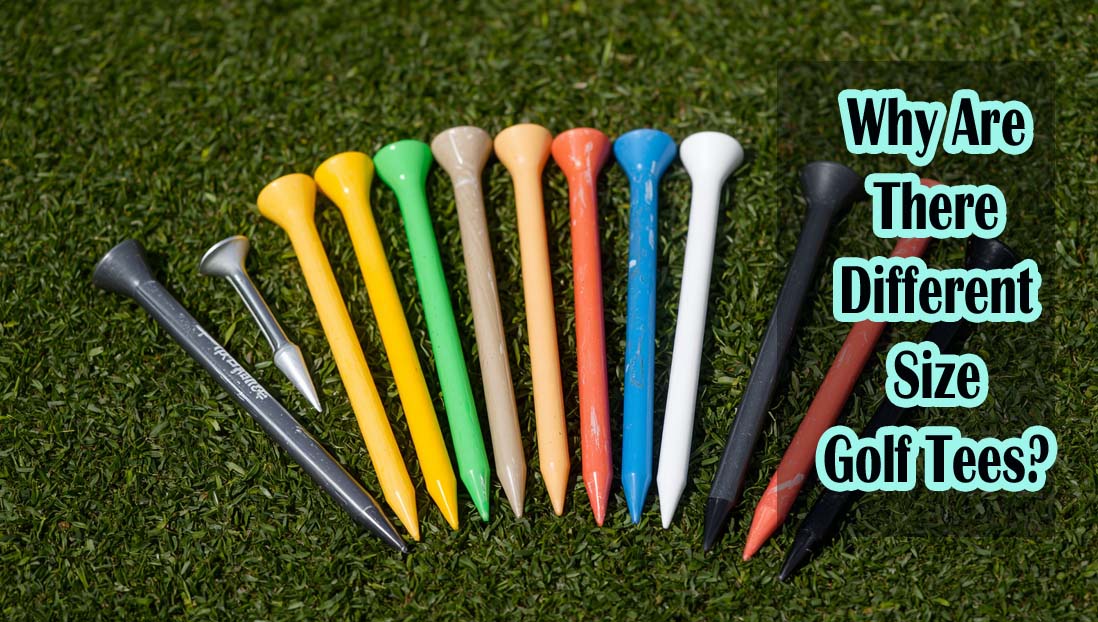
You have probably noticed that golf tees come in several different lengths. You might have wondered why you need more than one size. The answer is simple: every golf club has a different face height, a different sweet spot location, and a different way it should hit the ball.
The right tee length puts the ball at the exact height where your club is designed to make the best possible contact. Using the wrong size can cost you distance, accuracy, or both.
The Simple Physics Behind Tee Length Variation
A golf swing is not a straight-on hit. Your clubhead travels in a wide arc, and the angle it approaches the ball changes based on which club you are using. A driver swings upward into the ball. An iron swings downward into the ball. The tee must place the ball at the right height for that specific swing path.
Think of the tee as a platform. Its only job is to put the ball in the vertical zone where the clubface is designed to strike it. When the ball is too high for the club, you hit it on the top of the face or even the crown. When the ball is too low, the club sole digs into the ground before you ever reach the ball.
The general rule is this: the top of the ball should be roughly level with the top of the clubface at address. But that rule changes based on how the club is built and how you swing it.
How Clubhead Design Drives Tee Length Requirements?
Every clubhead is engineered differently. The size of the face, the shape of the sole, and the location of the center of gravity all determine what tee height works best.
Driver and the Tall Face
The driver has the largest head and the tallest face. Many driver faces are over two inches tall. To hit the sweet spot, you need the ball high enough that the clubface center meets the ball on an upward swing. A driver is designed to be swung slightly upward.
If you tee it too low, you either hit the top of the ball or dig the sole into the turf. The best tee heights for a driver are between 3.25 inches and 4 inches. The 4-inch tee is the maximum allowed by the rules. It gives you the highest launch and the least spin.
Fairway Woods and the Shallow Face
A fairway wood has a shorter face than a driver. Its center of gravity is lower. You want to sweep the ball off the turf or a low tee. A 2.75-inch or 3.25-inch tee works well. If you use a driver-height tee, you risk hitting the ball above the sweet spot or even hitting the crown of the club. That shot will feel dead and go nowhere.
Hybrids and the Compact Head
Hybrids have a thick sole and a compact face. They are designed to be hit with a slightly descending blow. A tee height of 2.125 inches to 2.75 inches is typical. A hybrid tee too high often results in a thin shot that skips along the ground.
Irons and the Descending Blow
Irons are made to hit down on the ball. The sole is narrow, and the leading edge sits close to the ground. A high tee works against the iron’s design. You want the ball low, so a 1.5-inch or 2.125-inch tee is best. Many golfers use no tee at all for iron shots, but on a par 3, a short tee gives you a perfect lie every time.
Wedges and Control
Wedges are rarely teed high. When you do use a tee for a wedge shot, it is usually a 1.5-inch tee. The goal is to keep the ball low for better spin and control. A high tee with a wedge often leads to a bladed shot that runs over the green.
| Club Type | Recommended Tee Length | Why This Length Works |
|---|---|---|
| Driver | 3.25 to 4 inches | Promotes an upward strike and full face contact |
| Fairway Wood | 2.75 to 3.25 inches | Matches the shallower face and sweeping swing |
| Hybrid | 2.125 to 2.75 inches | Keeps the ball low enough for a descending blow |
| Iron (3–9) | 1.5 to 2.125 inches | Allows a clean descending strike with the sole of the shoe clearing the ground |
| Wedge | 1.5 inches or none | Maximizes spin and control on short shots |
The 4-Inch Rule and the Limits of Tee Length
The USGA and R&A rules state that a golf tee cannot be longer than 4 inches. This rule exists for a good reason. If you could use a 6-inch tee, you could tee the ball so high that it would be almost impossible to mishit. The ball would float in the air with the clubhead, making the driver much easier to use. The rule keeps the game challenging.
The 4-inch limit also defines the natural range for driver tees. Most golfers use something between 3.25 and 4 inches. There is no practical reason to use a tee shorter than 1.5 inches for any club except a putter, which is never teed anyway.
Why Tee Height Affects Launch Angle and Spin?
The height of the tee directly changes how the ball launches. When you use a high tee with a driver, you naturally hit the ball on the upswing. This positive angle of attack reduces backspin and increases launch angle. Lower spin and higher launch usually mean more carry distance.
A 4-inch tee can give you 10 to 15 extra yards of carry compared to a 2.75-inch tee with the same driver and swing.
A low tee encourages a descending blow. More backspin is created, and the launch angle drops. This is useful with irons when you want the ball to stop quickly on the green. But with a driver, too much backspin can balloon the ball into the wind and shorten your total distance.
There is a limit to this effect. If your natural swing already produces too much spin, a very high tee can make it worse. The high tee might launch the ball too high with too much spin, costing you roll. The best approach is to experiment.
Try a 3.25-inch tee for five drives, then try a 4-inch tee for the next five. See which gives you the best combination of carry and roll.
Course Conditions and Player Adaptability
Tee height is not a fixed number. You should adjust it based on the conditions you face on the course.
Turf Firmness
On soft, lush tee boxes, a long tee sinks into the ground when you push it in. This reduces the effective height. If you normally use a 3.25-inch tee on hard ground, you might need a 3.75-inch or 4-inch tee on soft ground to get the same ball height. On hard, dry tee boxes, the same tee stays at its full height. A 4-inch tee on hard ground might feel too high. Try a 3.25-inch instead.
Wind
Wind changes everything. In a strong headwind, a high tee shot with a driver will balloon into the wind and lose distance. Drop down to a shorter tee for your driver. The lower trajectory will keep the ball under the wind, giving you more roll. In a tailwind, use a higher tee to take advantage of the lift.
Your Swing Plane
Your individual swing matters. If you are a steep swinger who hits down on the ball even with a golf driver, you need a higher tee. The longer tee prevents you from digging the sole into the ground before impact. If you are a shallow swinger who sweeps the ball, you can use a lower tee without risk.
Here is a simple checklist. If you are hitting pop-ups, tee the ball lower. If you are hitting grounders, tee it higher. One change at a time will show you what works.
Frequently Asked Questions
Can I use a driver tee with my 3-wood?
Yes, but you will likely hit the ball above the sweet spot. The 3-wood face is shorter. A driver-height tee puts the ball so high that the center of the face misses the ball. The result is a weak shot that flies lower and shorter than it should.
Why are some tees marked with a height line?
Some tees have a painted line or a ridge at a certain height. This helps you push the tee into the ground to the same depth every time. If you have found a tee height that works for your driver, a marked tee saves you from guessing.
Does the tee material affect the ideal length?
No. The material does not change the height. But plastic tees are more durable than wooden tees. If you use a plastic tee for many rounds, check that it has not worn down. A worn plastic tee might be shorter than when you bought it, which changes the effective height.
What happens if I use a 4-inch tee with a 9-iron?
You will likely swing under the ball. The club sole will hit the ground behind the ball, or you will catch the ball on the top edge of the face. The shot will be thin or topped. A 9-iron needs a descending strike, and a high tee prevents that.
Now you know why every tee length has a job. Experiment with one change at a time and see how your ball flight responds. The right tee is not complicated. It is just the one that matches your club and your swing.