

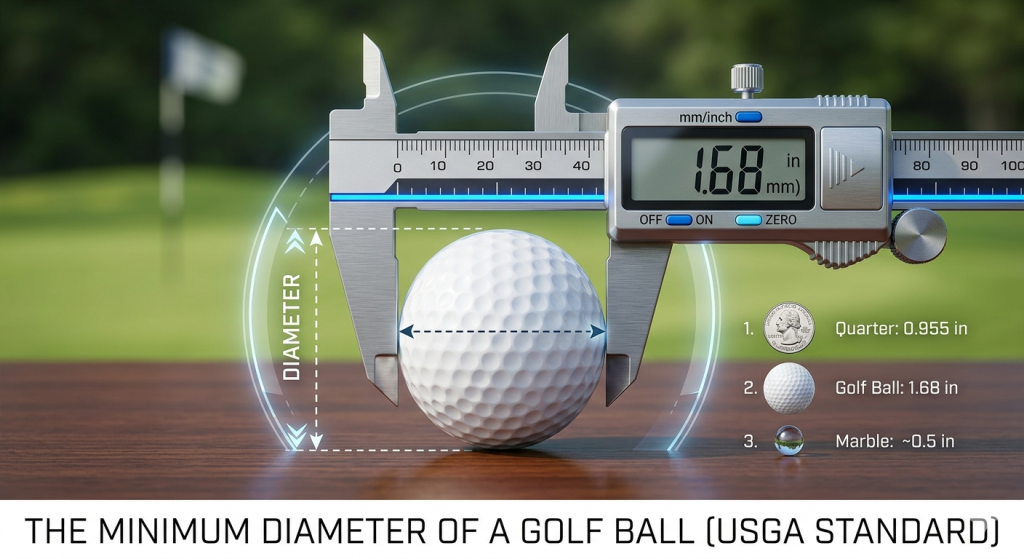
If you want to know the details about how to boost golf performance? Yes, just check the detailed answer here. The official minimum diameter of a regulation golf ball is 1.68 inches (42.67 millimetres). The USGA and The R&A set this standard. There is no maximum size limit, but every ball used in competitive golf follows this measurement to ensure fair and consistent performance.
What Is The Diameter Of A Golf Ball? Understanding the Official Golf Ball Diameter
Golf is a sport built on precision, and the golf ball is no exception. The diameter of a golf ball is not a random number. It is a carefully chosen standard designed to balance distance, control, and fairness across all levels of play.
A regulation golf ball must measure at least 1.680 inches across, measured from edge to edge through the centre. This measurement is used worldwide in professional tournaments, amateur events, and everyday competitive rounds.
Although the rules allow a ball to be larger than this minimum, manufacturers intentionally stay very close to the standard size. Any noticeable increase in diameter would negatively affect flight, spin, and feel, making the ball less practical for real play.
Golf Ball Diameter vs Radius: A Common Source of Confusion
Many beginners confuse a golf ball’s diameter with its radius, but the two measurements are different.
- Diameter: 1.68 inches (42.67 mm)
- Radius: 0.84 inches (21.34 mm)
The diameter measures the distance from one side of the ball to the other through its center, while the radius measures the distance from the center of the ball to its outer edge.
Understanding this difference is helpful when reading golf equipment specifications or comparing golf balls with other spherical objects. Regardless of brand, every conforming golf ball must have a minimum diameter of 1.68 inches under the Rules of Golf.
Quick Fact: The radius of a standard golf ball is exactly half of its diameter—0.84 inches (21.34 mm).
Who Sets the Rules for Golf Ball Size?
Two governing bodies control golf equipment rules globally: the United States Golf Association (USGA) and The R&A. Together, they create a single rulebook that applies across continents, tours, and competitions.
Their role goes beyond writing rules. Every golf ball model sold as “tournament legal” must be tested and approved. This ensures that when a golfer tees up anywhere in the world, the ball behaves within the same performance limits.
This shared governance is one reason golf maintains consistency across generations, even as technology evolves.
Golf Ball Diameter and Weight: Why They Work Together
The diameter rule cannot be separated from the weight rules. A golf ball must not weigh more than 1.620 ounces (45.93 grams). These two limits function as a pair.
If a ball were smaller but still heavy, it could fly farther than intended. If it were larger but very light, it could float unpredictably in the air. By controlling both size and weight, the rules protect the balance between power and skill.
This balance ensures that distance gains come from technique, not from exploiting equipment loopholes.
Why the Standard Is Exactly 1.68 Inches?
The 1.68-inch diameter is not arbitrary. It represents a point where aerodynamics, control, and playability meet.
At this size:
- The ball creates enough lift to stay airborne
- Drag remains manageable in windy conditions
- Dimples can be engineered for stable, predictable flight
This is why modern golf balls, including the most useful golf balls played on professional tours, are designed precisely around this dimension.
How Does Golf Ball Diameter Affect Performance?
Although all regulation balls share the same diameter, that size still plays a significant role in how a ball performs.
First, it influences aerodynamics. The diameter determines how air flows around the ball and how dimples interact with that airflow. This directly affects lift and drag.
Second, it impacts spin control. A consistent size allows manufacturers to fine-tune spin rates without changing how the ball sits on the clubface.
Finally, it affects putting and rolling. A uniform diameter ensures predictable roll speed and tracking on the green, which is critical for scoring.
A Short History of Golf Ball Size
Golf did not always use a single ball size. For much of the 20th century, two standards existed.
The smaller “British ball” measured about 1.62 inches, while the American ball measured 1.68 inches. Skilled players often preferred the smaller ball because it flew slightly farther, especially in windy conditions.
However, this created an inconsistency in international competition. To solve this, governing bodies unified the standard. By 1990, the smaller ball was fully phased out, and the modern diameter became universal.
This change made global competition fairer and simplified the manufacturing of equipment.
Why There Is No Maximum Golf Ball Size?
A common question is why the rules define only a minimum diameter.
The reason is practical. While larger balls are technically allowed, they perform worse. Increased surface area creates more drag, reduces distance, and limits shot shaping. Players quickly reject oversized balls because they feel slow and unresponsive.
As a result, market forces naturally keep ball sizes at the optimal level without the need for a maximum limit.
Regulation Balls vs Non-Regulation Balls
Not every golf ball you see is designed for competition. Some are made purely for training or entertainment.
There are three general categories:
- Regulation balls that meet all size and weight rules
- Practice balls designed for limited-flight ranges
- Novelty balls are used for fun or casual play
Only the first category is allowed in tournaments and official handicapped rounds.
How Manufacturers Design Balls Around the Size Rule?
Modern golf ball engineering takes place within tight constraints. Since size and weight are fixed, innovation focuses on internal construction.
Manufacturers adjust core compression, mantle layers, cover materials, and dimple geometry. This is why two balls of identical diameter can feel completely different at impact.
This also explains why tour professionals often stay loyal to one model. Consistency at a fixed size builds trust over time.
Most Useful Golf Balls for Real Players
The most useful golf balls are not defined by size alone. They are chosen for reliability, feel, and predictable flight.
Tour-level balls dominate professional play because they offer balanced performance across driving, iron shots, and putting. Mid-handicap golfers often prefer slightly firmer balls that reduce spin on mishits while still conforming to the same size rules.
Regardless of skill level, every proper ball starts with the same 1.68-inch foundation.
How to Check If a Golf Ball Is Regulation Size?
If you want to be sure your ball is legal for competition, there are simple ways to confirm it.
You can measure the diameter with a ruler or calliper, check the manufacturer’s conformity marking, or compare it against officially approved ball lists published by governing bodies.
This step matters for tournament players and anyone submitting scores for an official handicap.
Common Myths About Golf Ball Diameter
Many golfers assume size alone creates distance or control. In reality, diameter is just the baseline.
More petite balls are not faster in modern golf, and larger balls do not make the game easier. Performance gains come from construction, not from breaking size rules.
Understanding this helps golfers focus on what truly improves scoring.
Golf Expert Opinion
Dean Snell, a well-known golf ball designer and former senior engineer at Titleist, explains that the 1.68-inch golf ball diameter is the foundation of modern ball performance. According to Snell, this size creates the ideal balance between lift, drag, and spin control, allowing engineers to fine-tune distance and feel without changing the nature of the game.
He notes that once the global standard was unified, manufacturers shifted their focus from size manipulation to internal construction, which is why today’s most useful golf balls deliver consistent performance across different swing speeds and playing conditions.
This expert insight confirms that golf ball diameter is not about hitting the ball farther, but about maintaining fairness, predictability, and skill-based outcomes in the sport.
People always asked
FAQ 1: What is the standard diameter of a golf ball?
Ans: The standard diameter of a regulation golf ball is 1.68 inches (42.67 mm). This is the minimum size allowed by the USGA and The R&A.
FAQ 2: Is there a maximum size limit for a golf ball?
Ans: No, there is no maximum size limit for a golf ball. However, all competitive golf balls stay close to the minimum size for better performance and control.
FAQ 3: Did golf balls used to be smaller?
Ans: Yes. Before 1990, some competitions allowed a 1.62-inch golf ball, mainly under British rules. This smaller ball is no longer legal in competitive play.
FAQ 4: Does golf ball size affect distance?
Ans: Golf ball size affects aerodynamics, but since all legal balls are the same size, distance differences come from ball construction, not diameter.
FAQ 5: Are oversized golf balls legal in tournaments?
Ans: No. Oversized or novelty golf balls are not legal for tournament play. Only balls that meet official size and weight rules are allowed.
Final Thoughts: Why Golf Ball Diameter Still Matters
The 1.68-inch diameter is one of the most important constants in golf. It protects fairness, preserves skill, and allows innovation without changing the nature of the game.
Every most useful golf ball, from amateur rounds to major championships, follows this rule. Knowing why it exists helps golfers make smarter equipment choices and better appreciate how the game is designed.