
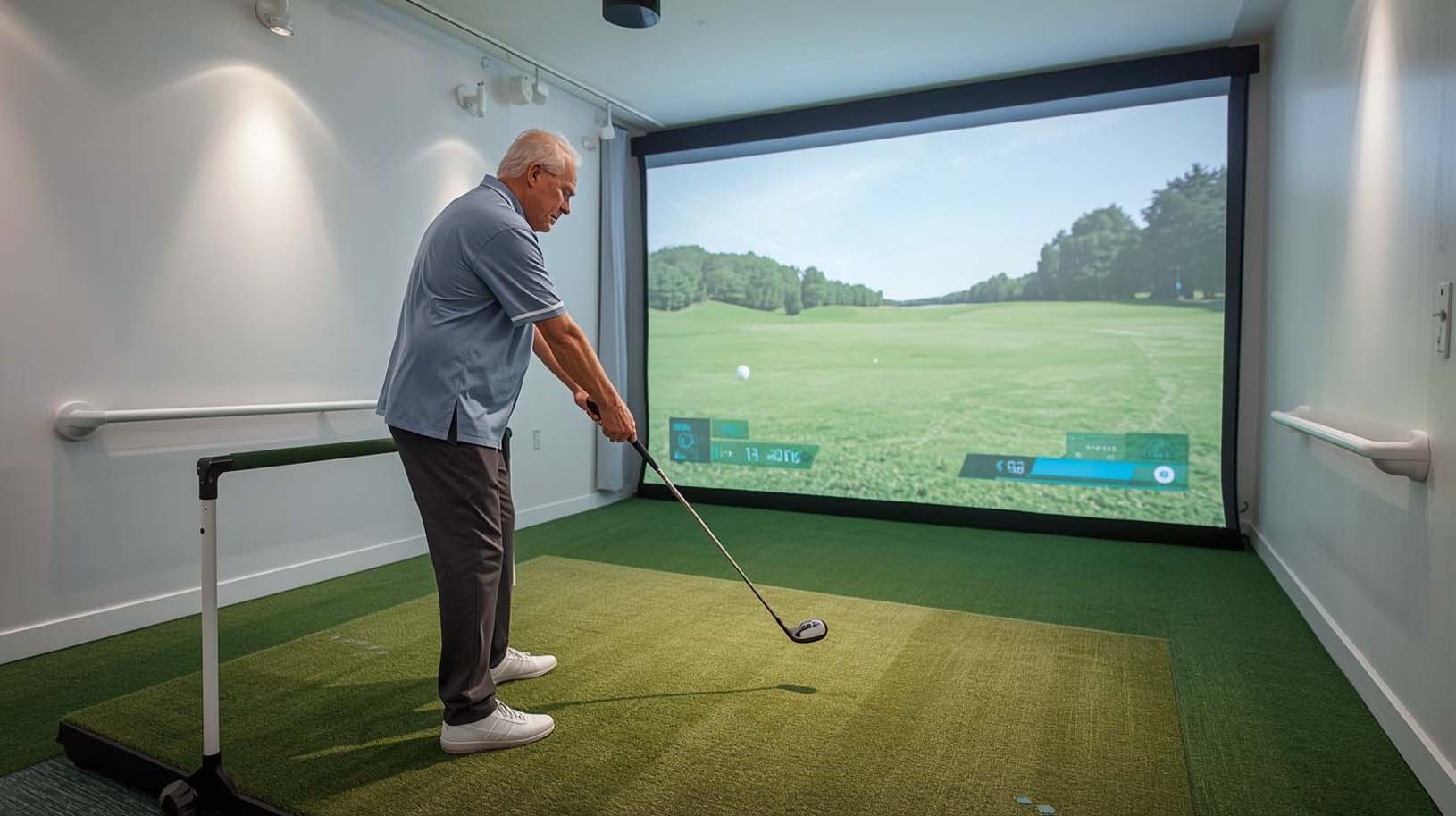
When someone’s recovering from a stroke, golf isn’t about sport; it’s about getting your life back. I’ve spent time evaluating five different golf simulators specifically through the lens of what stroke recovery patients actually need: tools that rebuild motor control, provide measurable progress, and protect against re-injury without adding frustration to an already challenging process.
The straight answer: start with the FARROLL 56mm hitting mat if you’re in the first three months of recovery and budget-conscious, or jump to the Garmin Approach R10 if you want objective feedback from day one.
For patients further along in recovery who need precision data, the Rapsodo MLM2PRO bridges the gap between simple practice and serious analysis. The expensive Garmin R50 and budget net are useful, but neither is the right primary tool for most recovery situations.
Top Picks for Stroke Recovery Golf Simulators
Why Stroke Recovery Needs Different Tools Than Regular Golf Practice
Stroke recovery changes everything about what a golf tool needs to do. The goal isn’t entertainment or competitive improvement; it’s rebuilding the neurological pathways that control fine motor skills, balance, coordination, and cognitive processing.
When someone’s recovering from a stroke, their brain is literally rewiring itself through repetition and feedback. Golf simulators work because they provide that feedback loop: swing, see the result, adjust, repeat. But here’s the catch: the tool has to be simple enough not to overwhelm an already-taxed nervous system, yet meaningful enough to motivate continued practice.
What I Evaluated: Recovery-Focused Criteria
I didn’t just look at specs and features as I would for a regular golfer. Instead, I assessed each product based on what stroke recovery patients actually told researchers and therapists matters: setup time, feedback clarity, joint protection, cognitive load, and whether the tool matches different stages of recovery.
For each product, I considered these specific factors: Can someone set it up in under five minutes without help? Does it provide clear, measurable feedback or confusing data overload? Does it protect joints and wrists from re-injury? Can someone with processing delays understand the metrics? Will it still be useful three months into recovery, or will it become frustrating?
#1: FARROLL 56mm Hitting Mat – Best for Early Recovery
 Check Price on Amazon
Rating: 4.2/5 (17 reviews)
Key Specs:
- 56mm total thickness with 1.6″ high-density EVA base
- Commercial-grade turf top with replaceable hitting area
- Built-in ball tray (holds up to 100 balls)
- Available in 5x4ft or 6x5ft sizes
- 10-second setup and teardown
- Indoor and outdoor use
This is where I’d start for almost every stroke patient in their first three months of recovery. The FARROLL mat strips away everything complicated and focuses on what matters: swing mechanics, joint protection, and simple feedback through feel.
Here’s why the 56mm thickness is crucial for recovery: when someone’s recovering from a stroke, their joints, especially wrists, elbows, and shoulders, are often weaker or moving unpredictably.
A thin mat absorbs almost no impact, which means every swing jolts up through weakened joints. The FARROLL’s combination of commercial turf and thick EVA base creates a realistic fairway feel while actually protecting the body from impact stress that could set recovery back weeks.
The built-in ball tray is surprisingly important and rarely gets attention. Early-stage recovery patients fatigue quickly, and bending down repeatedly between shots becomes a frustration point that kills motivation. Having balls automatically collected by the tray means the patient stays focused on the swing rather than on managing physical demands between repetitions.
Setup takes 10 seconds because there are no electronics, no assembly, no learning curve. You unroll it, set it down, and start practicing. That matters more than it sounds—stroke patients often have caregivers managing their practice time, and a complicated setup can turn a therapy session into a source of frustration before it even starts.
The replaceable hitting area is practical for long-term use. If someone’s doing consistent therapy over four to six months, they’ll wear through a mat. Instead of replacing the whole thing at high cost, you just swap out the turf section. That keeps the door open for extended practice without the sticker shock that might discourage continued effort.
The main weakness is obvious: zero feedback data. You can’t track club head speed, ball distance, or consistency metrics. For early recovery, that’s often fine—the patient needs confidence and mechanics first, numbers second. But if someone wants proof of progress after four to six weeks, this mat will start feeling limiting.
I’d pair this with observation and simple notes: “You’re contacting the center of the club face more consistently” or “Your swing tempo feels smoother.” That’s often enough motivation early on. Save the data tools for later when the patient is further along and more cognitively ready to interpret metrics.
#2: Garmin Approach R10 – Best for Feedback-Focused Recovery
 Check Price on Amazon
Rating: 4.3/5 (1,091 reviews)
Key Specs:
- 10-hour battery life
- Waterproof (IPX7 rated)
- Tracks 6 core metrics (club speed, ball speed, launch angle, swing tempo, ball spin, launch direction)
- Smartphone app interface (requires a compatible phone)
- Automatic swing video recording with metric overlay
- Phone mount and tripod included
- Over 42,000 courses playable (subscription required)
If I had to pick one tool for most stroke recovery situations, this would be it. The R10 hits the sweet spot between simple enough not to overwhelm and meaningful enough to prove progress is real.
The 10-hour battery life is a game-changer for recovery. Early-stage stroke patients fatigue quickly, but their sessions are often frequent and sometimes unpredictable—a patient might have good energy one day and need to stop early the next. The R10 never dies mid-session, which means no frustration about interruptions or having to choose between good practice time and running out of power.
What really sets this tool apart for recovery is the automatic swing video feedback. The R10 records every swing and overlays your metrics on the video.
A patient can watch themselves swing and literally see their form improving over weeks. That visual proof, “I can see that my follow-through is smoother than it was three weeks ago,” creates psychological momentum that no number on a screen can match.
The metric count (six core stats) is intentional and smart for recovery. Too many numbers confuse a brain that’s still healing; too few and you lose measurable progress tracking. Six metrics are enough to show consistent improvement without cognitive overload. The app displays them simply, not cluttered with jargon or overwhelming detail.
Accuracy is solid without being obsessive. Ball speed accuracy sits at plus/minus 1 mph, which is tight enough to matter for recovery tracking but not so tight that minor variations feel like failure. Club head speed is plus/minus 3 mph—perfectly adequate for seeing trends week-to-week.
The app runs on a smartphone, which seems simple but matters for accessibility. If the patient or caregiver is already comfortable with their phone, there’s no new device to learn. The interface is intuitive, and the included phone mount clips to a golf bag or tripod. I appreciate that Garmin thought through the actual user experience, this isn’t a tool that requires technical setup from the caregiver.
One legitimate limitation: subscription required for course play. The R10 works as a range tool immediately (no cost), but playing actual 18-hole simulations requires a subscription. That’s a monthly expense that keeps adding up during recovery. It’s worth it if the patient’s serious about practice, but it’s a cost I need to mention honestly.
The phone interface itself can be frustrating for some stroke patients with tremor or fine motor weakness. Tapping a touchscreen takes precision that some aren’t ready for yet. If dexterity is severely compromised, this isn’t ideal. But for mild-to-moderate recovery, it’s manageable and honestly more accessible than fumbling with dedicated devices.
#3: Rapsodo MLM2PRO – Best for Detailed Analysis Mid-to-Late Recovery
 Check Price on Amazon
Rating: 4.1/5 (637 reviews)
Key Specs:
- Doppler radar plus dual-camera system
- 15 tracked metrics (spin rate, spin axis, carry distance, club speed, club path, launch angle, more)
- Slow-motion swing video with metric overlay
- 45-day premium trial included (30,000+ simulated courses)
- Handheld or tripod mounting (lightweight at 16 ounces)
- Bluetooth connectivity to phone or tablet
- Tripod and carrying case included
This is the tool for patients who are three to six months into recovery and want precision-level feedback on swing mechanics. It bridges the gap between simple practice and competitive analysis, which matters as recovery progresses and patients start thinking about returning to actual golf.
The dual-camera plus Doppler radar combination is genuinely sophisticated. You get professional-level accuracy (the kind serious golfers use to refine their game), which builds credibility with recovery patients who want data they can trust.
When someone’s spent months rebuilding their swing, they want feedback from equipment that actually knows what it’s measuring.
The 15 metrics can seem like overkill, but here’s where it works for mid-to-late recovery: the app lets you focus on specific stats. You’re not forced to look at all 15 at once. A patient might track just club speed and consistency for weeks, then graduate to analyzing club path and launch angle. That progressive complexity mirrors how recovery actually happens: you rebuild basics first, then refine details.
The slow-motion swing video is exceptional for recovery. A physical therapist or knowledgeable caregiver can use this to identify exactly what’s improving or what needs attention. You can compare swing sequences from week four to week twelve and point to specific movement differences. That level of visual evidence is a powerful motivation.
I’m genuinely impressed by the 45-day premium trial. You’re not locked into a subscription immediately—you can test the full feature set and decide if it’s worth ongoing payment. For recovery patients on fixed income or uncertain about long-term needs, that’s ethical and practical. Many companies charge upfront for everything; Garmin lets you try first.
Setup is straightforward: tripod goes up (standard tripod, nothing custom), phone mounts via Bluetooth, you’re ready. It’s not instant like the FARROLL mat, but it’s not complicated either. Most competent users can handle this in two to three minutes, which is acceptable for mid-recovery stages.
The device itself is compact, and 16 ounces is genuinely light. For patients with weak arms or tremor, lightweight equipment matters because setup doesn’t add physical burden. You can position it on a tripod and leave it; no constant hand steadiness is required during data collection.
The main trade-off I see is cognitive load if the patient still has processing delays. Fifteen metrics displayed, even if you’re only using one, can feel overwhelming if executive function is compromised. This tool works best for patients with mild cognitive impairment or those further into recovery when mental sharpness is returning.
Subscription costs do add up, though the trial period lets you evaluate whether it’s worthwhile before committing. The premium unlock is necessary for simulated courses, so understand that it’s an ongoing expense if the patient wants full functionality.
#4: Zensouds 10x7ft Golf Net – Budget-Friendly Starting Point
 Check Price on Amazon
Rating: 4.4/5 (577 reviews)
Key Specs:
- 10×7 feet setup area
- 600D Oxford cloth material with 270g nylon net
- 0.45-inch reinforced fiberglass frame
- Central bullseye target plus four directional targets
- Includes 3-in-1 turf mat, 5 golf balls, rubber tee, carry bag
- Assembly takes 5–10 minutes
- Portable for indoor and outdoor use
This is the entry point if someone wants to spend minimal money and test whether golf practice helps their recovery before committing to better equipment. It’s honest and practical, but comes with real limitations for stroke recovery specifically.
The net design is sturdy. The 600D Oxford cloth is genuinely thick, and the nylon backing won’t tear easily, even with aggressive swinging. That durability matters, if someone’s re-building motor control, shots won’t always be clean, and you need a net that survives balls hit from odd angles or with unusual force.
The multi-target system is useful for adjusting difficulty. The central bullseye is achievable early on, while the four directional targets add challenge as coordination improves. That scaling matters for long-term motivation—practice doesn’t feel stale if the goals evolve.
The complete package (mat, balls, tee, carry bag) means there’s no need to buy anything else immediately. That’s helpful for someone just testing whether recovery-focused golf practice is worthwhile before upgrading to a launch monitor.
Here’s the fundamental limitation: zero feedback on what’s actually happening. You can see where the ball goes relative to targets, but you have no data on swing mechanics, consistency, or objective improvement. For early recovery, that’s sometimes okay; it’s better than nothing. But it becomes frustrating after four to six weeks when patients want proof that they’re genuinely improving.
Setup requires assembling a frame and propping up the dome structure, which takes more effort than just unrolling the FARROLL mat. For early-stage patients with limited stamina or caregiver labor concerns, that setup burden can eliminate motivation before practice even starts.
The included mat is thin and doesn’t provide the joint protection that matters for stroke recovery. If someone’s practicing multiple days a week with weakened wrists or shoulders, a thin mat won’t protect joints from cumulative impact stress. You’d need to add a separate hitting mat, which means spending more money anyway.
I see this as a testing tool, not a solution. Use it to discover whether the patient engages with the practice and feels motivated by the golf simulation. Once you know it works, upgrade to something with better feedback and joint protection. It’s not the right primary tool, but it’s a reasonable, low-cost way to find out if investing further makes sense.
#5: Garmin Approach R50 – Premium Option for Late-Stage Recovery Planning Actual Golf Return
 Check Price on Amazon
Rating: 4.2/5 (54 reviews)
Key Specs:
- 10-inch built-in color touchscreen display
- 3-camera system for precision tracking
- 43,000+ simulated courses
- Training mode with club-by-club stat tracking
- Impact video recording with slow-motion playback
- Barometer for atmospheric pressure adjustment
- HDMI output to external monitor or projector
- 4-hour battery life, includes carrying case
This is where I need to be honest: the R50 is phenomenal equipment, but it’s not the right primary tool for most stroke recovery patients. It’s overkill for therapy and is designed more for someone returning to competitive golf than someone rebuilding from a neurological injury.
The system is genuinely impressive. The built-in screen, 43,000 courses, and entertainment factor create a compelling experience. If a patient’s goal is to simulate actual golf rounds to practice strategy and course management, this delivers that. But that’s a goal for months six and beyond, not months one through three.
The complexity is where recovery patients hit a wall. Complex setup, subscription management, multiple settings, 43,000 courses to choose from, that’s cognitive load that doesn’t serve early recovery.
Someone relearning fine motor control needs simplicity. Someone later in recovery who wants to play virtual rounds on famous courses? Then this complexity becomes a feature, not a bug.
The four-hour battery is actually a limitation for recovery compared to the R10’s ten hours. If a patient is doing multiple practice sessions or has variable energy levels, running out of power mid-session becomes frustrating.
Cost is substantial. It’s not just the equipment purchase; it’s the ongoing subscription for courses, and that financial commitment might feel risky when recovery timelines are unpredictable. A stroke patient might be ready to use this tool in two months or ten months. Spending that amount when you’re unsure of timing creates real decision anxiety.
I’d recommend starting with the R10 if you want feedback-based recovery, then graduating to the R50 or a professional range setting once the patient is six-plus months into recovery with clear return-to-golf goals. There’s no harm in buying the R50 later once you know the patient’s trajectory. There’s real waste in buying it early when a simpler tool would serve recovery better.
Recovery Timeline: When to Use Each Tool
Stroke recovery isn’t a straight line, which means the right tool changes as the patient progresses. I’ve seen people get discouraged because they started with equipment that was either too simple or too complex for their current stage. Matching the tool to the recovery phase makes a real difference in long-term motivation.
In weeks one through four, keep it simple. The FARROLL mat or Zensouds net serve here—confidence building and basic mechanics matter more than metrics. Fatigue is high, cognitive processing is compromised, and the goal is proving to yourself that you can still hit a golf ball. That’s it.
Months two and three are when feedback becomes motivating instead of overwhelming. This is where the Garmin R10 shines. The patient’s brain is recovering, and measurable improvement (club speed going from 75 mph to 80 mph over four weeks) becomes powerful motivation. The video feedback showing smoother form is psychological gold.
Months four through six, if recovery is progressing well, precision matters more. This is when the Rapsodo MLM2PRO becomes useful. Spin rate, club path consistency, and axis tilt—these details help identify specific areas for continued improvement. The patient is cognitively capable of processing this now, and the data-driven approach feeds competitive instincts.
Month six and beyond, if return-to-golf is the goal, simulate actual courses. The R50 or a professional indoor facility makes sense now. The patient isn’t relearning anymore; they’re preparing to play real golf again. Course simulation bridges recovery and actual return in a way that range practice can’t.
Setup Realities: Space and Physical Demands Matter
One thing I didn’t emphasize enough earlier: where and how easily someone can use this equipment matters as much as the equipment itself. A tool that requires your garage, weekly reassembly, or HDMI cable management isn’t getting used consistently by a stroke recovery patient with limited energy.
The FARROLL mat wins on pure accessibility. It lives in one spot (bedroom corner, living room), unrolls in seconds, and requires no ongoing fidgeting. For apartment-bound patients or anyone with limited space, this eliminates friction. That matters more than feature lists.
The R10 or Rapsodo work anywhere outdoors or in open indoor spaces—garage, basement, driveway—as long as there’s ten feet of clear area.
Both are portable and battery-powered, which means the patient can set up, practice, and pack away without technical help or complex assembly. Portability helps, especially as mobility improves and the patient wants to practice in different locations.
The R50 is honestly a room commitment. It needs a dedicated space with stable power, an HDMI cable setup if you want full features, and ideally a quiet environment for focus.
If the patient lives in a one-bedroom apartment or needs mobility for varying recovery appointments, this gets complicated. Space constraints can make it impractical, no matter how good it is on paper.
The Zensouds net requires assembly each time or a permanent setup in one location, which adds friction. That’s workable, but it’s another reason I see it as a testing tool rather than a primary solution—the setup burden discourages consistent use over months.
The Data Overload Trap: Why Simpler Metrics Beat Complex Ones in Recovery
Here’s something most product reviews skip: more data isn’t better for stroke recovery, it’s often worse. A recovering brain doesn’t need 15 metrics; it needs one or two metrics it can understand, track, and celebrate.
Imagine you’re four weeks into recovery, your brain’s still healing, and your cognitive processing is slower than normal. You swing, and the monitor shows you 15 different numbers: spin rate, axis tilt, smash factor, face-to-path, dynamic loft, on and on. Your brain freezes trying to process it all. You feel confused instead of accomplished.
Now imagine the same swing, same patient, but the feedback is: “Club speed 82 mph (up from 78 last week).” That registers instantly. You feel progress. That’s the difference between a tool that helps recovery and one that frustrates it.
This is why I recommend the R10 over the Rapsodo early on, even though Rapsodo is technically more sophisticated. Six metrics are enough to show improvement without causing cognitive overload. Graduate to 15 metrics once the patient’s brain is further along in healing and can handle complexity without distraction.
That single metric, carry distance, club speed, consistency percentage, becomes your recovery conversation. Week four: “Your carry distance is averaging 135 yards.” Week eight: “Your carry distance is now averaging 145 yards.” That progression is real, measurable, and motivating. Not overwhelming, just clear.
Joint Protection: Why Shock Absorption Matters for Stroke Recovery
Stroke can affect more than motor control—it sometimes damages proprioception (body awareness) or leaves joints weakened or moving unpredictably. That’s why I keep hammering on the 56mm thickness of the FARROLL mat: joint protection isn’t a nice feature, it’s essential for safe recovery.
A thin mat absorbs almost no impact. When someone with compromised wrist control swings aggressively (even unintentionally), every shot sends impact shock up through the arm. Over weeks of practice, that accumulated stress can trigger tendinitis, bursitis, or other overuse injuries that set recovery back significantly.
The FARROLL’s 1.6-inch EVA base genuinely changes this. Impact is distributed and absorbed, not transferred straight to joints. If a patient has any shoulder, elbow, or wrist involvement in their stroke recovery (and many do), this protection matters enormously.
The other tools (R10, Rapsodo, R50) don’t protect joints directly—they’re feedback devices, not practice surfaces. This is why I recommend pairing any launch monitor with a decent hitting mat, not using them without one. You’re getting the best of both: joint protection through the surface and feedback through the monitor.
That’s another reason the Zensouds net ranks lower: its included mat is thin. If you’re going to buy that system, budget for a separate protective mat underneath. Otherwise, you’re trading feedback for injury risk, which is a bad trade in recovery.
Caregiver Reality: Setup Labor and Reliability
Stroke recovery often means a caregiver is managing the practice schedule and equipment. I’ve seen plenty of research on patient motivation, but less on caregiver burden—and caregiver burden kills consistency as much as patient motivation does.
The FARROLL mat wins caregiver efficiency completely. Ten seconds to set up, nothing to manage, nothing to troubleshoot. The caregiver can set it up while the patient gets comfortable, then practice happens. No phone configuration, no tripod balance adjustments, no app settings.
The R10 and Rapsodo both require basic phone tech competency from the caregiver. Downloading an app, connecting Bluetooth, mounting the phone—these aren’t hard, but they’re small friction points that add up across dozens of practice sessions. For tech-comfortable caregivers, no big deal. For others, these become hassles.
The R50 is honestly caregiver-intensive. HDMI cables, subscription management, complex menu navigation on a 10-inch screen, and power management require someone comfortable with technology and willing to troubleshoot. If the caregiver is overwhelmed or tech-averse, this system becomes a burden instead of a help.
Reliability matters too. Electronics fail. Apps crash. Bluetooth disconnects. The FARROLL mat has zero failure points—it’s turf and EVA and nothing else. If you need consistency and minimal troubleshooting across months of practice, mechanical simplicity wins.
That doesn’t mean don’t get an R10 if you can manage it—the feedback benefits are real. Just understand going in that caregivers carry some tech load. Budget time and patience for occasional troubleshooting, or ensure the caregiver is genuinely comfortable with smartphones.
The Cost Reality: Matching Budget to Recovery Need
Stroke recovery often happens on fixed income—disability benefits, medical retirement, and limited savings. Expensive equipment feels like a risk, especially when recovery timelines are unpredictable. I need to be honest about value at different price points.
Under one-hundred dollars gets you a net and a basic mat. That’s a testing tool. Use it to confirm the patient engages with the practice. Then upgrade when you know it works and understand what the patient needs.
Two hundred dollars gets you genuine joint protection and a tool that works for months of consistent recovery practice. The FARROLL is an investment, not a test. It’s a real solution if the budget is tight.
Five hundred dollars gets you feedback and portability. The R10 is meaningful enough to justify the cost and simple enough to avoid frustration. This is the next logical upgrade once you’ve confirmed practice is working.
Seven hundred dollars gets you precision analysis. The Rapsodo is for serious patients with clear improvement goals who want professional-level data. This is an investment in accelerating progress, not just enabling it.
Five thousand dollars is beyond most recovery patients’ budgets and, honestly, beyond most recovery needs. If you’re there—great, wonderful—but don’t feel you need to be. Recovery works with the R10 and a solid mat; the R50 is luxury, not a necessity.
My advice: start modest, upgrade as you understand what works. A patient who uses a FARROLL mat consistently for two months makes more progress than someone with an R50 they use inconsistently. Tool quality matters less than consistent use in recovery.
Red Flags: Mistakes to Avoid
I’ve seen people make purchasing mistakes that cost money and derail recovery motivation. These are worth naming specifically because they’re genuinely preventable.
Don’t assume expensive equals better for recovery. The R50 is incredible equipment, but it’s not better for relearning fine motor control than the R10, which costs a fraction. Recovery has specific needs; premium features don’t address those needs necessarily.
Don’t prioritize entertainment over mechanics. Forty-three thousand courses sound fun, but they mean nothing if the patient isn’t tracking consistent improvement in their swing. Recovery patients need progress metrics first, fun second. Build confidence through simple feedback first; add entertainment later.
Don’t ignore joint protection because you want to save money on a mat. A thin mat feels cheaper upfront; wrist tendinitis from cumulative impact stress costs time and recovery setback. That’s a poor economy.
Don’t force data on patients who respond better to feel. Some recovering brains trust their body; some need numbers. If your patient gets energized by “my swing feels smoother,” don’t force them into the R50 with 15 metrics. Match the tool to the person.
Don’t upgrade expecting motivation to solve itself. A new tool helps for two to four weeks, then motivation plateaus if practice structure isn’t consistent. Upgrade when the current tool has genuinely stopped serving recovery, not as a motivation jump-start.
Don’t buy the most complex option first and expect to use all its features. Simplicity in early recovery beats sophistication every time. You can buy more sophisticated tools later; you can’t get back lost motivation from overwhelming equipment.
Which Simulator Matches Your Situation
I’ve broken down all five tools in detail, but let me give you the direct recommendation for each recovery scenario because I know decision-making is hard when you’re worried about whether your recovery tool is the right choice.
If you’re in the first two months of recovery and money is tight, start with the FARROLL 56mm mat. It’s affordable, protective, and builds confidence through mechanics. No overwhelm, just practice and improvement through feel.
If you’re in the first two months of recovery and want objective feedback: Choose the Garmin R10. Ten-hour battery, video feedback, six-metric simplicity, and affordability. This is genuinely the best all-around first tool for most situations.
If you’re three to six months in, improving steadily, and want precision data to push further: Go with the Rapsodo MLM2PRO. Doppler radar accuracy, 15 metrics you can scale into use, slow-motion video analysis, and a 45-day trial to confirm it’s worth the subscription.
If you’re six-plus months into recovery, return-to-golf is realistic, and budget allows, consider the Garmin R50 or a professional indoor range membership instead. Full course simulation prepares you for actual play in ways no practice tool can replicate.
If you’re testing whether recovery-focused golf practice works at all, try the Zensouds net for under one hundred dollars. See if the patient engages. Then upgrade based on what you learned.
Questions to Answer Before Buying
Before you make a decision, sit with these questions. They’ll point you toward the right tool without overthinking it.
How far into recovery are you or your loved one? Weeks two to four are different from weeks eight to twelve. Early recovery and late recovery need different tools.
Does the patient tire quickly, or do they have reasonable stamina for practice sessions? High fatigue means setup needs to be instant; low setup friction matters enormously. Good energy means you have room for slightly more complex equipment.
Does the patient struggle with technology, or are they comfortable with smartphones and apps? That directly affects whether R10 or Rapsodo works versus whether you need mechanical simplicity.
Are joint injuries or weakness a significant part of the recovery? If yes, joint protection through mat thickness is non-negotiable. If not, feedback matters more than protection.
Is the goal therapy and rehabilitation, or return to competitive play? Recovery and return-to-competition are different. Early recovery isn’t preparation for competition; it’s restoration of function.
What’s your budget genuinely comfortable with? If two hundred breaks the bank, FARROLL is the answer. If five hundred is doable, R10. If seven hundred makes sense, Rapsodo. If five thousand is realistic, R50. Match budget to recovery phase, not features.
The Honest Bottom Line
After evaluating these five tools specifically for stroke recovery, here’s what actually matters: the best golf simulator for stroke recovery patients is the one they’ll use consistently without frustration or re-injury risk.
Start with simplicity. The FARROLL mat is the safest bet for early recovery—affordable, protective, immediately accessible, no learning curve. If you want feedback, pair it with a smartphone app and camera (honestly, cheaper and more flexible than buying a launch monitor), then upgrade to a dedicated tool once the patient wants more precision.
Upgrade when the current tool stops serving recovery, not before. Someone using an R10 consistently makes better progress than someone with an R50, which they occasionally use because it feels too complex. Tool consistency beats tool sophistication.
Protect joints first, add features second. A thin mat with advanced metrics is worse than a thick mat with basic feedback. Recovery is fragile; support it with a proper foundation before adding complexity.
Match the tool to the recovery phase, not the recovery goal. You don’t know yet if someone will return to competitive golf. What you know is that they need confidence, mechanics, and measurable progress right now. Choose tools that serve today’s needs, not speculation about future goals.
Revisit your choice every two months. As the patient improves, so should the tool. Starting with FARROLL and upgrading to R10 after eight weeks is completely normal and smart. That progression matches how recovery actually happens.
The best simulator is the one that keeps the patient believing recovery is real and progress is happening. Everything else—metrics, features, portability—supports that central goal. Choose equipment that makes that belief true, and you’ve made the right decision.
Frequently Asked Questions
Can stroke recovery patients use any golf simulator, or do they need something special?
Most golf simulators work mechanically for stroke patients, but recovery-specific design matters. Tools need low setup burden (patients tire quickly), clear feedback without cognitive overload (processing is often compromised), and joint protection through proper mat thickness.
A premium simulator designed for competitive golfers doesn’t have these features and can actually frustrate recovery rather than help it. Start with tools built for accessibility and safety, not entertainment.
How long does it take to see measurable improvement with golf simulator practice?
Patients usually notice feeling improvements (swing feels smoother, more consistent contact) within two to three weeks of consistent practice. Measurable objective improvements (club speed increasing, consistency improving) typically show up after four to six weeks.
Psychological breakthrough—genuine belief that recovery is progressing—often comes around week six to eight when the data backs up the subjective feeling. Consistency matters more than intensity; three-times-weekly practice beats once-weekly intensity.
What happens if the simulator is too complex and frustrates the patient?
Frustration kills recovery motivation faster than almost anything else. A complex tool that overwhelms a recovering brain creates an association between practice and negative feelings, not progress. If a patient becomes frustrated with equipment, step back to simpler tools, even if they seem less sophisticated.
The best tool is one that gets used consistently; a complicated tool gathering dust helps nobody. Frustration isn’t a sign to push harder; it’s a sign the tool doesn’t match the patient’s recovery stage.
Should caregivers play too, or is this only for the recovery patient?
Having a caregiver practice alongside the patient creates motivation and provides real-time feedback on form. A caregiver who understands the game can identify swing improvements and encourage.
That said, caregiver involvement should enhance, not pressure, the patient’s practice. Some patients recover better with solo practice; others thrive with a caregiver partner. Try both and see what creates consistent, positive engagement.
Is the subscription cost for courses worth it during recovery, or should I stick to range practice?
For early recovery (first three months), range practice with feedback is sufficient. Subscription courses add cost and cognitive load without a recovery benefit in the early stages. Around month three to four,
when the patient’s ready for more challenge and entertainment, course play becomes motivating. Range practice builds mechanics; course play builds confidence and real-world readiness. Time the subscription purchase to match the recovery stage, not the budget availability.
What if the patient has tremor or severe fine motor weakness?
Tremor and significant fine motor weakness make touchscreen interaction and complex setup difficult. Mechanical mats (FARROLL) and simple feedback devices work better than electronics-heavy systems. Voice-controlled apps or simplified interfaces help where available.
Some patients with severe motor compromise benefit from putting-focused simulators rather than full-swing practice, lower force requirements, and faster feedback loops. Work with occupational therapists to match tools to motor capabilities; don’t force complex equipment onto compromised motor function.
Can golf simulators be used outdoors, or do I need a dedicated indoor space?
Most simulators work outdoors or indoors. The R10 and Rapsodo are both outdoor-friendly (battery-powered, weather-resistant). The FARROLL mat works anywhere with flat ground. The R50 needs electricity and ideally a stable space with an HDMI setup, so it’s more indoor-dependent.
If space is limited or the patient moves between locations (recovery appointments, caregiver homes), outdoor-capable tools are practical. If you have a dedicated garage or basement, any tool works, though complex setups (R50) are easier with a permanent location.
How do I know if the patient is ready to upgrade from one simulator to a better one?
Patient readiness for upgrade shows three signs: (1) they’re consistently using current equipment three or more times weekly, (2) they’re asking for more detailed feedback or specific metrics not available on the current tool, (3) they’re not frustrated; they’ve mastered the current tool and want a challenge, not overwhelm.
Don’t upgrade to solve motivation problems; motivation problems need tool simplification, not advancement. Upgrade when the patient has outgrown their current tool through genuine progress, not frustration.
What’s the difference between a golf simulator and a launch monitor?
A launch monitor (R10, Rapsodo, R50) measures ball and club data and provides feedback. A golf simulator (R50 full-course play, range apps) recreates golf courses and gameplay.
Most golf launch monitors work as simulators if they include software for course play, but not all do. For stroke recovery, the distinction matters: launch monitors provide feedback useful for mechanics; simulators provide entertainment and course-management practice.
Early recovery needs mechanics feedback; later recovery adds simulator entertainment. Both are tools; recovery uses them at different stages.
Is it worth buying used golf simulator equipment to save money?
Used equipment in good condition can work, but recovery-specific concerns make new equipment smarter. Recovery happens over months; you want current warranty support, full battery life, and current software if it’s electronic. A used mat that’s worn thin loses shock protection.
A used launch monitor with a degraded battery won’t last a four-week recovery cycle. For recovery, invest in new equipment designed to last the full recovery timeline. Once recovery’s complete and the patient’s playing regular golf, used equipment for continued play is fine.